

Last Tuesday, Mark was merging onto the Monash Freeway when his pride and joy suddenly lost its pulse. Instead of the usual visceral surge of torque, he met a wall of sluggish hesitation; a terrifying dashboard warning signalled the onset of Limp Mode. It’s the nightmare scenario for any diesel enthusiast. Your engine feels strangled. We know that feeling of helplessness as fuel costs climb and throttle response vanishes into thin air. Identifying the early signs your DPF is blocked is the only way to protect your engine’s performance and dodge a soul-crushing A$5,000 replacement bill. This article provides the essential checklist you need to confirm your filter’s health, restore your lost power, and keep your vehicle running with the precision it deserves. We’ll break down the sensory warnings and technical triggers that every driver must know to stay ahead of the soot.
Key Takeaways
- Understand why your diesel engine feels strangled by distinguishing between temporary soot buildup and permanent ash accumulation.
- Master the ultimate checklist to identify the early signs your DPF is blocked before your vehicle triggers a restrictive Limp Mode.
- Discover how the “Melbourne Commuter Trap” in areas like Frankston and Carrum Downs creates a recipe for rapid filter failure.
- Learn the critical difference between passive and active regeneration and how your driving habits influence your car’s ability to self-clean.
- Uncover the professional diagnostic techniques that can restore your engine’s performance and help you avoid a total filter replacement.
What is a DPF and Why is Your Engine Feeling Strangled?
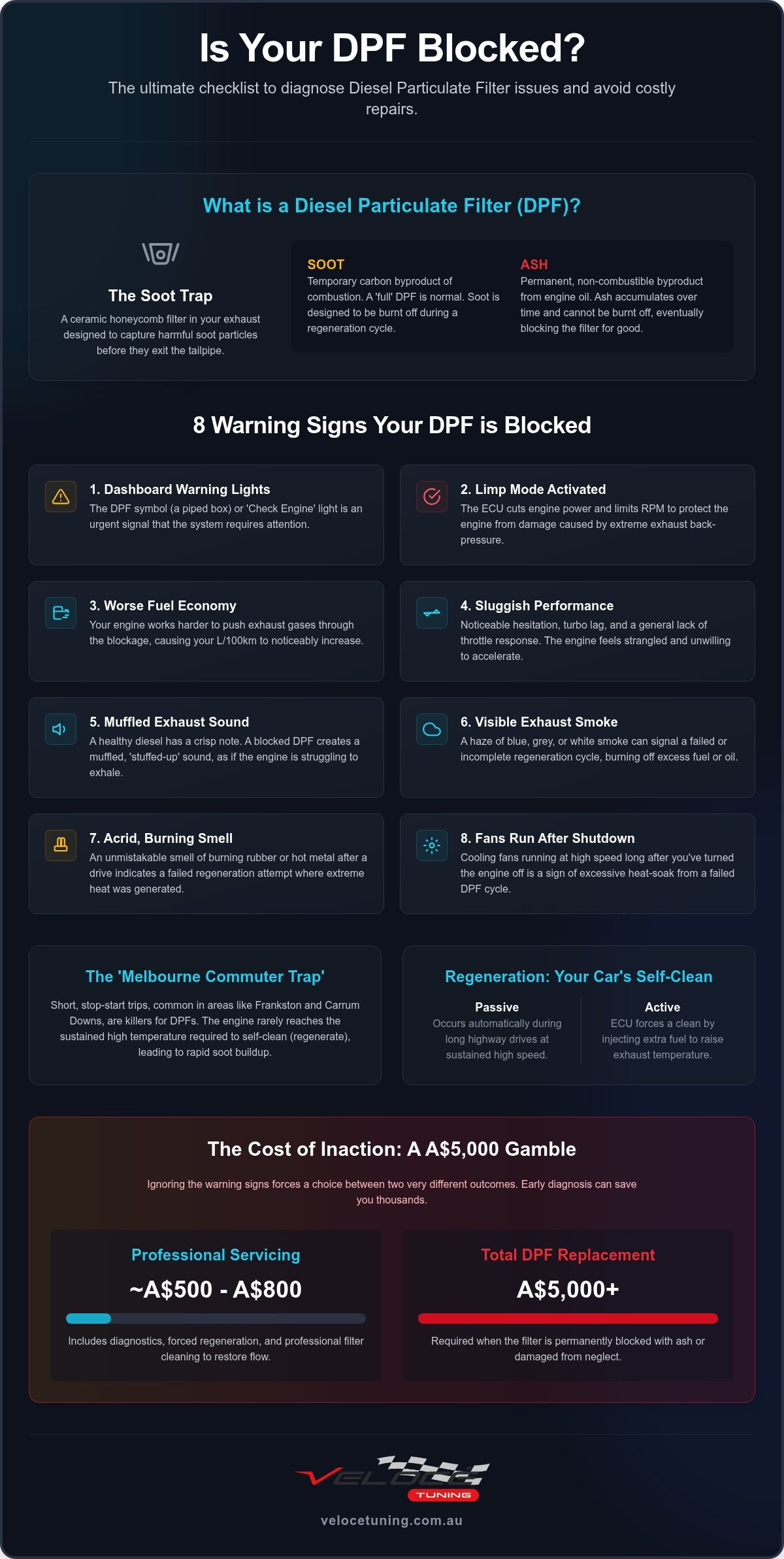
Imagine trying to sprint a hundred-metre dash while breathing through a narrow straw. Your heart is willing, your muscles are primed, but your lungs simply cannot exchange the volume of air required to sustain the effort. This is exactly what happens to your diesel engine when the exhaust tract becomes compromised. To accurately identify the signs your DPF is blocked, you must first view the Diesel Particulate Filter not as a passive piece of metal, but as the critical respiratory organ of your vehicle. What is a DPF? It is a sophisticated trap designed to capture soot before it exits the tailpipe, ensuring your high-performance machine meets modern environmental standards without sacrificing its soul.
Every diesel owner needs to understand the volatile relationship between soot and ash. Soot is the black carbon produced during combustion; it is temporary and designed to be burnt away during a “regeneration” cycle. Ash, however, is the non-combustible byproduct of engine oil additives and metallic compounds that remains in the filter forever. When soot levels rise too high, back-pressure builds up within the system. This pressure is the ultimate enemy of performance. It pushes back against the turbocharger, resisting its rotation and stifling the visceral surge of power you expect when you plant your foot. It robs you of that crisp throttle response. It turns a precision machine into a sluggish chore.
The Science of the Soot Trap
Inside the DPF canister lies a dense, ceramic honeycomb structure with alternating blocked channels. This labyrinth forces exhaust gases through porous walls, catching microscopic particulates in the process. There is a fine line between a filter that is merely ‘full’ and one that is ‘blocked.’ A full filter is a normal part of the operating cycle, waiting for the right conditions to self-clean. A blocked filter occurs when the soot load becomes so dense that the car’s internal cleaning processes can no longer penetrate the mass. Once the system hits the critical soot load threshold, which is generally around 80 percent of its total capacity, the vehicle’s computer will force a Limp Mode to protect the engine from internal damage.
Why Modern Diesels Depend on Exhaust Flow
Your turbocharger relies on a smooth, rapid exit of exhaust gases to spool up and deliver boost. When the DPF is choked, that flow is interrupted, leading to significant turbo lag and a noticeable loss of ‘launch’ off the line. This mechanical restriction also creates a dangerous side effect known as oil dilution. When the car tries and fails to clear a blockage, unburnt diesel can leak past the piston rings and into the oil sump. This thins your lubricant and puts your entire bottom end at risk. Ignoring the lungs of your car eventually leads to a mechanical cardiac arrest for the entire engine. It’s a high-stakes game of maintenance that you cannot afford to lose.
8 Warning Signs Your DPF is Blocked: The Ultimate Checklist
You’re cruising toward the Peninsula Link when you notice that the familiar, visceral surge of torque has been replaced by a flat, uninspired hesitation. It’s frustrating. It’s also one of the most common signs your DPF is blocked. Your dashboard is usually the first to scream for help; keep an eye out for the amber ‘piped box’ icon or the ubiquitous ‘Check Engine’ light. These aren’t just suggestions. They are urgent warnings that your exhaust system is reaching a critical state of congestion that requires immediate attention.
When the blockage becomes too severe, your car’s ECU enters a defensive posture known as Limp Mode. It cuts boost and limits RPM to prevent a total mechanical meltdown, effectively turning your high-performance machine into a sluggish commuter. You’ll also notice your fuel economy tanking. As the filter chokes, the engine works harder to push gases through the restriction, causing your L/100km readout to climb steadily while your performance drops. Understanding the symptoms of a blocked DPF is the difference between a simple maintenance stop and a catastrophic repair bill.
Sensory Signals: What to Listen and Look For
Listen to your engine’s rhythm. A healthy diesel has a crisp, purposeful cadence, but a blocked filter creates a muffled, ‘stuffed up’ exhaust note that sounds like the car is struggling to exhale. Look at your tailpipe in the rearview mirror. While black smoke often indicates an over-fuelling issue, a haze of blue or grey smoke can signal a failed regeneration attempt. If your car smells like acrid, burning rubber after a short trip through Carrum Downs, it’s likely stuck in a high-heat cycle it can’t finish. The heat-soak from a failed regen is unmistakable and often accompanied by cooling fans running long after the ignition is off.
Performance Red Flags Under Load
Performance red flags often hide in plain sight during your daily drive. If your Automatic Start-Stop system suddenly refuses to engage, the ECU is likely keeping the engine running to maintain heat for a desperate regeneration attempt. Heavy loads make the symptoms undeniable. You might find the car struggling to maintain speed or hunting for gears while towing a caravan or boat. Most dangerously, check your dipstick regularly. If the oil level appears to be rising, it’s a sign that unburnt diesel is diluting your lubrication. If you notice these red flags, a professional DPF diagnostic is the only way to ensure your engine’s longevity and restore its original soul.
Why the ‘Melbourne Commuter Trap’ is Killing Your DPF
Melbourne’s morning grind is more than just a test of your patience; it is a silent assassin for your diesel engine. While your high-torque 4×4 was engineered to conquer the rugged terrain of the High Country, the reality of stop-start traffic through Frankston or Carrum Downs creates a mechanical bottleneck. To effectively burn off trapped soot, a DPF requires internal temperatures to reach a scorching 600°C. Urban commuting rarely, if ever, generates this kind of heat. Instead, your engine produces massive volumes of soot while idling at traffic lights, leading to the unmistakable signs your DPF is blocked long before you ever see a wide-open highway.
The ‘Melbourne Commuter Trap’ is essentially a recipe for rapid soot saturation. When you use a modern diesel for ‘grocery getting’ or short school runs, the exhaust gas temperatures (EGTs) stay stubbornly low. The soot remains trapped, cold, and sticky. Without the thermal energy required to oxidise these particles, the filter becomes a literal plug in your exhaust system. We advocate for a strict 20-minute rule: at least once a week, your vehicle needs a sustained, high-speed run on a freeway. Whether you are taking a weekend trip to the coast or driving into the city to buy fine antique furniture for a town or country home, this allows the system to reach its self-cleaning temperature and purge the accumulated waste before it hardens into an immovable mass.
The Short-Trip Syndrome
Short-trip syndrome occurs when your engine never reaches its optimal operating temperature. During a five-minute dash to the local shops, the metal components expand and the fuel system works harder, but the exhaust never gets hot enough to trigger a regeneration cycle. These frequent cooling and heating cycles accelerate soot accumulation at an alarming rate. For Melbourne drivers stuck in the daily grind, this means the filter is constantly under immense stress, never receiving the chance to breathe properly or clear its lungs.
4X4s, Towing, and Heavy Loads
Putting your engine under load can actually be its salvation, provided the conditions are right. Towing a heavy caravan or boat often helps maintain stable, high EGTs that facilitate passive regeneration. However, there is a tactical risk. During steep climbs under heavy load, your engine can enter an ‘over-fuelling’ state to maintain momentum. If the filter is already struggling, this extra fuel creates a thick, heavy soot that chokes the system even faster. Regular maintenance is non-negotiable to prevent these issues. A professional Log Book Service Carrum Downs: Precision Care for High-Performance Machines ensures your vehicle’s software and hardware are perfectly synchronised. This proactive approach helps you identify the early signs your DPF is blocked before they escalate into a total system failure that leaves you stranded.
Passive vs. Active Regeneration: Can Your Car Fix Itself?
Your vehicle is a masterpiece of precision engineering, designed to maintain its own internal equilibrium through a sophisticated process called regeneration. When you are pinning the needle on the Hume Highway at sustained speeds, the exhaust gas temperatures rise naturally to incinerate trapped soot without the ECU lifting a finger. This is passive regeneration. It is clean; it is efficient; it is effortless. It represents the engine operating in its natural, high-performance state. However, when the urban grind prevents these temperatures from climbing, your car must take matters into its own hands. It initiates an active regeneration by injecting extra diesel directly into the exhaust stroke to force the filter temperature toward a scorching 600°C. It is a calculated, high-heat intervention designed to prevent the signs your DPF is blocked from becoming a permanent fixture on your dashboard.
The danger lies in the interrupted cycle. If you kill the ignition while the car is mid-regeneration, you leave the job half-finished and the soot becomes a sticky, tar-like residue that is twice as hard to clear next time. Repeat this enough times, and the system eventually gives up. The soot load climbs beyond the point of self-recovery. When the computer can no longer trigger a self-clean, a forced regeneration via a professional scan tool becomes the final line of defence before the hardware fails entirely.
Spotting an Active Regen in Progress
You can feel when your car is fighting to clear its lungs. At a red light, you might notice the idle RPM has jumped from its usual 800 up to a steady 1000. The cooling fans might be screaming at full tilt, even on a mild Melbourne evening, as the system tries to manage the extreme heat being dumped into the exhaust. Your fuel economy will take a temporary dive. The engine feels heavy, slightly less responsive, and burdened by the extra work it is performing behind the scenes. These sensory cues are your car’s way of telling you to keep driving until the job is done.
When the Highway Run Isn’t Enough
There is a hard limit to what regeneration can achieve, and it is defined by ash. Unlike soot, ash is a permanent byproduct of combustion that cannot be burnt away; it physically occupies space in the honeycomb structure until the filter is full. Once you hit the ash limit, no amount of highway driving will restore your performance. Ignoring the warning lights at this stage is a gamble that leads directly from a manageable service to a soul-crushing A$5,000 replacement bill. Don’t be fooled by “DPF cleaners” in a bottle. These chemical additives often just mask the issue by lowering the soot burn temperature without addressing the underlying ash accumulation. If your dashboard is already lit up, a professional DPF servicing and repair is the only way to clear the blockage and restore your engine’s soul.
Professional DPF Servicing: Restoring Your Engine’s Soul
Recognising the signs your DPF is blocked is merely the first step in a journey toward mechanical liberation. Once the soot has settled and the dashboard warnings have taken hold, you face a choice: settle for a generic, surface-level fix or invest in a precision restoration that addresses the root cause. At Veloce Tuning, we don’t just clear codes; we restore the visceral surge of power that defines the diesel experience. Our diagnostic-first philosophy ensures that we aren’t just treating a symptom. We use advanced European technology to interrogate your vehicle’s brain, ensuring that the blockage isn’t being caused by a deeper malady like a faulty EGR valve or a leaky injector that would simply choke a new filter within weeks.
When it comes to the hardware itself, the industry is often divided between chemical and thermal cleaning. While basic chemical flushes can offer a temporary reprieve from soot, they often fail to dislodge the permanent ash accumulation we discussed earlier. Professional thermal cleaning is the only way to truly “reset” the filter. By using controlled heat and high-pressure air, we can purge the non-combustible ash that strangles your exhaust flow. This process, combined with custom ECU tuning, transforms your vehicle’s relationship with its exhaust system. For 4×4 enthusiasts, a custom tune can optimise fuel delivery and timing to significantly reduce soot production, keeping your DPF healthier for longer while unleashing hidden torque. Before committing to any service, it pays to understand the realistic DPF cleaning cost Melbourne drivers can expect, so you can make an informed decision and avoid being overcharged for a straightforward restoration. We ensure your machine remains fully roadworthy and compliant, proving that environmental responsibility and high-octane performance can exist in perfect harmony.
Diagnostic Precision in Carrum Downs
Our workshop in Carrum Downs is a specialised facility where we deep-dive into live engine data to monitor differential pressure sensors and EGT probes in real-time. We look for the “why” before we ever touch the “how.” If a leaky injector is dumping excess fuel into the cylinders, no amount of cleaning will provide a long-term solution. We are dedicated to bringing European-standard diagnostics to local Melbourne drivers, ensuring every diesel heart beats with factory-spec precision or better. This meticulous attention to detail is what separates a master craftsman from a general mechanic.
The Veloce Performance Edge
A clean DPF is only half the story; the real magic happens when your hardware is perfectly synchronised with our custom software. This combination transforms the drive from a choked, sluggish chore into a visceral, responsive experience that reminds you why you fell in love with your car in the first place. We stand by our work and our community, which is why our regular clients enjoy the peace of mind that comes with our 24/7 breakdown support for mechanical emergencies. If you’ve spotted the signs your DPF is blocked, don’t wait for the engine to fail. Book your DPF health check at Veloce Tuning today.
Take Control of Your Diesel’s Future
Your vehicle is a high-performance machine that deserves better than a strangled exhaust and a sluggish throttle response. We have explored how the daily urban grind and interrupted regeneration cycles lead to mechanical gridlock; however, identifying the signs your DPF is blocked early is your best defence against a soul-crushing repair bill. Remember that while passive regeneration is your friend on the open road, professional intervention is the only way to purge permanent ash and restore your engine’s original visceral torque. Don’t settle for a compromised drive.
At Veloce Tuning, we bring European-standard precision to our local community. As Carrum Downs’ leading performance workshop, our expert European-trained technicians use specialist DPF diagnostic equipment to look beyond the dashboard lights and treat the root cause of every blockage. Don’t let a choked filter rob you of the driving experience you deserve. Unleash your engine’s potential-Book a DPF Diagnostic at Veloce Tuning today. It is time to get back on the road with total confidence and uncompromised power. Your engine will thank you for it.
Frequently Asked Questions
Can I drive with a blocked DPF warning light on?
Driving with a blocked DPF warning light is a high-stakes gamble that leads directly to Limp Mode and potential engine damage. The light is an urgent signal that the system’s back-pressure has reached a critical level. Ignoring the early signs your DPF is blocked can turn a simple maintenance task into a catastrophic repair. Pull over safely and seek professional diagnostics before the restriction strangles your turbocharger or dilutes your engine oil. It’s a risk you don’t need to take.
How long does a DPF regeneration take while driving?
A typical active regeneration cycle takes between 10 and 20 minutes of sustained driving at speeds over 80km/h. You need to maintain consistent engine load to keep the exhaust gas temperatures high enough to incinerate the soot. If you stop the vehicle or drop your speed significantly, the cycle may be interrupted. This forces the system to start again from scratch later, which increases the soot load and heightens the risk of a permanent blockage.
What is the average cost of a DPF clean in Melbourne?
Professional DPF cleaning in Melbourne is a cost-effective alternative to a total replacement, which can often reach A$5,000 for original equipment. While the final investment depends on the vehicle’s make and the severity of the soot accumulation, a professional off-car clean is significantly cheaper than buying a new OEM unit. For a detailed breakdown of what Melbourne drivers should expect to pay, our guide to DPF cleaning cost Melbourne covers the full range of professional options and pricing. It is an investment in your vehicle’s longevity. You restore factory-level flow without the premium price tag of new hardware.
Will a blocked DPF cause my car to fail its roadworthy certificate?
Yes, a blocked DPF or an active warning light will result in an immediate failure of a Victorian Roadworthy Certificate (RWC). Under Australian vehicle standards, all original emissions equipment must be present and fully operational. A dashboard warning light indicates a fault in these systems. This makes the vehicle non-compliant until the issue is professionally resolved and the diagnostic codes are cleared. Safety and compliance go hand in hand.
Can a blocked DPF damage my turbocharger?
Excessive back-pressure from a choked filter is a primary cause of premature turbocharger failure. When the exhaust gases can’t exit freely, they push back against the turbo’s turbine wheel, creating immense heat and stress on the internal bearings and seals. Over time, this pressure leads to oil leaks and mechanical breakdown. It turns a filter issue into a far more expensive turbo replacement. Your turbo needs to breathe to survive.
Is it better to clean or replace a blocked DPF?
Professional cleaning is almost always the superior choice for a filter that is structurally sound but saturated with ash. Modern thermal and chemical cleaning processes can restore up to 98 percent of the original flow capacity for a fraction of the cost of a new unit. Replacement is typically only necessary if the internal ceramic honeycomb has melted or cracked. If the core is intact, we can usually save it.
How often should I get my DPF professionally serviced?
We recommend a professional ash-service every 100,000 to 150,000 kilometres, even if you haven’t seen the signs your DPF is blocked yet. While the car can burn off soot through regeneration, ash is a permanent byproduct that slowly fills the filter over time. Proactive servicing ensures that your engine never has to fight against unnecessary back-pressure. It maintains your vehicle’s soul and performance for the long haul.
Does my car have a DPF if it’s an older diesel model?
Most diesel passenger vehicles and 4x4s manufactured from 2009 onwards are equipped with a DPF to meet Euro 5 emissions standards. Some European models adopted the technology as early as 2005. If your vehicle was built before 2009, it might only have a diesel oxidation catalyst (DOC). These systems require less maintenance but offer lower filtration levels than a modern particulate filter. Check your owner’s manual to be certain.