The sickening thud of your bump stops hitting home on a dusty outback road is more than just a noise; it is the sound of your vehicle losing the battle against gravity. When you’re hauling a heavy caravan or a loaded boat trailer, that sagging rear end does more than just ruin your silhouette. It lifts the nose, makes your steering feel dangerously light, and turns every corner into a nerve-wracking exercise in body roll. Finding the best suspension lift for towing Australia requires moving beyond basic off-the-shelf kits and embracing a setup designed for the visceral reality of our harshest terrain.
You know the frustration of a rig that feels unsettled and unpredictable under load. It’s a compromise that makes long-distance touring feel like a chore rather than an adventure. This guide will show you how to transform that sagging liability into a precision-engineered powerhouse built for the long haul. We’ll explore how to achieve a perfectly level ride height and improved steering response, giving you the absolute confidence to tackle any track from Carrum Downs to the furthest reaches of the Red Centre. It’s time to reclaim your drive.
Key Takeaways
- Understand why factory-fitted springs are often the weakest link in your towing setup and how to identify the signs of dangerous rear-end sag before your next trip.
- Discover how to select the best suspension lift for towing Australia by matching high-performance shock valving with the correct constant load spring rates for your specific rig.
- Learn the critical differences between mechanical spring tension and pneumatic assistance to determine if airbags are a genuine solution or merely a temporary band-aid for your caravan.
- Navigate the latest VSB 14 regulations and Victorian engineering requirements to ensure your 2026 GVM upgrade remains fully legal and insurance-compliant.
- Explore the synergy between a stable chassis and custom ECU tuning to unlock the precise torque management required for effortless towing on the toughest Australian tracks.
The Towing Dilemma: Why Stock Suspension Struggles Under Pressure
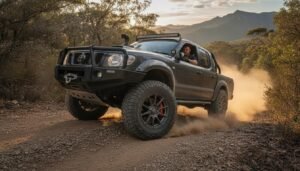
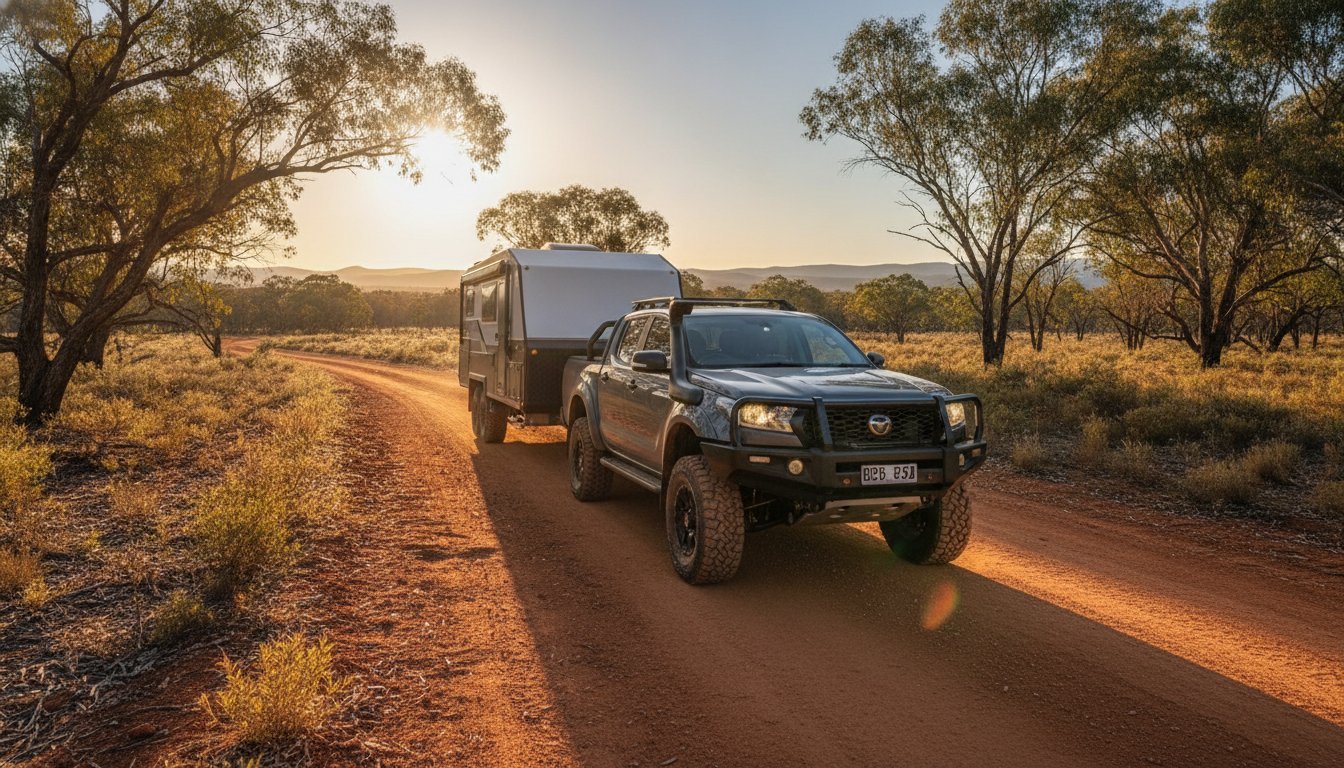
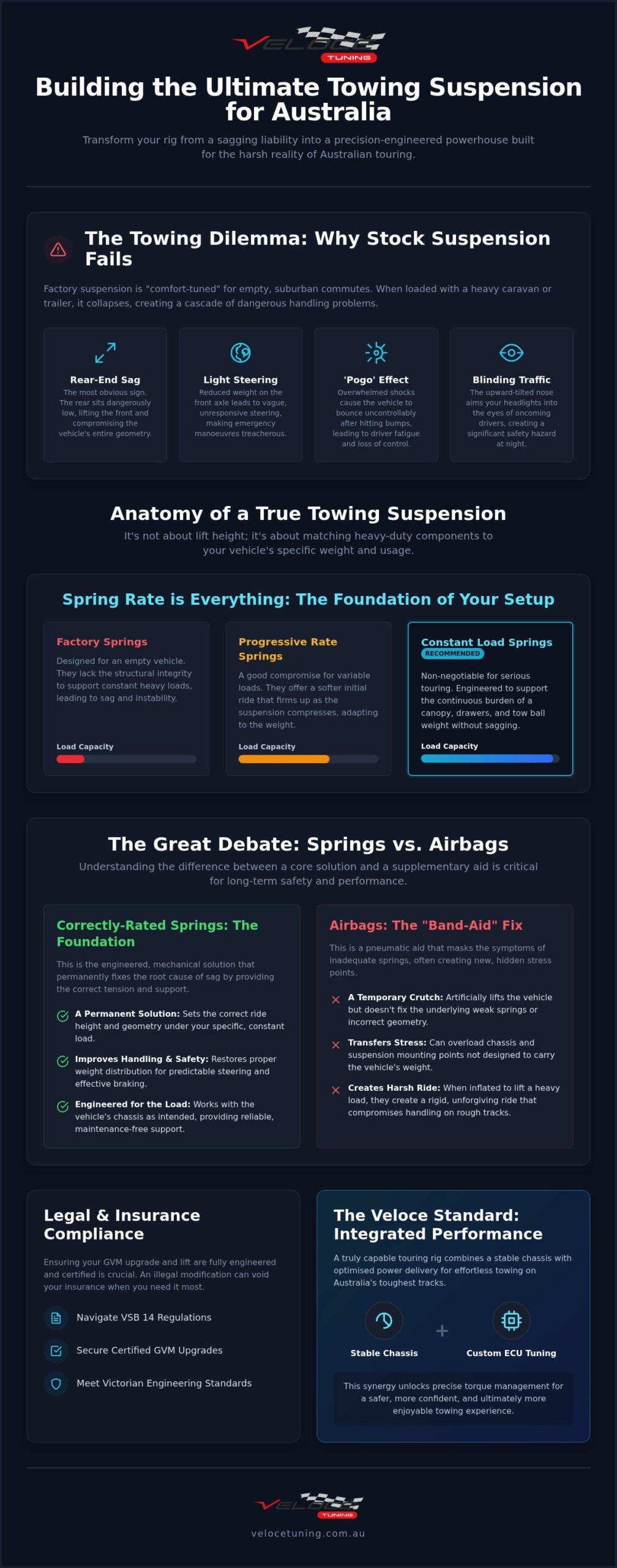
Imagine the scene: you’ve hitched the three-tonne caravan, the boot is packed with the fridge and recovery gear, and you’re ready for the big lap. But as you pull out of the driveway, the nose of your 4×4 points skyward while the rear sits dangerously close to the bitumen. This is the visceral reality of rear-end sag. It is a fundamental failure of factory vehicle suspension systems when they are pushed beyond their daily design limits. Manufacturer springs are almost always “comfort-tuned,” designed to provide a plush ride for a solo driver on a suburban commute. When you introduce a heavy trailer, these soft rates collapse. This isn’t just an aesthetic issue; it’s a structural one that compromises your steering geometry and drastically increases braking distances. On Victorian highways, this imbalance creates a lethal “pendulum effect,” where the trailer begins to dictate the vehicle’s direction rather than the other way around. You are no longer driving; you are merely a passenger in a high-speed struggle against physics. Understanding the limits of your factory Gross Vehicle Mass (GVM) is the first step toward reclaiming control.
The Sensory Signs Your Suspension is Failing
Your vehicle communicates its struggle through your fingertips and your vision. When the rear sags, the front wheels lose their bite on the road, making the steering feel “light” and alarmingly unresponsive during emergency manoeuvres. You’ll notice oncoming drivers flashing their lights as your tilted nose blinds traffic across the Mornington Peninsula. Then there’s the “pogo” effect. After hitting a single dip, the vehicle continues to oscillate, bouncing uncontrollably as the overwhelmed factory shocks fail to dissipate the energy of the load. It’s exhausting. It’s dangerous. These aren’t just minor inconveniences; they are clear indicators that your rig is operating at the edge of its safety envelope.
Static vs. Dynamic Loads in Australia
A stationary vehicle in the driveway only tells half the story. While tow-ball weight transforms your centre of gravity at a standstill, the dynamic forces on a corrugated track are where the real damage happens. Standard shock absorbers aren’t built for the relentless heat generated by heavy-duty damping. They fade, they leak, and they fail. Many owners believe a standard 50mm lift is the solution, but height without the correct spring rate is useless. The best suspension lift for towing Australia isn’t just about clearance; it’s about managing the massive energy transfer that occurs when your rig hits a washout at 80km/h. You need a setup that stays composed when the pressure is on. True performance comes from a system that maintains its integrity under both the static weight of the hitch and the violent, dynamic forces of the outback.
Should your suspension fail to maintain that integrity during a remote trek through Western Australia, specialised recovery services like Allout Towing provide the heavy-duty equipment necessary to transport a compromised rig and trailer safely back to civilisation.
Anatomy of the Best Suspension Lift for Towing in Australia
The anatomy of the best suspension lift for towing Australia isn’t found in a pre-packaged box sitting on a retail shelf. It is a calculated assembly of steel and oil, meticulously matched to the specific mass of your vehicle. While most entry-level kits offer a generic lift, a true towing setup focuses on the science of spring rates. Linear springs provide a predictable response, but progressive coils offer a softer initial touch that firms up as the load increases. For the serious tourer with a permanent canopy, steel tray, or rear drawer system, constant load springs are non-negotiable. These heavy-hitters are designed to maintain ride height and geometry under a continuous burden, ensuring your rig doesn’t surrender to gravity the moment you hitch up. Precision is the only way forward.
Spring Rate Science for the Outback
Spring rate science for the outback requires a cold, hard look at your vehicle’s actual weight. To find your ideal setup, you must calculate the combined mass of every accessory, from the bullbar and winch up front to the long-range tank and fridge slide at the rear. Constant load springs are the antidote to the sagging rear end we discussed earlier, but there is a trade-off. When the caravan is left at the campsite, a vehicle equipped with heavy constant load springs will feel stiff and uncompromising on the local tracks. It’s a small price to pay for the unwavering stability and safety provided when you’re fully laden on the open road. Performance always demands a choice.
Heavy-Duty Shock Absorbers and Heat Dissipation
Controlling that mass requires more than just heavy steel; it demands sophisticated shock absorber valving. Heavy-duty damping is essential to manage the immense kinetic energy of a 3.5-tonne trailer. Monotube shocks generally offer superior heat dissipation compared to twin-tube designs, thanks to their larger piston diameters and increased oil capacity. This prevents the dreaded “shock fade” that occurs during long stints on corrugated roads. For those pushing into the most remote corners of the continent, remote reservoir shocks provide the ultimate in thermal management, though they may be overkill for the weekend caravaner. Every component must work in harmony, including high-quality bushes that maintain suspension alignment under the extreme lateral stresses of a heavy load. If you’re ready to move beyond generic parts, the team at Veloce Tuning can help you engineer a solution tailored to your rig’s specific tare weight. Transformation begins with the right hardware.
Constant Load Springs vs. Airbags: Deciphering the Best Setup
The debate between mechanical spring tension and pneumatic assistance is the central conflict in the world of heavy-duty touring. While many look for a quick fix to a sagging rear end, the best suspension lift for towing Australia isn’t found in a “one size fits all” air kit. Too often, airbags are treated as a band-aid for an inadequate spring rate. When you force a pneumatic bag to do the heavy lifting that a steel coil should be managing, you create dangerous high-pressure points on your chassis. In the visceral environment of a corrugated outback track, this concentrated stress can lead to catastrophic chassis failure. A steel spring is designed to distribute load through the factory-engineered mounts; an over-inflated airbag often focuses that energy on a single point of the frame. It is a gamble that rarely pays off when you’re 500 kilometres from the nearest workshop.
This risk highlights why thorough pre-trip inspections are non-negotiable for serious tourers. For those seeking comprehensive vehicle servicing and repairs, Thurton Auto Centre provides the expert oversight required to ensure motorhomes and caravans are mechanically sound before facing the rigours of the road.
The Case for Constant Load Coils
For the dedicated tourer, mechanical reliability is the ultimate currency. A constant load coil spring will never “pop,” leak, or suffer a sliced airline in the middle of the Simpson Desert. These springs provide a predictable roll centre and consistent damping, ensuring your rig remains composed through every hairpin turn. This setup is the gold standard for full-time touring rigs equipped with permanent steel trays, canopies, and long-range tanks. You gain a level of unwavering stability that pneumatic systems simply cannot replicate. It is the backbone of a precision-engineered powerhouse.
The Versatility of Airbag Helpers
Airbags do have a legitimate place, particularly for the “weekend warrior” who uses their vehicle for the daily commute in Carrum Downs before hitching up the boat on Friday afternoon. Their primary strength is adjustability. You can level the load when hitched and drop the pressure for a more compliant ride when the trailer is left behind. However, this versatility comes with a strict caveat. You must never use airbags to compensate for an inherently weak spring, and you must never exceed the manufacturer’s maximum pressure. When used correctly, a low-pressure airbag helper can complement a heavy-duty coil, providing that final bit of levelling without compromising the chassis. It is about choosing the right tool for your specific mission.
- Constant Load Coils: Best for permanent builds and extreme off-road durability.
- Airbag Helpers: Best for variable loads and maintaining suburban comfort.
- The Risk: Over-reliance on airbags can lead to bent chassis rails on harsh terrain.
- The Solution: Start with the correct spring rate, then use air only as a fine-tuning tool.
Navigating Australian Standards: Legal Lifts and GVM Upgrades
Precision engineering meets bureaucratic reality when you step into the world of vehicle modifications. Building a high-performance tow rig is a pursuit of excellence, but that excellence must be anchored in the law. In Australia, the guiding light for these modifications is VSB 14, the national code of practice that dictates how we can safely and legally alter our vehicles. While many enthusiasts focus solely on the aesthetic of a high-riding 4×4, the best suspension lift for towing Australia is one that respects the 50mm threshold. In Victoria, once you exceed a 50mm lift through a combination of suspension and tyres, you enter a territory that requires formal engineering certification. This isn’t just about avoiding a yellow sticker from the highway patrol. It is about ensuring your insurance remains valid when you’re hauling a heavy load. Being overweight or “too high” is a fast track to a denied claim and personal liability in the event of an accident. Compliance is your safety net.
The Engineering Certification Process
Transforming your rig into a legally recognised heavy-hauler follows a strict, methodical path. It begins with a deep consultation with a specialised technician who understands the specific demands of your build. You can’t just bolt on parts and hope for the best. The installation must involve an ADR-compliant Gross Vehicle Mass (GVM) upgrade kit, designed to handle the increased stresses of a 3.5-tonne tow. Finally, a certified engineer must inspect the work, providing the critical sign-off and the blue or second-stage plate that makes your modification permanent and legal. It is a process of meticulous validation. For heavy-duty explorers seeking a complete transformation, a professional GVM upgrade Melbourne ensures your vehicle is both legally compliant and mechanically superior for the demands of Victorian terrain.
State-Specific Nuances: Victoria and Beyond
Victorian roadworthy requirements are notoriously stringent for lifted 4x4s, especially regarding track width and tyre clearance. You must account for the impact of tyre size on your total legal lift height; a larger tyre adds to the 50mm limit just as much as a taller spring does. This is where local expertise becomes invaluable for residents across the Mornington Peninsula. A rig that is road-legal is your best defence in a towing accident, providing the intellectual reassurance that your insurance will stand behind you when the unthinkable happens. If you are ready to ensure your vehicle meets these rigorous standards, the team at Veloce Tuning offers specialised suspension and lift kits that bridge the gap between raw performance and legal compliance. Don’t leave your liability to chance.
- VSB 14 Compliance: The essential framework for all Australian light vehicle mods.
- The 50mm Rule: The Victorian threshold where simple mods become engineered projects.
- GVM Upgrades: The only legal way to increase your vehicle’s payload and towing composure.
- Insurance Integrity: Why a legal lift is the only way to protect your financial future.
The Veloce Standard: Precision Suspension and Power Integration
Achieving the best suspension lift for towing Australia is a masterclass in balance, but hardware alone cannot conquer the Great Dividing Range. A perfectly levelled rig is only as good as the energy that moves it. At Veloce Tuning, we understand that suspension is only half the battle. While your heavy-duty coils manage the weight, your engine must manage the momentum. Our Carrum Downs workshop is where European technical precision meets the raw, unyielding grit required for Australian tracks. We don’t just bolt on parts; we integrate systems. The Veloce promise is a vehicle that handles as well as it pulls, creating a seamless connection between the driver, the machine, and the road ahead. It’s about unlocking the hidden potential of your 4×4.
Custom ECU Tuning for the Ultimate Towing Experience
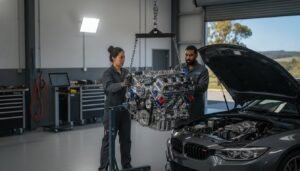
Managing visceral power requires more than just a stable chassis. It demands a recalibrated heart. Custom ECU tuning is the final piece of the puzzle, unlocking the low-down torque necessary for effortless overtaking when you’ve got a three-tonne caravan in tow. We focus on torque remapping that complements your new suspension geometry, ensuring the power delivery is smooth and relentless. Transmission remapping is equally vital, keeping your DSG or automatic gearbox firmly within the power band to prevent hunting on steep inclines. This holistic approach doesn’t just improve performance; it can also significantly provide ECU tuning for fuel economy Melbourne, allowing you to maximise your range across the vast stretches of the outback. Transformation is technical.
Expert Installation and Local Support
The soul of your rig deserves meticulous care. Professional alignment is non-negotiable after every 4×4 lift kit installation, as even a millimetre of deviation can lead to premature tyre wear and compromised safety under load. We provide the local expertise Mornington Peninsula residents trust, backed by the peace of mind of our 24/7 breakdown service. Whether you’re navigating the suburban streets or the Oodnadatta Track, you’re never truly alone. If your current setup feels tired or unresponsive, our specialised 4×4 suspension repair Melbourne service can restore the precision your vehicle once had. Don’t settle for a rig that merely survives the journey. Elevate your towing performance at Veloce Tuning today and experience the thrill of a precision-engineered powerhouse.
Reclaim the Road with Unwavering Stability
The journey from a sagging, unpredictable rig to a precision-engineered powerhouse is a technical evolution that demands more than just taller springs. You’ve discovered that the best suspension lift for towing Australia is a calculated symphony of constant load coils, heavy-duty damping, and legal GVM upgrades. It is about more than just aesthetics; it is about ensuring your steering remains sharp and your braking stays decisive when the pressure is on. By integrating these mechanical enhancements with custom power delivery, you transform your vehicle into a rig that doesn’t just survive the outback, but masters it.
Our expert 4×4 technicians specialise in Victorian road conditions, providing comprehensive GVM and towing assessments to keep you safe and legal. With the added security of our 24/7 emergency breakdown support, you can venture into the unknown with total peace of mind. Your next great Australian tour shouldn’t be a struggle against gravity. Book Your Custom Suspension Consultation at Veloce Tuning and start your transformation today. The horizon is waiting, and now you have the rig to reach it.
Frequently Asked Questions
What is the best suspension lift height for towing a 3-tonne caravan?
A 50mm (2-inch) lift is widely considered the optimal height for heavy towing. This height provides the necessary clearance for rugged tracks while maintaining a stable centre of gravity. Going higher than 50mm can introduce excessive body roll and instability when hitched to a heavy caravan. It’s the sweet spot for the best suspension lift for towing Australia, balancing off-road capability with highway composure.
Will a 2-inch lift kit affect my car’s towing capacity?
A standard lift kit does not increase your manufacturer’s legal towing capacity. While it significantly improves how the vehicle handles the weight, your legal limits remain the same as they were on the showroom floor. If you need to legally carry or tow more than the factory rating, you must invest in a certified GVM upgrade. This involves specific engineering sign-off to ensure the chassis and brakes can handle the increased load.
Do I need a GVM upgrade if I only tow a few times a year?
Safety and legality aren’t determined by how often you tow. If your vehicle exceeds its Gross Vehicle Mass even once, you’re driving an illegal and uninsured rig. Many modern 4x4s reach their GVM limit surprisingly quickly once you add a bullbar, passengers, and tow-ball download. If your occasional trips put you over the limit, a GVM upgrade Melbourne specialists can provide is a necessary investment for your legal protection and peace of mind.
Can I install a lift kit myself, or should I use a professional in Carrum Downs?
Professional installation is essential for a rig that needs to perform under pressure. A specialised technician in Carrum Downs ensures that every component is torqued correctly and that the wheel alignment is precise. DIY installations often overlook critical suspension geometry, which leads to premature tyre wear and unpredictable handling. When you’re hauling three tonnes at highway speeds, you want the intellectual reassurance that a master craftsman handled the build.
What is the difference between a “comfort” and “heavy-duty” lift kit?
Comfort kits are designed for vehicles that spend most of their time unladen, providing a plush ride for daily commuting. Heavy-duty kits, often featuring constant load springs, are engineered for vehicles carrying permanent weight like steel trays or canopies. Using a comfort kit for heavy towing will result in the same rear-end sag you’re trying to avoid. You must match the spring rate to your vehicle’s actual working weight for the best results.
Will a suspension lift void my new car warranty in Australia?
Your warranty isn’t automatically voided by a suspension upgrade. Under Australian Consumer Law, a manufacturer can only deny a warranty claim if they can prove the modification directly caused the failure. For example, a lift kit won’t affect your warranty on the infotainment system or engine electronics. However, it may affect claims related to original suspension components or driveline vibrations if the geometry wasn’t corrected during installation.
How much does a quality 4×4 lift kit for towing cost in 2026?
The cost of a high-performance setup varies significantly based on your vehicle’s requirements and the level of engineering involved. A basic spring and shock upgrade is a different investment compared to a comprehensive GVM upgrade with remote reservoir dampers and engineering certification. Because every tow rig is unique, it’s best to seek a tailored quote that accounts for your specific accessories and towing needs. Quality components are a long-term investment in your vehicle’s soul.
Should I get an ECU tune at the same time as my suspension upgrade?
Pairing a suspension upgrade with a custom ECU tune creates the ultimate towing experience. While your new suspension manages the visceral weight of the trailer, the tune provides the low-down torque required to move it effortlessly. This combination ensures your vehicle has the power to match its new-found stability. It is the definitive way to achieve the best suspension lift for towing Australia, managing both the chassis and the powertrain for total control.