
True towing mastery isn’t found in the height of your springs or the aggressive look of your wheel arches; it’s felt in the steady pulse of your steering wheel when the wind picks up and the road starts to twist. You’ve likely felt that unsettling lightness in the front end as your rear suspension surrenders to a heavy ball weight, or perhaps you’ve white-knuckled through the terrifying rhythm of a trailer sway on a rain-slicked highway. To fix this, you need the best suspension lift for towing Australia can offer to restore balance to your chassis. It’s a compromise no driver should have to make.
We agree that family safety is paramount during long-haul trips across the outback. Discover the ultimate suspension setups to eliminate sag, stop the sway, and transform your towing experience into a masterclass of stability and control. We’ll explore the latest 2026 GVM upgrade regulations, the physics of load-matched valving, and the path to achieving a level ride height under full load. It’s time to stop surviving the drive and start commanding it.
Key Takeaways
- Understand how rear-end sag creates a “teeter-totter” effect that compromises your steering and braking, making your rig feel disconnected from the road.
- Identify why the best suspension lift for towing Australia relies on heavy-duty shock absorbers and load-matched springs rather than simple ground clearance.
- Compare the “set and forget” reliability of heavy-duty spring kits against the adjustable versatility of airbag assistance for varying caravan loads.
- Decipher the critical legal differences between GVM and GCM to ensure your modified 4×4 remains fully compliant with 2026 Australian Design Rules.
- Learn why a tailored suspension solution from master craftsmen outperforms generic off-the-shelf kits by balancing visceral driving rewards with technical precision.
The Physics of Towing: Why Factory Suspension Often Falters
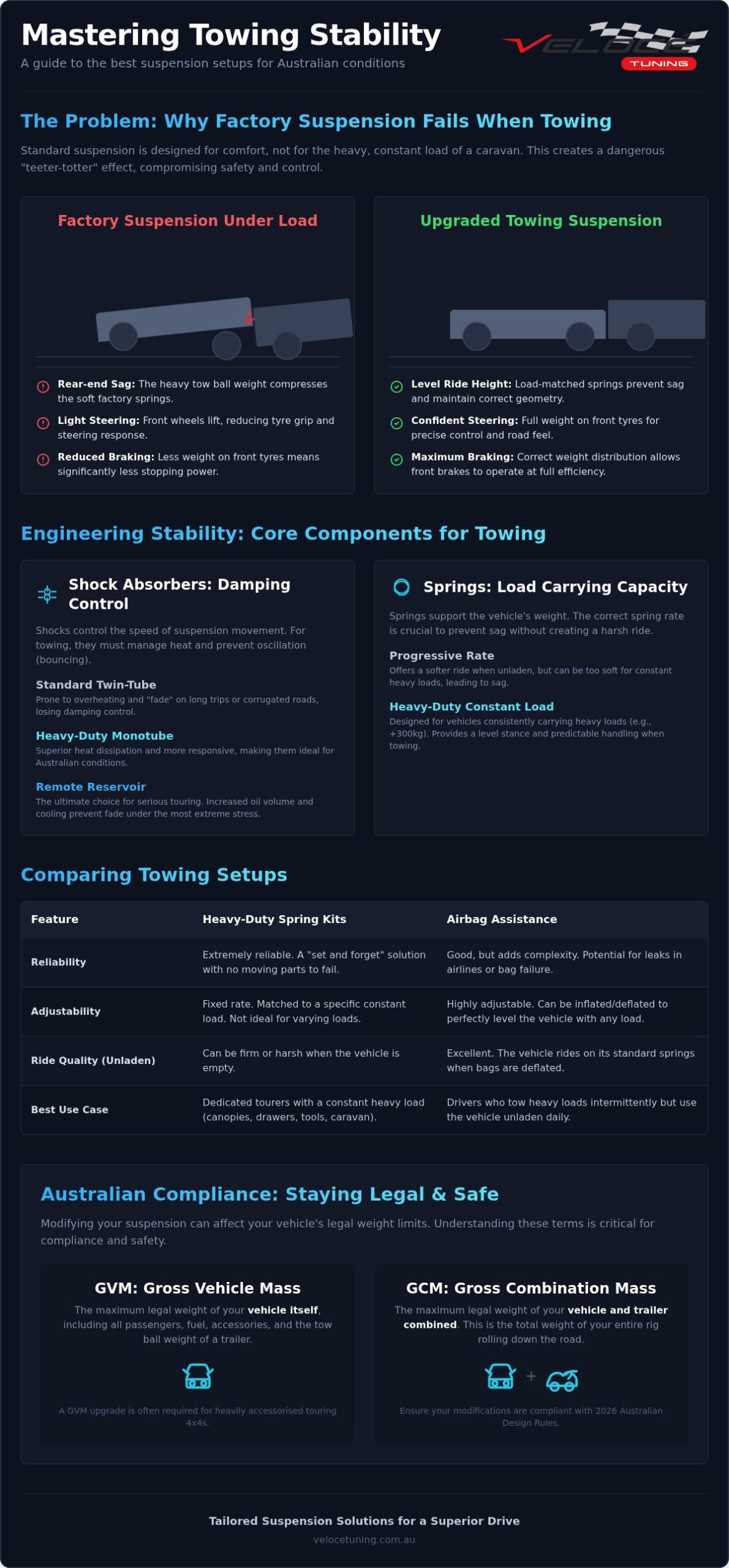
When you hitch a three-tonne caravan to a standard 4×4, the transformation is immediate and rarely positive. The rear end squats; the nose points toward the clouds. This isn’t just an aesthetic issue. It’s a physics-driven crisis. The rear axle acts as a fulcrum, where heavy ball weight pushes down and levers the front wheels upward. This teeter-totter effect strips the front tyres of their grip. The steering goes light. The front tyres lose their bite. You’re no longer driving; you’re merely suggesting a direction. Finding the best suspension lift for towing Australia is about reclaiming that contact patch and restoring the balance of your machine.
Manufacturers design factory suspension for the average buyer. Usually, that means a comfortable ride during the suburban commute with an empty tray. They utilize progressive rate springs that feel plush on bitumen but fold under the constant, heavy pressure of a touring load. Without sufficient rebound damping, your rig enters a dangerous cycle of oscillation. Every dip in the road sends the rear end bouncing like a pogo stick. It’s a visceral, unsettling sensation that breeds fatigue. A stable rig changes your emotional state behind the wheel. It replaces white-knuckled anxiety with the polished, professional confidence of a driver in total command.
The Impact of Sag on Braking and Geometry
A nose-up attitude affects more than just your steering feel. Your headlight aim shifts, blinding oncoming traffic while leaving the road ahead in shadows. More critically, braking efficiency plummets. When the front end is light, the front brakes, which provide the majority of your stopping power, cannot bite effectively into the bitumen. Dynamic load refers to the shifting weight forces exerted on a vehicle’s suspension components during movement, which can drastically alter wheel alignment and contact patches as the trailer reacts to road surfaces. This instability can turn a routine stop into a heart-stopping slide.
Suspension Fatigue and the Long-Haul Reality
Standard shock absorbers are often too small to handle the heat generated by heavy towing. On corrugated outback tracks, they work overtime, causing the internal oil to thin and the shocks to fade. Once they fade, you lose all damping control. Many drivers mistakenly rely on bump stops for support, but these are emergency limiters, not load-bearing components. Relying on them leads to a harsh, jarring ride that can damage your chassis over time. Transitioning from a suburban commute setup to a high-performance touring system is a necessary evolution for anyone serious about the long haul. It’s the difference between merely surviving the trip and enjoying the journey with absolute precision.
Engineering Stability: The Core Components of a Towing-Specific Lift
While upgrading your vehicle’s suspension is a vital step, the caravan itself also requires expert maintenance to ensure total safety on the road. For those seeking professional standards in mobile caravan care, LeisureVan Service Solutions provides comprehensive maintenance to keep your caravan or motorhome in peak condition.
The best suspension lift for towing Australia isn’t a trophy for the tallest truck in the caravan park; it is a calculated investment in managing momentum. While generic kits chase ground clearance for rock crawling, a towing-focused system prioritises load-carrying capacity and absolute damping control. It ensures the chassis remains composed when the weight behind you tries to dictate the terms of the journey. Engineering stability is a game of precision, where the goal is to manage kinetic energy rather than just gaining altitude.
Shock Absorbers: The Art of Rebound and Compression
This commitment to precision is a global standard for specialised workshops; for instance, suspensionrepair.ae focuses exclusively on the technical maintenance of suspension systems and shock absorbers to ensure peak vehicle performance.
Shock absorbers act as the thermal regulators of your suspension system. Standard twin-tube shocks are adequate for the school run, but they often succumb to heat soak and aeration on the long road to Exmouth or Alice Springs. Monotube shocks offer a larger piston area and superior heat dissipation, making them the weapon of choice for the Australian climate. There is a distinct visceral reward in using adjustable valving; it grants you the power to switch from a compliant daily driver to a rigid, high-performance towing platform with a few clicks. Remote reservoir shocks keep your oil cool under heavy towing stress by separating the nitrogen gas and oil while increasing the total fluid volume to prevent performance fade during relentless corrugations.
Spring Choice: Managing the Static and Dynamic Load
Choosing the right spring rate is a delicate balance of static and dynamic forces. A 300kg constant-load spring is a bone-jarring nightmare for an unladen ute, yet it transforms into a masterclass of stability once a heavy caravan is hitched. While progressive springs offer a variable rate for mixed use, dedicated tourers often prefer the raw durability of heavy-duty leaf packs or linear coils for their predictable response under pressure. High-quality steel is the silent hero here, preventing the “settling” or sagging that plagues inferior kits after a single season of hard work. To sharpen the experience, we often integrate upgraded bushes and anti-sway bars to eliminate body roll and ensure a precise line through every mountain pass. If you’re ready to transform your rig’s handling, our team at Veloce Tuning provides expert installation of high-quality suspension and lift kits tailored to your specific load requirements.
Comparing Towing Setups: Heavy-Duty Springs vs. Airbag Assistance
Choosing between the brute force of steel and the pneumatic finesse of air is the defining moment in your build. It’s a choice between mechanical purity and modern versatility. For those seeking the best suspension lift for towing Australia, the decision hinges on how often your rig actually carries the weight. If your 4×4 is a dedicated touring weapon, permanently laden with a steel canopy and a full kit of drawers, then heavy-duty springs are your foundation. They offer a “set and forget” simplicity that never complains, no matter how many thousands of kilometres of corrugations you throw at them. It’s about building a rig that feels planted, predictable, and powerful.
Heavy-Duty Spring Kits: Pros and Cons
Heavy-duty springs are engineered to resist compression. They provide a rock-solid platform that maintains vehicle geometry under immense pressure, ensuring your steering remains sharp and your braking stays balanced.
- Pros: Total mechanical simplicity. They won’t leak, they won’t pop, and they provide immense durability for constant loads.
- Cons: Without a load, the ride is punishing. You’ll feel every pebble on the bitumen, and the rear end may skip or bounce through corners when unladen.
- Ideal for: Vehicles that spend 80% or more of their life hauling a heavy caravan or carrying a permanent touring setup.
Airbag Assistance: When Versatility is King
For the driver who uses their rig as a daily commuter during the week and a tow-tug on the weekend, airbags offer a compelling transformation. They allow you to maintain factory-spec comfort when the tray is empty, then level the rig with a burst of air once the caravan is hitched. It’s a sophisticated way to manage varying static loads without a permanent compromise.
- Pros: On-the-fly levelling and the ability to prevent “bum sag” regardless of the cargo weight.
- Cons: They require regular pressure checks and carry a genuine risk of frame stress. If you over-inflate an airbag to compensate for an overloaded vehicle, you concentrate the entire load on a small section of the chassis rail, which can lead to catastrophic cracking.
- Critical advice: Airbags are a helper to keep your rig level. They are not a replacement for a proper GVM assessment.
The “Goldilocks” solution is often a hybrid approach. We frequently recommend mildly heavier springs that handle the vehicle’s base weight, paired with airbags to manage the extra tongue weight of the caravan. This creates a masterclass of stability. It provides the control you crave without sacrificing the visceral joy of a well-sorted, unladen drive. It’s about tailoring the machine to your lifestyle.
Australian Compliance and GVM Upgrades: Staying Legal and Safe
Commanding the road requires more than just raw power. It demands total legal compliance. In Australia, modifying your 4×4 for heavy hauling is a high-stakes game where precision matters as much as performance. The 50mm suspension lift rule serves as the baseline for most states, ensuring your vehicle remains within the boundaries of Australian Design Rules (ADRs). Going beyond this without certification isn’t just a risk to your safety; it’s a risk to your licence and your legacy. The best suspension lift for towing Australia is one that satisfies both the driver’s soul and the engineer’s checklist.
Understanding the numbers is vital. Your Gross Vehicle Mass (GVM) is the maximum weight your vehicle can carry, while the Gross Combined Mass (GCM) is the total legal weight of your car and trailer combined. It is a critical distinction, as a GVM upgrade often does not increase your GCM. If you exceed these limits, your insurance claim can be denied in a heartbeat. There is a visceral confidence that comes with knowing your rig is 100% road-legal. It’s the feeling of liberation that comes from knowing you’re engineered for the task, not just hoping for the best.
How to Achieve a Legal GVM Upgrade
Achieving a certified upgrade is a methodical process. First, you must weigh your rig fully loaded, including fuel, water, passengers, and tow-ball mass, to understand your baseline. Next, consult a specialised workshop like Veloce Tuning for a certified kit that matches your specific requirements. Finally, the process concludes with engineering certification and plating. This is the final stamp of approval that transforms your 4×4 into a legally recognised heavy-hauler.
The Importance of Tow-Ball Mass (TBM)
Tow-ball mass acts as a lever on your rear axle, effectively doubling the perceived weight and lifting the front tyres away from the bitumen. If your suspension lift doesn’t account for this leverage, you’ll suffer from dangerous light steering and poor braking performance. Integrating a high-performance suspension lift kit Melbourne into a legal towing strategy ensures your chassis remains level and your front wheels stay planted. It’s about total control. If you’re ready to master your rig’s potential, reach out to our master craftsmen to discuss a custom solution that keeps you safe and legal.
The Veloce Tuning Edge: Tailored Suspension Solutions in Carrum Downs
At Veloce Tuning, we believe your rig is an extension of your ambition. Off-the-shelf kits are a compromise we refuse to accept. In our Carrum Downs workshop, we merge European-inspired precision with the raw, uncompromising demands of the Australian outback. We don’t just sell parts; we craft experiences. To achieve the best suspension lift for towing Australia, we look beyond the box to understand the specific weight distribution of your setup. It is a meticulous tuning process that aligns your vehicle’s centre of gravity with the weight of your caravan. The result is a visceral reward, a machine that feels light on its feet despite a heavy load.
The road ahead is unpredictable. We make sure your vehicle isn’t. By treating your 4×4 as a complete ecosystem, we ensure that every component works in harmony to deliver a stable, high-performance ride. Our local expertise on the Mornington Peninsula allows us to tune for the unique conditions our clients face, from the daily commute to the most punishing corrugated tracks. For the ultimate peace of mind, we combine our technical mastery with a 24/7 breakdown service, providing a safety net that follows you from the suburbs to the furthest reaches of the bush.
Customisation Over Convenience
We begin by matching spring rates and shock valving to your specific vehicle weight and tow-ball mass. This isn’t about guess work; it’s about engineering. We often pair our suspension work with custom ECU tuning Melbourne to ensure your engine has the torque required to complement your new-found stability. This holistic approach is why local drivers from Frankston to Mornington trust us with their high-performance machines. They know that a Veloce-tuned rig doesn’t just look the part, it performs with a level of precision that generic kits can never replicate.
The Veloce Standard of Care
Our commitment to excellence extends through every facet of your vehicle’s life. From a standard log book service Carrum Downs to complex engine conversions, we see the whole vehicle. We understand how a brake upgrade influences your suspension’s dive or how a DPF service keeps your towing power consistent. There is a profound satisfaction in driving a perfectly integrated machine that handles, stops, and hauls without effort. It’s time to stop settling for average and start commanding the road. Book your consultation with our team today and let us organise the best suspension lift for towing Australia for your specific needs.
Master the Momentum of the Long Haul
Your journey across the Australian landscape shouldn’t be defined by the weight on your tow ball or the unsettling sway of your trailer. It should be defined by the absolute control you feel when the road gets tough. We’ve explored how moving beyond factory compromises and embracing load-matched engineering transforms your 4×4 into a masterclass of stability. Whether you choose the durability of heavy-duty springs or the versatility of airbags, the focus remains on maintaining geometry and safety.
Securing the best suspension lift for towing Australia is about more than just height; it’s about the technical precision that keeps you legal and planted. At Veloce Tuning, we bring European-inspired precision engineering to our local Carrum Downs workshop, ensuring your custom-valved shock absorbers deliver a visceral reward on every drive. With our 24/7 emergency support, you can tour the outback with the ultimate peace of mind.
Elevate your towing performance—contact the master craftsmen at Veloce Tuning today.
The road is calling. It’s time to stop managing the sag and start commanding the drive.
Frequently Asked Questions
Is a 2-inch lift enough for towing a 3-tonne caravan?
A 50mm lift is often the sweet spot, but height alone won’t solve your problems. For a three-tonne caravan, the best suspension lift for towing Australia prioritises heavy-duty spring rates and high-flow shock absorbers. It’s about managing the massive downward force on the tow ball. If your kit isn’t specifically valved for that weight, you’ll still experience front-end lightness and poor braking regardless of the extra clearance provided by the lift.
Can I install a lift kit myself to save on costs?
You can technically fit a kit in your driveway, but we strongly advise against it for high-performance towing rigs. Precision is everything when you’re hauling heavy loads at highway speeds. Professional installers use specialised equipment to ensure wheel alignment and driveline angles are perfect. DIY installs often miss the subtle geometry shifts that lead to premature tyre wear or, worse, catastrophic component failure under the stress of a big caravan.
Do I need a GVM upgrade if I only tow once a year?
Legality is not a part-time commitment. If your vehicle exceeds its plated Gross Vehicle Mass for even one kilometre, your insurance is effectively void. It’s a harsh reality that many tourers ignore until it’s too late. Even if you only hitch up once a year, the physical stress on your chassis and the legal liability remain the same. You should weigh your rig fully loaded to know exactly where you stand before heading out.
Will a suspension lift void my new car warranty in Australia?
A suspension lift won’t void your entire warranty, but it does change the terms for related components. Under Australian Consumer Law, a manufacturer cannot blanket-void a warranty because of a modification. However, they won’t cover failures directly caused by the lift kit, such as accelerated CV joint wear or bush failure. It’s vital to choose high-quality components and professional installation to maintain your vehicle’s long-term reliability and protection during your travels.
What is the difference between a suspension lift and a body lift for towing?
A suspension lift changes the distance between your axle and chassis, while a body lift only raises the cabin off the frame. For towing, a body lift is virtually useless. It offers no improvement in load-carrying capacity or damping control. A proper suspension lift is the only way to manage the increased weight of a caravan, as it upgrades the actual components responsible for supporting the load and absorbing road energy through the chassis.
How much does a professional 4×4 lift kit installation cost in Melbourne?
Professional installation costs vary based on the complexity of your 4×4 and whether you require a certified GVM upgrade. While you might find budget workshops, the investment in a master craftsman ensures your rig is road-legal and engineered for the task. Factors like wheel alignments, bush resets, and engineering certification for 2026 regulations influence the final investment. It’s best to book a consultation to get an accurate assessment for your specific vehicle setup.
Can I use airbags with a 2-inch lift kit?
Yes, airbags are a brilliant addition to a 50mm lift kit for managing variable loads. They allow you to maintain a level ride height when the caravan is hitched without making the unladen ride too stiff during the week. Just ensure the airbags are specifically designed for lifted suspension. Using standard-height bags in a lifted rig can cause them to overextend and fail when you’re traversing uneven outback tracks or corrugated roads.
Why does my 4WD sway even with a brand-name lift kit?
Sway often occurs when your spring rates don’t match your constant load or your shock absorbers can’t control the rebound. Even the best suspension lift for towing Australia can fail if it’s a generic, one-size-fits-all kit. If the rear end is too soft or the shocks are fading due to heat, the caravan will start to dictate the vehicle’s movement. Correcting this requires a tailored approach to damping and potentially upgraded anti-sway bars for stability.