When fuel use feels higher than expected, it’s natural to ask whether an ECU tune for fuel economy Carrum Downs drivers are considering could make a difference. The answer depends on more than the calibration: your vehicle’s condition, load, routes and driving habits all affect what you see at the pump.
A custom tune adjusts engine settings to suit the vehicle and its intended use. It can’t repair faulty components or guarantee lower fuel consumption. Veloce Tuning provides custom ECU remapping for petrol and diesel vehicles, with on-site dyno testing and before-and-after graphs to document measured performance changes. Those graphs show performance data, not proof of fuel savings. This guide explains what tuning can change, what influences the outcome and what to discuss before a tune, so you can judge results against your own driving needs rather than generic claims.
Key Takeaways
- An ECU tune changes engine-control calibration. An economy-focused approach should reflect your vehicle and how you use it, not promise a set saving.
- Separate routine servicing, fault diagnosis and tuning by identifying what your vehicle needs before deciding on a calibration change.
- Before an ECU tune for fuel economy Carrum Downs, clarify your goals and share your vehicle details, typical driving and relevant maintenance history.
- Judge the outcome against real-world fuel use and your normal driving, not performance graphs alone.
- Veloce’s Carrum Downs workshop offers custom tuning for petrol and diesel vehicles, with on-site dyno testing and before-and-after graphs to document measured performance changes.
ECU tuning for fuel economy in Carrum Downs: Pros and cons
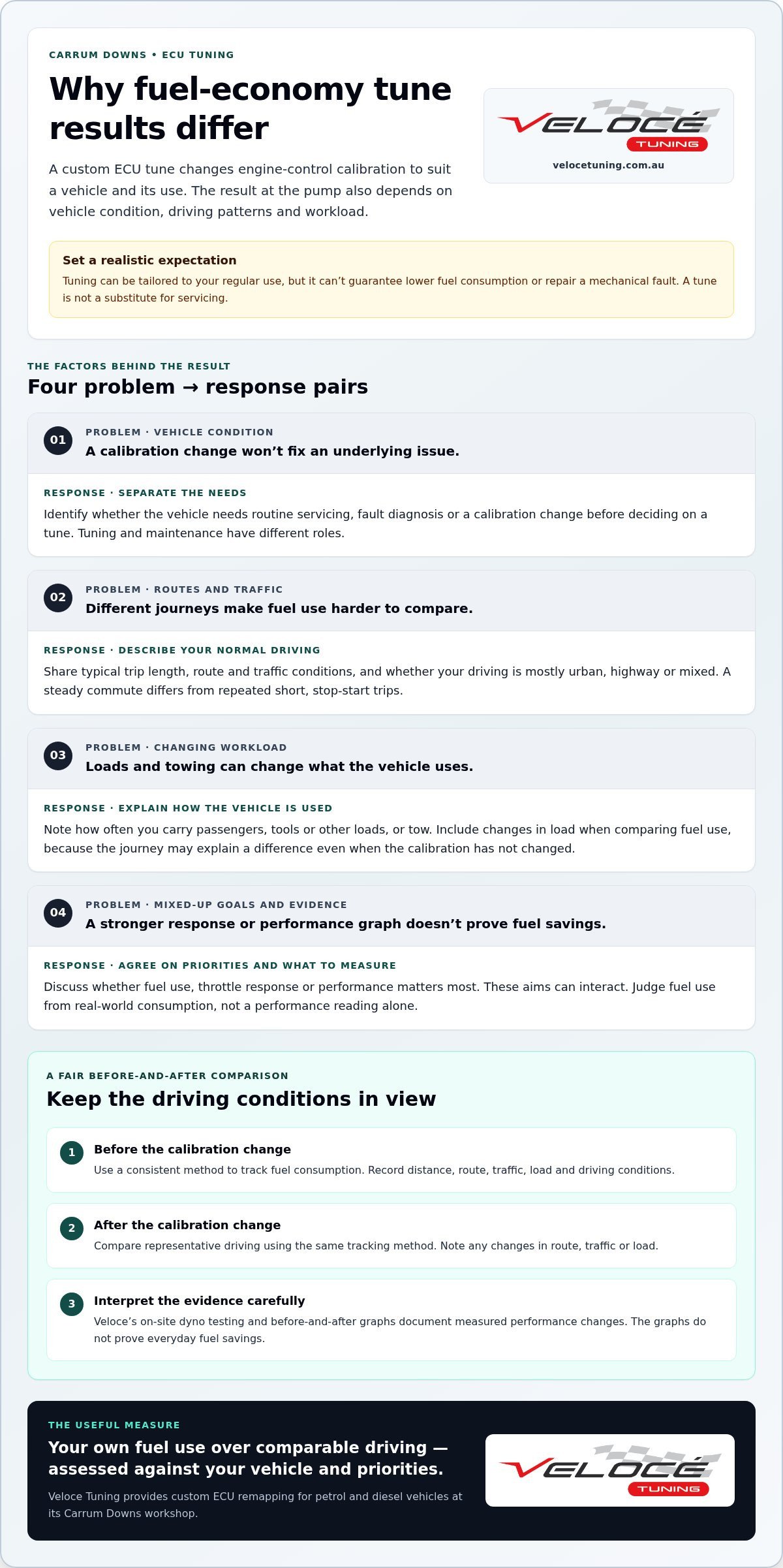
Fuel use reflects several factors: engine-control settings, the vehicle’s condition and the way it’s driven. An ECU tune for fuel economy Carrum Downs drivers consider should start with a realistic goal: a calibration suited to the vehicle’s regular use, not a promise of a particular reduction at the pump.
In brief: ECU tuning changes the engine control unit’s calibration. Routine servicing maintains the vehicle and addresses maintenance needs. A tune isn’t a substitute for servicing.
How the ECU influences fuel use
The engine control unit, or ECU, is the vehicle’s electronic controller for engine operation. It uses information from sensors to manage functions such as fuel delivery and ignition. The calibration is the set of instructions and settings that guide those decisions.
An ECU tune adjusts that calibration to suit the vehicle and its intended use. It changes software settings rather than adding fuel-saving hardware. The aim of a fuel-focused tune is to find a suitable balance for everyday driving, but changes intended to influence efficiency can also affect how the engine responds. Be clear about your priorities before calibration begins.
Engine tuning can involve different methods and trade-offs. This overview of engine tuning and its effects on fuel economy provides broader context on how tuning may relate to performance, economy and durability.
Why fuel-saving claims need context
There’s no single result that applies to every vehicle. The engine and its existing calibration matter, as do mechanical condition, traffic, terrain, load, trip length and driving habits. A vehicle used for towing or frequent stop-start traffic has a different workload from one used mainly for steady highway cruising. A change that suits one driving pattern may not deliver the same experience in another.
Keep efficiency separate from power, torque and throttle response. A tune may be designed to change one or several of these characteristics, but a stronger response or performance reading isn’t proof of reduced fuel consumption. A change in fuel use also doesn’t automatically mean a financial saving. That depends on actual consumption and fuel prices over time.
To assess fuel use fairly, compare similar driving rather than relying on a single trip. Record the distance, route, traffic, load and driving conditions, and use a consistent method to track consumption before and after a calibration change. When those conditions vary widely, it’s harder to tell whether the tune or the journey explains the difference.
- Potential benefit: Calibration can be tailored to the vehicle’s use, with efficiency considered alongside drivability and performance goals.
- Important limit: Results vary. Tuning can’t guarantee a particular change in fuel use or resolve an underlying mechanical issue.
How a custom ECU tune may influence real-world fuel economy
A calibration can influence how an engine responds to the driver and operating conditions, which may in turn affect fuel use. But a change in throttle response or engine output doesn’t, by itself, prove the vehicle is consuming less fuel. The result depends on how the tune is set up and how the vehicle is driven afterwards.
One driver’s fuel-economy result can’t predict another’s, because vehicles, routes, loads and driving habits differ. A useful discussion starts with your normal driving, not a headline claim or someone else’s result. An ECU tune for fuel economy Carrum Downs drivers consider should be judged against their own needs and comparable use.
Driving patterns and the way you use your vehicle
Consider a typical week behind the wheel. A steady commute with longer stretches at a consistent speed is different from repeated short, stop-start trips, where traffic and frequent acceleration can affect consumption. Neither pattern guarantees a particular tuning outcome. Both provide useful context for deciding what to measure and what you want the calibration to prioritise.
Before discussing a tune, note details such as:
- Typical trip length, route and traffic conditions.
- How often you carry passengers, tools or other loads, or tow.
- Whether your driving is mostly urban, highway or a mix.
- How you usually accelerate and whether your routine changes from week to week.
These details help describe the vehicle’s regular workload. A different route, heavier load or more time in traffic can change observed fuel use even when the calibration hasn’t changed.
Calibration goals: economy, response and performance
Custom tuning can be discussed around your priorities. You might want to place greater emphasis on fuel use during your usual driving, or value a sharper response or stronger performance as well. These aims can interact, so clarify which matters most rather than assuming every benefit will improve together. Discuss the calibration in the context of your vehicle and how you use it.
When considering tuning goals, weigh economy and performance separately. A useful discussion focuses on what you want from the vehicle and how you’ll assess the result, rather than relying on a general claim.
After a tune, compare fuel consumption over representative driving using a consistent tracking method, and note changes in route, traffic and load. A dyno graph can document measured performance changes, but it doesn’t establish fuel savings in everyday driving. For a discussion tailored to your vehicle’s use and tuning priorities, explore custom ECU tuning at Veloce.
Fuel-economy tune or maintenance first? Compare the factors
Before changing a vehicle’s calibration, separate three different needs: routine maintenance, investigating a change or symptom, and adjusting engine settings to suit a driving goal. These needs can relate to fuel use, but they aren’t interchangeable. A tune isn’t a repair and shouldn’t be treated as a way to address an unexplained vehicle fault.
| Approach | What it addresses | When it may be relevant |
|---|---|---|
| Routine servicing | Scheduled care and maintenance in line with the vehicle’s servicing needs. | When maintenance is due or you want to keep the vehicle’s servicing up to date. Logbook servicing in Carrum Downs supports this distinct role. |
| Diagnosis | Investigating a concern to identify its cause, rather than assuming a calibration change will address it. | When fuel use changes alongside another noticeable symptom or a new change in how the vehicle behaves. |
| ECU tuning | Changing engine-control calibration to suit the vehicle and the owner’s priorities. | When the vehicle’s condition and intended use have been considered and the tuning goal is clear. |
When servicing or diagnosis deserves attention
If fuel use seems different, note what else has changed. Is there a new warning light, unusual noise, altered response or another noticeable symptom? Those observations don’t identify a fault on their own, but they provide useful context for deciding whether maintenance or investigation should come before tuning. Veloce is a one-stop workshop in Carrum Downs offering servicing, repairs and custom ECU tuning. Each addresses a different need.
Routine servicing helps maintain a vehicle, while diagnosis investigates a reported concern. Neither should be replaced by an ECU tune. If a fault or overdue maintenance is present, changing the calibration won’t establish or resolve its cause. Treat fuel use as one part of the picture, not a diagnosis.
Questions to clarify before choosing a tune
Be specific about what you want from the vehicle. Is your priority fuel economy, throttle response, power or a considered balance? A clear goal makes the discussion more useful and helps distinguish different outcomes.
Bring practical context: your vehicle details, typical routes, usual loads and recent fuel-consumption observations. Describe how you use the vehicle and whether those patterns have changed. Representative information helps relate a calibration discussion to real use rather than a generic claim.
An ECU tune for fuel economy Carrum Downs owners are considering should make sense for the particular vehicle and its intended use. If the main concern is a new change in consumption, describe the full picture first. If the vehicle is maintained and your tuning goals are clear, a custom calibration can then be considered on its own merits.
Preparing for an ECU tune in Carrum Downs
A productive tuning conversation starts with a clear picture of the vehicle, how you use it and what you want to change. This gives the workshop practical context for discussing whether an ECU tune for fuel economy Carrum Downs suits your priorities, rather than relying on a broad promise.
Use this simple sequence to prepare:
- Clarify your goal. Decide whether you’re prioritising fuel economy, response, power or a considered balance.
- Share vehicle details. Describe the vehicle and engine type, along with any relevant changes you know about.
- Explain how you drive. Outline your usual routes, trip patterns, loads and typical driving conditions.
- Review what’s measured. Discuss the documented before-and-after results and what they can, and can’t, tell you.
What to discuss with the workshop
Explain why you’re considering a tune. For example, say whether you want the vehicle better suited to regular commuting, carrying a load or another everyday use. Mention any recent change in fuel consumption and other noticeable changes in how the vehicle behaves. Veloce provides custom ECU tuning for both petrol and diesel vehicles, with the approach shaped around the vehicle and your priorities.
It also helps to define what a worthwhile result means to you. Is a more responsive feel important, or is your focus on using the vehicle efficiently in its usual role? Be realistic about what you expect: the aim is to discuss a suitable calibration, not to assume every goal can be maximised at once or that a particular fuel saving is certain.
Understanding dyno testing and before-and-after graphs
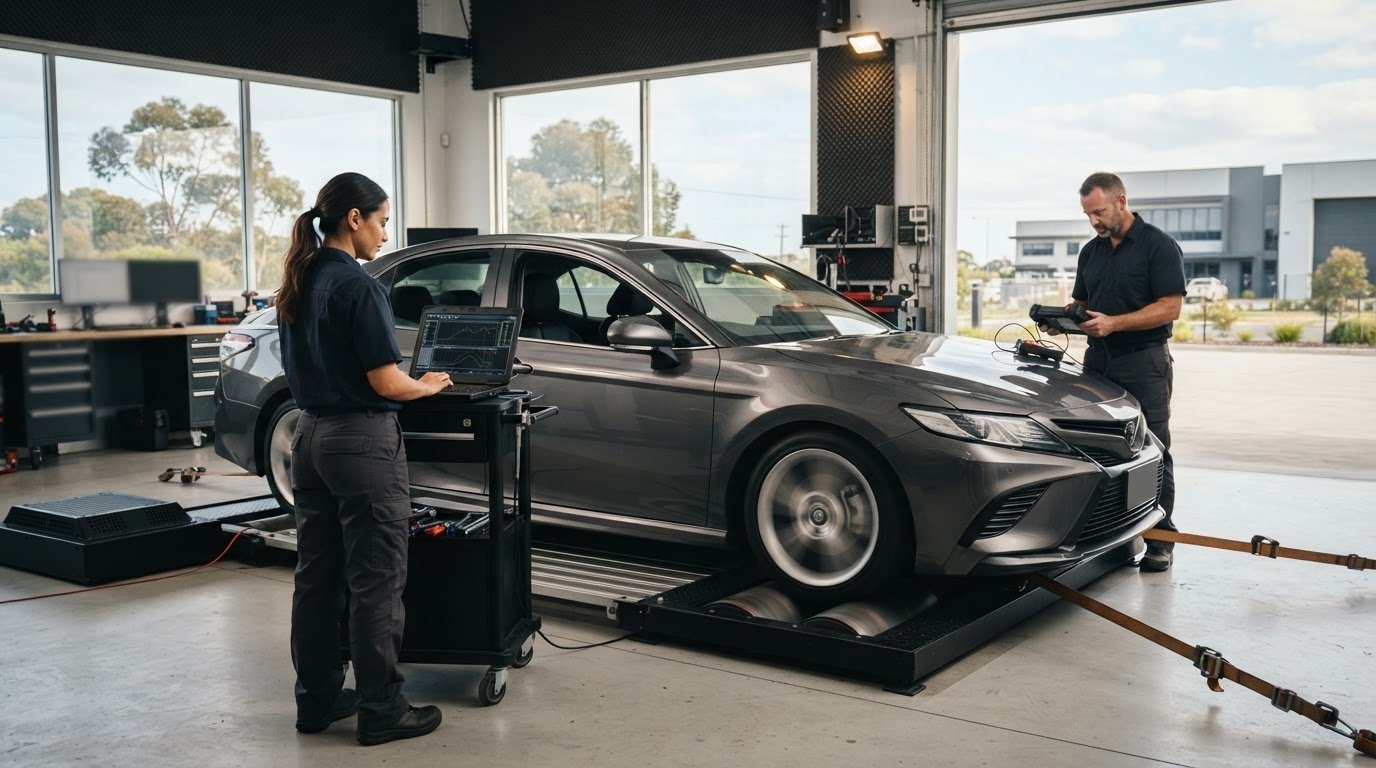
Veloce has an on-site dyno that measures vehicle performance and provides before-and-after graphs. These records show documented performance changes associated with the tuning work. Discuss what the graph measures and how to interpret the comparison in relation to your vehicle’s goals. A graph is useful evidence, but its scope matters.
A dyno graph can document measured performance changes; it does not, by itself, prove fuel savings in everyday driving. Real-world consumption depends on how and where you drive, so assess fuel use separately under comparable conditions. Track your usual routes, loads and consumption to make that comparison more relevant than treating a performance result as an economy result.
Veloce is a one-stop workshop in Carrum Downs with 19 years in business. If you’re ready to discuss your vehicle, goals and measured results, talk with Veloce about custom ECU tuning.
Custom ECU tuning at Veloce: local expertise and next steps
Choosing a workshop for an ECU tune is about more than changing settings. You need a clear conversation about your vehicle, how you use it and what you hope to improve. Veloce is a one-stop workshop in Carrum Downs, VIC, with 19 years in business and custom ECU remapping for petrol and diesel vehicles. Its services span servicing, repairs and performance upgrades, bringing related vehicle needs together in one local workshop.
Why local workshop experience matters to the conversation
A useful tuning discussion starts with your priorities, not a one-size-fits-all claim. Describe your normal driving, the vehicle’s role and whether economy, response, power or a balance matters most. Veloce works with petrol and diesel vehicles, helping ground the conversation in the vehicle in front of the team. If servicing or another workshop need is also relevant, the one-stop setting makes it easier to consider tuning alongside broader vehicle care.
Veloce’s on-site dyno provides before-and-after graphs to document measured performance changes. These offer a tangible comparison of the vehicle’s recorded performance and help explain what changed through the tuning process. A graph isn’t proof of lower fuel consumption on your everyday routes; assess fuel use separately in comparable real-world driving.
Book a tuning discussion with Veloce
Before getting in touch, gather the details that will make the conversation useful: your vehicle and engine type, typical routes and loads, any changes in fuel use you’ve observed, and your main tuning goal. Be clear about your expectations. A considered discussion can align the tuning approach with your vehicle and intended use, without treating a particular saving, performance result or timeframe as guaranteed.
For an ECU tune for fuel economy Carrum Downs drivers can assess on its own merits, start with the facts of your vehicle and the way you drive. Veloce welcomes owners who want to discuss custom ECU tuning and practical expectations with a local workshop.
Payment options include Afterpay, humm, Zip, cash, EFTPOS, Visa, Mastercard and American Express (Amex).
Talk to Veloce about custom ECU tuning and discuss your vehicle, driving needs and fuel-economy goals.
Make your next step a measured one
Before changing your vehicle’s calibration, decide how you’ll judge whether it suits your needs. A simple record of fuel use and typical driving gives you a practical reference point, while a clear priority keeps the tuning discussion focused. That way, you’re making a considered decision for the vehicle you rely on rather than chasing a headline figure.
If you’re weighing up an ECU tune for fuel economy Carrum Downs, bring your questions and real-world expectations into the conversation. A thoughtful approach can help you understand which outcomes are measurable, which depend on everyday conditions and what matters most for your driving. You can explore whether custom tuning aligns with your goals without assuming a guaranteed saving.
Start a conversation with Veloce about your tuning goals and take the next step with a clearer picture of what you want from your vehicle.
Frequently Asked Questions
Can an ECU tune improve fuel economy?
A custom ECU tune may help some vehicles use fuel more efficiently, but the outcome depends on the vehicle, its condition, calibration and use. An ECU tune for fuel economy Carrum Downs owners consider should be based on their vehicle and priorities, not a universal claim. If your fuel use has changed unexpectedly, note when it started and any other changes in how the vehicle runs before deciding that tuning is the answer.
How much fuel will I save with an ECU tune?
There’s no reliable figure that predicts how much fuel an individual vehicle will save. The result can vary with the engine, vehicle condition, routes, traffic, load and driving habits. Track fuel volume and distance over comparable fill-ups to assess consumption, rather than judging by one tank. A change in litres used doesn’t guarantee a financial saving, as fuel prices can change independently of your vehicle’s consumption.
Is a fuel-economy tune different from a performance tune?
The calibration can be discussed around different priorities, including economy, response and power. A fuel-focused approach gives attention to how the vehicle is used day to day, while a performance priority may place more emphasis on engine response or power delivery. These aims can overlap, but they aren’t identical. Be clear about what matters most, particularly if the vehicle has a specific role such as carrying regular loads.
Does ECU tuning work for both petrol and diesel vehicles?
Custom ECU tuning is available for both petrol and diesel vehicles, though the calibration must suit the specific vehicle and engine. Their operating characteristics differ, so one vehicle’s tune or result shouldn’t be treated as a template for another. Veloce works with petrol and diesel vehicles. Sharing the make, model, engine type and relevant changes helps make the tuning discussion specific to your vehicle.
Should I service my car before getting an ECU tune?
If servicing is due or your vehicle has developed a noticeable change, address that context before treating tuning as the next step. Follow the maintenance schedule in your vehicle’s handbook and describe any symptoms, warning lights or recent changes to the workshop. A service maintains the vehicle; tuning changes its calibration. Discuss a concern before proceeding with a tune rather than assuming calibration will resolve it.
How can I tell whether an ECU tune has made a difference?
Set a practical baseline before tuning: note your odometer reading, fuel added and the kind of driving you’ve done. Afterwards, use the same tracking method across comparable journeys or fill-ups, and record major differences such as extra passengers, towing or heavy traffic. This helps you assess real-world fuel use. Dyno graphs show measured performance changes, but fuel consumption on the road needs to be evaluated separately.