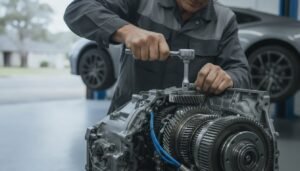
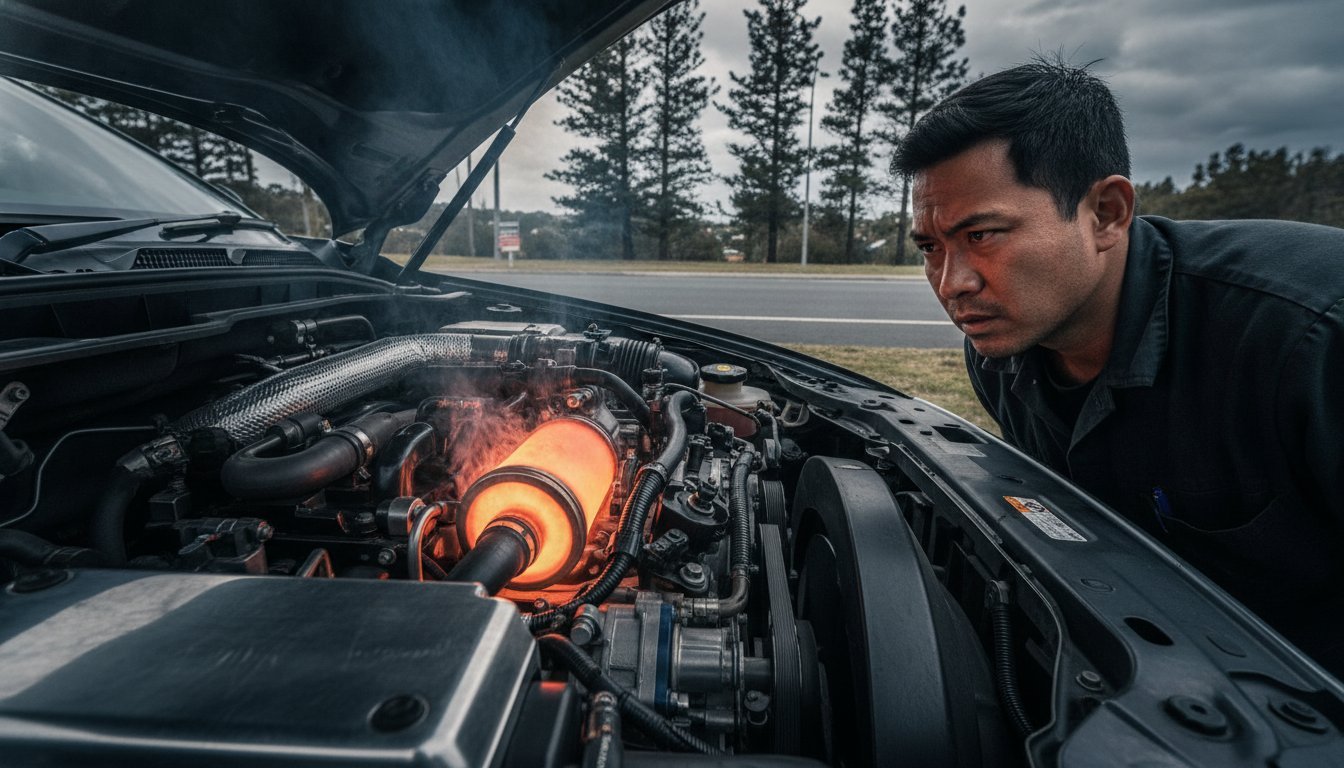
You are pulling out to overtake on the Monash, the gap is closing fast, and you bury your foot into the carpet expecting that familiar, surging rush of diesel torque; instead, your engine emits a muffled, strangled gasp as the power simply vanishes. It is a moment of pure, heart-stopping vulnerability. You have likely noticed your fuel needle dropping faster than usual lately, or perhaps a heavy, acrid scent has begun to linger around the chassis after a long haul. These are the unmistakable signs your DPF is blocked, and your vehicle is pleading for a technical rescue before the soot completely chokes its lungs. We know the frustration of a dampened drive and the looming fear of being stranded in the bush with a dead engine. This article will help you identify the visceral warning signs of a clogged filter before it compromises your engine’s integrity or leads to an eye-watering repair bill. We are diving into the seven critical symptoms, ranging from subtle throttle lag to the dreaded limp mode, to ensure your machine regains its breath and its brilliance.
Key Takeaways
- Learn to recognise the visceral sensory warnings, from muffled engine notes to acrid smells, that serve as the first signs your DPF is blocked.
- Understand why your vehicle enters “Limp Home Mode” and how this protective measure prevents catastrophic engine failure and soaring repair costs.
- Discover why “short trip syndrome” during your local Melbourne commute is a silent killer for diesel filters and how to break the cycle of soot accumulation.
- Uncover the hidden danger of fuel dilution and rising oil levels, a critical red flag that indicates your engine’s regeneration cycle is failing.
- Identify why precision diagnostics and professional DPF servicing offer a permanent restoration of power compared to the temporary fix of off-the-shelf chemical additives.
Understanding the Diesel Particulate Filter: The Lungs of Your Machine
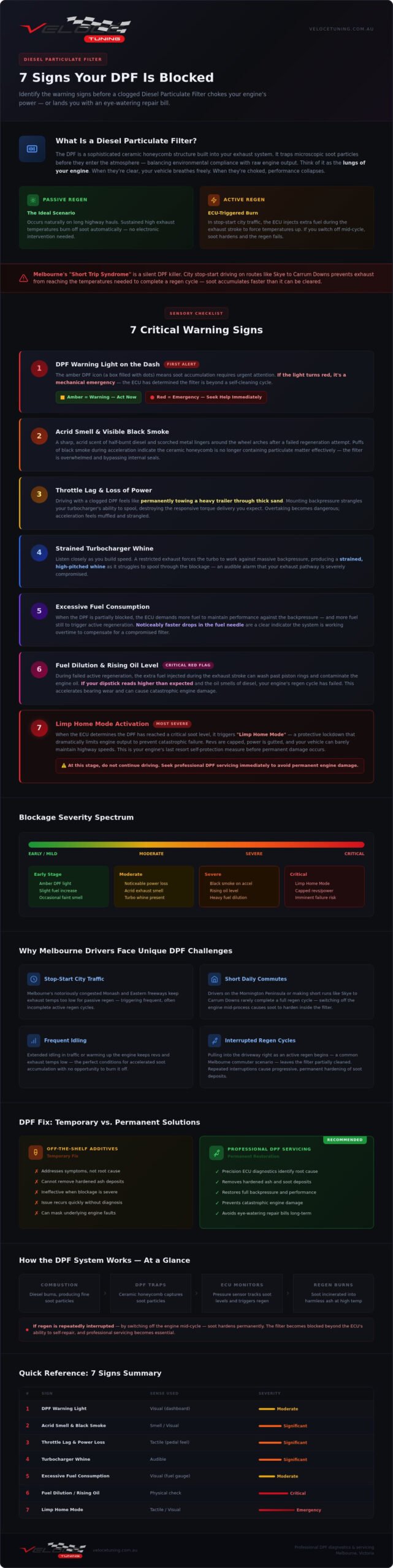
Imagine your engine as a high-performance athlete. To sprint, it needs to breathe with absolute freedom. The Diesel Particulate Filter (DPF) acts as the lungs of your machine, a sophisticated ceramic honeycomb structure integrated into your exhaust system to trap microscopic soot particles before they reach the air. The DPF is the critical component that balances environmental compliance with raw engine output. When these lungs are clear, your vehicle moves with effortless grace, but the visceral reality is that when the lungs are choked, the heart of the engine cannot beat with its full power. You will soon feel the physical resistance in the drivetrain, a telltale hint that you are seeing the early signs your DPF is blocked.
The Science of Soot Accumulation
Every time your diesel engine completes a power stroke, a fine mist of particulate matter is born from the combustion process. While modern common-rail systems are incredibly refined, they still produce carbon that must be captured within the filter’s intricate channels. Your vehicle manages this through a high-precision pressure sensor. This sensor constantly monitors the flow differential before and after the filter, reporting back to the ECU when the soot levels are reaching a critical mass. In standard Melbourne city driving, where speeds are low and idling is frequent, this accumulation happens rapidly. If the system cannot clear this buildup, the backpressure begins to mount, strangling your turbocharger’s ability to spool and deliver the boost you expect.
Passive vs. Active Regeneration
To maintain peak performance, the filter must periodically incinerate trapped carbon into a fine, harmless ash through a process called regeneration. There are two primary ways your vehicle attempts this rescue mission:
- Passive Regeneration: This is the ideal scenario. It occurs naturally during long highway hauls where sustained exhaust temperatures are high enough to burn off the soot without any electronic intervention.
- Active Regeneration: When you are stuck in stop-start traffic, the exhaust never reaches the required heat. The ECU then steps in, injecting extra fuel into the cylinders during the exhaust stroke to force temperatures up and trigger an artificial burn.
For many drivers on the Mornington Peninsula or those making short dashes from Skye to Carrum Downs, these active cycles are frequently interrupted. You might pull into your driveway and switch off the ignition just as the process begins. When this happens repeatedly, the soot hardens and the cycle fails. This failure to complete a “regen” is why many owners eventually encounter the unmistakable signs your DPF is blocked, resulting in a vehicle that feels heavy, unresponsive, and starved of its natural potential.
The Sensory Checklist: 7 Signs Your DPF is Blocked
Your vehicle communicates through a vocabulary of vibration, scent, and visual cues. It doesn’t just stop; it warns you through a series of escalating symptoms that indicate its internal pathways are narrowing. Recognising these signs your DPF is blocked early can be the difference between a simple technical rescue and a catastrophic failure on the side of the road. Your engine’s health depends on your ability to interpret these desperate cries for help before the soot turns into a permanent obstruction.
The most immediate signal is the amber glow on your dash. Unlike the generic “Check Engine” light, the DPF icon, which usually looks like a box filled with dots, specifically indicates a soot accumulation issue that requires urgent attention. If this light turns red, the situation has shifted from a warning to a mechanical emergency. At this stage, the ECU has likely determined that the filter is beyond the point of a self-cleaning cycle, and it’s time to seek professional intervention.
Visual and Audible Warning Signals
The failed regeneration attempt leaves behind a sharp, acrid scent of half-burnt diesel and scorched metal that lingers in the wheel arches. You might also notice a puff of black smoke during acceleration. This is a clear indicator that the filter’s ceramic honeycomb is no longer containing the particulate matter effectively or is so overwhelmed that it’s bypassing internal seals. Listen closely to your turbocharger as you build speed. A restricted exhaust forces the turbo to work against massive backpressure, often resulting in a strained, high-pitched whine as it struggles to spool through the blockage.
The Tactile Experience of Power Loss
Driving a vehicle with a clogged filter feels like you are permanently towing a heavy trailer through thick sand. The throttle becomes unresponsive, and that visceral punch of torque you usually feel at 2,000 RPM simply vanishes, leaving a flat, hollow sensation in the power delivery. Your automatic start-stop system may also stop functioning. The ECU intentionally keeps the engine running at idle to maintain as much heat as possible, desperately trying to trigger a burn-off. If you notice a rough, surging idle while stopped at the Frankston lights, your engine is likely gasping for air. These signs your DPF is blocked are your final warning to act before the vehicle enters a protective limp mode.
If your machine is showing these symptoms, it requires a master’s touch to restore its rhythm. Our team at Veloce Tuning provides precision DPF servicing and repairs in Carrum Downs to unlock your engine’s hidden potential and prevent a permanent loss of power.
Technical Red Flags: Limp Mode and Fuel Dilution
When the sensory warnings are ignored, the ECU acts as the final arbiter of your engine’s survival. It transitions from providing warnings to enforcing restrictions. This is no longer about a slight loss of torque or a lingering scent in the air; it’s about the vehicle’s computer system intervening to prevent a total mechanical meltdown. At this stage, the signs your DPF is blocked have moved from the exhaust pipe to the very heart of your engine’s control software. The consequences of reaching this point are both immediate and potentially terminal for your machine’s most expensive components.
One of the first technical red flags you will encounter is a sharp spike in fuel consumption. As the filter becomes a literal wall in the exhaust stream, the engine must pump harder just to expel waste gases. This massive back-pressure doesn’t just waste diesel; it puts immense strain on the turbocharger. The exhaust gases, unable to escape freely, heat up the turbo housing and can eventually cause the delicate oil seals to fail. This leads to oil leaking into the intake or exhaust, further complicating the blockage and turning a filtration issue into a turbocharger replacement.
Decoding Limp Home Mode
Limp Home Mode is a digital straitjacket. It is a software-governed restriction that neuters your engine’s RPM and boost pressure to protect the internal hardware from the heat and pressure of a blocked exhaust. Suddenly, your vehicle feels as though it has lost 70% of its horsepower. You might find yourself unable to exceed 60km/h or climb a simple incline without the engine gasping. This is a critical safety feature, but it’s also a clear signal that your window for a simple fix has closed. When your dash flashes this warning, the urgency of seeking a DPF repair Melbourne specialist becomes paramount to avoid being stranded.
The Silent Engine Killer: Oil Dilution
Perhaps the most dangerous technical consequence is oil dilution. During a failed regeneration, the ECU injects extra diesel into the cylinders to raise exhaust temperatures. If the cycle is constantly interrupted because the filter is too blocked to clear, that unburnt diesel doesn’t exit through the exhaust. Instead, it washes down the cylinder walls, bypasses the piston rings, and enters the oil sump. This thins your engine oil, stripping away its ability to lubricate vital bearings and journals.
If you notice your oil level is actually rising on the dipstick, you are witnessing a major mechanical emergency. Contaminated oil can lead to “engine runaway,” where the engine begins to ingest its own thinned oil as fuel, revving uncontrollably until it self-destructs. Checking your dipstick is a vital diagnostic step. If the oil smells of diesel or the level has crept above the “full” mark, these are definitive signs your DPF is blocked and is now actively poisoning the engine’s lifeblood.
Why Melbourne Drivers Face Unique DPF Challenges
Melbourne drivers face a specific set of environmental and logistical hurdles that turn their diesel engines into soot-producing machines. The bite of a Victorian winter means your engine spends more time in the “warm-up” phase, where combustion is at its dirtiest and least efficient. During these cold starts, the Exhaust Gas Recirculation (EGR) valve is working overtime, recycling soot-heavy gases back into the intake to reduce emissions. This creates a feedback loop of carbon accumulation that rapidly accelerates the signs your DPF is blocked. It is a silent, cold-weather strangulation of your vehicle’s potential that requires a master’s understanding to overcome.
Low-quality fuel further compounds the issue. While Australian diesel standards have improved, variations in lubricity and cetane levels can lead to incomplete combustion, leaving behind a heavy, oily residue that the filter struggles to process. When you combine poor fuel quality with the stop-start grind of the South East suburbs, the internal ceramic structure of your DPF becomes overwhelmed. Your machine isn’t just failing; it’s being suffocated by its own operating environment.
The Commuter’s Dilemma
The 15-minute dash from Skye to Carrum Downs is a DPF killer. These short bursts of urban driving never allow your exhaust to reach the sustained 600°C required to trigger a natural, passive incineration of trapped carbon. Instead of a clean burn, you get a slow smoulder that leaves behind a sticky residue. Breaking this cycle requires a deliberate strategy. A weekly “highway run” down the Peninsula Link, maintaining steady RPMs for at least twenty minutes, is often the only way to give your machine the heat it craves to breathe again. Without this thermal liberation, the soot continues to pack into the honeycomb, leading to the inevitable loss of power you’ve been feeling.
Maintenance Mistakes to Avoid
Precision maintenance is the only shield against total filter failure. Using anything other than Low SAPS (Sulphated Ash, Phosphorus, and Sulphur) oil is the fastest way to permanently ash-load your filter. Unlike soot, which can be burnt off, metallic ash is a permanent resident; once that ceramic core is packed, the filter is effectively dead. Even a single faulty glow plug, often ignored because the car still starts, can prevent the ECU from ever attempting a regeneration. This is why a meticulous log book service Carrum Downs is so vital. It ensures every sensor, plug, and fluid is functioning in harmony to keep the exhaust clear.
If your vehicle is already struggling with the unique pressures of Melbourne’s roads, don’t wait for the engine to enter a terminal limp mode. You need a partner who understands the technical nuances of high-performance diesel systems and can provide a permanent solution. Book a precision DPF diagnostic with Veloce Tuning today to restore your engine’s heartbeat and reclaim your driving experience.
Restoring the Pulse: Professional DPF Solutions at Veloce Tuning
Once you have identified the visceral signs your DPF is blocked, the temptation is often to reach for a quick fix in a bottle. Chemical additives found on service station shelves are frequently marketed as miracle cures, yet they are often nothing more than a temporary band-aid for a deep-seated mechanical issue. These fluids might lower the ignition temperature of soot for a moment, but they cannot clear a filter that has already reached its physical capacity. At our Carrum Downs workshop, we don’t believe in surface-level patches. We focus on technical mechanical rescues that address the root cause of the restriction, ensuring your engine’s heartbeat is restored with lasting precision.
Professional restoration is about more than just clearing a blockage; it is about protecting the integrity of your machine. Through forced regeneration and specialised professional cleaning, we can often restore the flow of a filter that other shops would simply condemn to the scrap heap. This process saves you the eye-watering cost of a full replacement while ensuring your exhaust system works in perfect rhythm with your turbocharger. By integrating these services with custom ECU tuning Melbourne drivers can achieve a level of efficiency that actually reduces future soot production, creating a cleaner, more powerful drive.
Our Diagnostic Process
We begin every rescue with a deep dive into your vehicle’s digital brain. Using advanced scan tools, we read live soot-load data and monitor pressure differentials in real-time to see exactly how much your engine is struggling. We don’t stop at the filter. Our master craftsmen inspect the health of related components including the turbocharger, fuel injectors, and the EGR valve to ensure no secondary faults are triggering the blockage. This comprehensive approach allows us to provide a clear technical roadmap, moving you from a state of mechanical anxiety to the visceral joy of a high-performance machine.
Performance Optimisation and 24/7 Support
True liberation for your diesel engine comes from optimising how it breathes and burns fuel. Through precision remapping, we can improve combustion efficiency so your engine naturally produces less particulate matter during every power stroke. This proactive approach to DPF health means you spend more time on the open road and less time worrying about dashboard warning lights. We also understand that mechanical emergencies don’t keep business hours. If your vehicle enters a terminal limp mode at midnight, our 24/7 breakdown service is ready to provide the technical support you need to get back on track. Don’t let a choked exhaust dictate your journey. Book your DPF assessment today and unleash the true potential hidden within your engine.
Restore the Rhythm of Your Drive
Ignoring the signs your DPF is blocked is a high-stakes gamble with your machine’s soul. You have felt the sluggishness, noticed the acrid scent, and heard the strained gasp of a turbocharger fighting for air. We have explored how Melbourne’s urban grind and cold winters accelerate this soot-loading nightmare, turning a simple filtration task into a mechanical emergency. Don’t wait for limp mode to leave you stranded on the shoulder of the Monash. Our local Carrum Downs workshop is equipped with specialist European diagnostic technology to pinpoint the exact cause of your engine’s distress. Whether you need a precision rescue or 24/7 emergency breakdown support, our expert engineers are your dedicated partners in performance. It is time to stop the strangulation and start the transformation. Restore your engine’s breath; book a DPF Diagnostic at Veloce Tuning today. Your vehicle is ready to breathe with absolute freedom again, and we are ready to help it find its true voice on the open road.
Frequently Asked Questions
Can I drive my car with the DPF light on?
You can drive for a short period, but you must treat the amber light as an urgent request for a highway run. Driving at sustained speeds on a freeway like the Peninsula Link allows the exhaust to reach the temperatures needed for regeneration. If the light stays on or turns red, you must stop immediately. Ignoring this warning leads to limp mode, which is one of the definitive signs your DPF is blocked and requires a professional rescue.
How much does it cost to fix a blocked DPF in Melbourne?
The cost of restoration depends entirely on the severity of the soot accumulation and whether the filter requires a forced regeneration or a professional chemical clean. While we don’t provide fixed quotes without a diagnostic, a professional clean at our Carrum Downs workshop is significantly more affordable than a full replacement unit. Our engineers use specialist European scan tools to provide a technical roadmap and a clear explanation of the required work after assessing the soot load.
Will a long highway drive always clear a blocked DPF?
A highway run is not a universal cure. It only facilitates passive regeneration if the soot levels are within a manageable range and the sensors are functioning correctly. Once the filter is heavily impacted or face-plugged with permanent ash, no amount of driving on the EastLink will clear the obstruction. At this stage, the ECU often blocks the regeneration cycle to protect the engine, making a professional diagnostic at Veloce Tuning essential for recovery.
What happens if I ignore the DPF warning signs?
What happens if I ignore the DPF warning signs?
Ignoring these warnings leads to an escalating series of mechanical failures, starting with a restricted limp home mode and potentially ending with turbocharger destruction. Back-pressure mounts until the turbo seals fail, and repeated failed regens can cause fuel to dilute your engine oil. This turns a preventable service into a catastrophic repair bill. If your vehicle fails at midnight in Frankston or Mornington, our 24/7 breakdown service is available to handle these mechanical emergencies. If the repair costs are no longer viable, Cash For Cars Perth offers an alternative for those looking to sell unwanted scrap cars for instant value.
It is illegal to remove or tamper with a factory-fitted DPF for any vehicle used on public roads in Australia. Such modifications violate the Australian Design Rules and can result in heavy fines, failed roadworthy inspections, and voided insurance policies. We focus on legal, high-performance solutions. By combining professional DPF cleaning with custom ECU tuning, we ensure your vehicle remains compliant while unlocking the visceral power and efficiency you expect from a modern diesel engine.
How often should I have my DPF professionally checked?
We recommend a DPF health check during every log book service, particularly for Melbourne drivers who frequently navigate stop-start urban traffic. Monitoring the pressure differential and soot accumulation allows us to catch potential issues before they manifest as physical signs your DPF is blocked. For high-mileage fleet vehicles or those used for heavy towing, more frequent inspections ensure the exhaust system isn’t strangling your engine’s efficiency or compromising your fuel economy over time.
Can a blocked DPF cause my engine to fail completely?
A severe blockage can lead to total engine failure through a process called engine runaway. When diesel enters the oil sump during failed regeneration cycles, it thins the oil and strips away its lubricating properties. In extreme cases, the engine may begin to ingest this oil-fuel mixture as an uncontrolled fuel source, revving until it self-destructs. This is why a rising oil level on your dipstick is a critical mechanical emergency that requires immediate technical intervention; however, if the engine has already suffered terminal damage, you can visit Melbourne Car Removal to learn more about professional disposal options.
The acrid, burning scent is the result of the intense heat, often reaching 600 degrees Celsius, incinerating the trapped carbon soot within the ceramic filter. You might also notice a faint ticking sound as the exhaust metal expands and contracts under the thermal load. While a slight odour is normal during a successful active cycle, a persistent or heavy burning smell could indicate a failed regeneration attempt or a leak in the exhaust housing that requires a professional assessment.