
You are merging onto the EastLink, the needle climbs, and for a heartbeat, the seamless surge of power falters into a rhythmic, unsettling shudder beneath the floorboards. It is a moment of mechanical friction where the bond between driver and machine feels frayed. Most enthusiasts recognise that these subtle protests are more than just quirks; they are the visceral signs your car needs a service before a minor glitch becomes a terminal breakdown. You don’t want to risk your log book warranty or your engine’s integrity on a guess. It’s time to listen.
We understand the anxiety of a mysterious DSG shudder or the dread of a DPF warning light glowing on the dash. Ignoring these signals is a gamble that eventually leads to a total loss of momentum. This guide will help you decode the specific symptoms that indicate your vehicle is losing its competitive edge. You will learn how professional maintenance in Carrum Downs protects your investment and restores the raw, factory-fresh performance you crave. We’re moving from uncertainty to technical precision.
Key Takeaways
- Learn how to interpret tactile and auditory warnings to identify mechanical issues before they escalate into expensive roadside emergencies.
- Recognise the specific red flags for complex DSG and DPF systems, ensuring these high-performance components remain efficient and reliable.
- Discover why the salt air and heavy towing conditions of the Mornington Peninsula mean you should monitor the signs your car needs a service more closely.
- Maintain your manufacturer warranty and vehicle integrity through specialist log book servicing that meets or exceeds factory standards.
- Bridge the gap between reactive dashboard lights and proactive maintenance to ensure your engine’s pulse remains strong and consistent.
Beyond the Dashboard: Why Sensory Signs Matter More Than Warning Lights
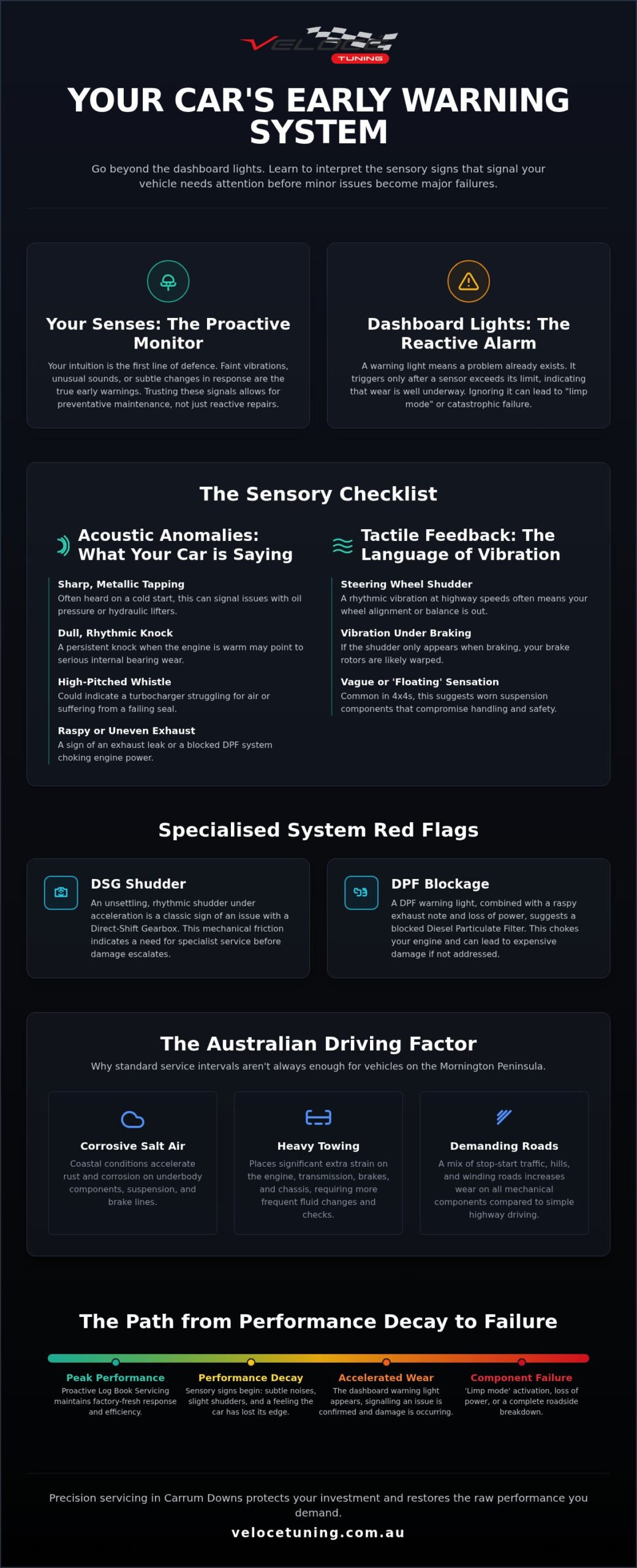
Modern vehicles are marvels of silicon and software; they monitor thousands of data points every second through a complex web of electronics. Yet, there is a fundamental flaw in relying solely on the instrument cluster to tell you when something is wrong. Sensors are inherently reactive. They trigger only when a pre-set parameter has already been exceeded, often long after the initial degradation has begun. Your senses, however, are proactive. That faint, high-frequency vibration through the seat or the slight, almost imperceptible delay in throttle response are the true, early signs your car needs a service. Trusting your intuition over a plastic bulb can be the difference between a routine afternoon at the workshop and a catastrophic engine failure that leaves you stranded on the side of the road. If a vehicle eventually reaches a point where it is no longer economical to repair, you can learn more about Cash For Junk Cars Michigan to see how specialised services evaluate and purchase used or damaged cars.
The Psychology of the Dashboard Light
Many drivers treat the “service due” indicator like an annoying notification on a smartphone; they swipe it away, promising to deal with it later when life is less hectic. This delay is a dangerous gamble, especially for those driving high-performance European models or work-ready utes. Ignoring these prompts often leads to “limp mode,” a restricted safety state that drastically cuts power to protect the drivetrain. Imagine pulling out to overtake on the highway only for your engine to suddenly lose its edge. It is a terrifying loss of control. A dashboard light is the final cry for help, not the first warning of a developing issue. By the time the amber glow appears, internal wear is already well underway.
Performance Decay vs. Mechanical Failure
Mechanical health exists on a sliding scale. On one end, you have factory-spec precision and effortless power; on the other, you have total component failure and a dead engine. Most vehicles on Melbourne roads exist in a state of “performance decay,” a gradual, insidious loss of efficiency that many drivers fail to notice until it’s too late. This is the “boiling frog” effect of automotive maintenance. As engine oil loses its viscosity and filters become choked with carbon or dust, the car’s visceral response begins to dull. A comprehensive motor vehicle service is designed to interrupt this decline before it results in permanent damage to delicate internals. At Veloce Tuning, we don’t just clear fault codes or tick boxes. We focus on restoring the raw performance and sharp throttle response that defines the driving experience. We validate that gut feeling you have when your ute feels sluggish or your sedan lacks its usual punch. Your senses are rarely wrong. Identifying these early signs your car needs a service ensures you stay ahead of the curve, keeping the machine’s pulse strong and its power delivery uncompromised.
The Sensory Checklist: Sound, Smell, and Tactile Feedback
Driving is a complete sensory engagement. It isn’t just about the visual of the road ahead; it’s about the feedback loop between the bitumen, the tyres, and your fingertips. While Regular maintenance keeps the mechanical heart beating, your ears and hands act as the primary diagnostic tools. These visceral signals are the most reliable signs your car needs a service before a minor friction point turns into a major failure. When the machine begins to lose its edge, it will tell you through a change in its fundamental frequency.
Acoustic Anomalies: What Your Engine is Saying
A precision-engineered engine should hum with a consistent, melodic rhythm. When that cadence breaks, you’re hearing the machine’s protest. A sharp, metallic tapping during a cold start often signals issues with oil pressure or hydraulic lifters, whereas a dull, rhythmic knock that persists once the engine is warm points to more serious bearing wear. You might notice a high-pitched whistle from the turbocharger, suggesting it’s struggling for air or suffering from a failing seal. Even your exhaust note provides clues. A deep, resonant rumble that transforms into a raspy, uneven cough often indicates a leak or a blocked DPF system that’s choking your power delivery and muffled your engine’s raw voice.
The Language of Vibration
Vibrations are the language of imbalance. If you feel a rhythmic shudder through the steering wheel as you reach highway speeds, your wheel alignment or balance is likely compromised. However, if that vibration only emerges when you apply pressure to the brake pedal, your rotors are probably warped. This tactile feedback is essential for maintaining the “presence” of the vehicle on the road. For 4×4 enthusiasts, a vague, floating sensation in the corners often indicates that your factory suspension has finally surrendered to the Australian bush. If your rig feels disconnected or sluggish in its response, exploring a suspension lift kit Melbourne can restore that lost authority and sharpen your handling.
Don’t ignore the olfactory alarms either. The sickly-sweet scent of vaporised coolant or the acrid, heavy aroma of burnt oil are urgent calls to action that usually precede a smoke-filled breakdown. Similarly, your brake pedal should feel firm and decisive. A spongy, wooden response underfoot or the high-octane screech of metal-on-metal are definitive signs your car needs a service to prevent a total loss of stopping power. If your vehicle is starting to feel like a stranger, it’s time to book a technical consultation with a specialist who understands the soul of your machine.
Specialised Red Flags: DPF, DSG, and Performance Systems
High-performance European engines and heavy-duty 4x4s operate with surgical precision, but this complexity introduces specific vulnerabilities that a standard commuter car rarely faces. Unlike the generic mechanical failures of the past, modern drivetrains exhibit nuanced signs your car needs a service that require a specialist’s eye to decode. When these sophisticated systems falter, the loss of power is rarely subtle; it is a throttled, restricted experience that strips the joy and reliability from your drive. Recognising these red flags early is the only way to prevent a minor sensor glitch from cascading into a terminal hardware failure.
Diesel Particulate Filter (DPF) Warning Signs
If you primarily use your diesel rig for short Melbourne commutes or stop-start school runs, your DPF is likely under siege. These filters require sustained exhaust temperatures to incinerate accumulated soot, a process known as regeneration. When your vehicle is unable to complete this cycle, you might notice excessive exhaust smoke or a distinct, acrid smell of “cooking” metal while idling. These are the visceral warnings of a system that is becoming choked. Ignoring these signs leads to a permanent loss of torque and eventual engine shutdown. Professional DPF repair Melbourne can restore the breath and raw power of your diesel engine, clearing the blockage before an expensive full replacement becomes your only option.
Dual-Clutch (DSG) Transmission Alerts
The DSG transmission is a masterpiece of gear-changing speed, yet it remains hypersensitive to fluid degradation and thermal stress. A tell-tale sign of trouble is a distinct, rhythmic shudder during low-speed take-offs or a sense that the gearbox is “hunting” for the right ratio while you are cruising. This hesitation isn’t just a quirk of the technology; it’s a critical alert that the mechatronic unit is struggling to manage hydraulic pressures. Maintaining the surgical precision of these shifts requires specialised diagnostics and high-grade fluid management. If your gear changes feel clumsy, delayed, or uncharacteristically harsh, seeking DSG mechatronic repair Melbourne is essential to preserve the pulse of your performance machine.
The ECU acts as the digital sentinel for your vehicle’s soul. Whether you are running factory software or a custom tune, this controller will trigger “limp mode” to protect the hardware from damage when it detects a critical imbalance. This often coincides with the “heavy breath” of an engine struggling for oxygen. A blocked air intake or a fouled sensor chokes the power delivery, leaving the machine gasping and sluggish. These are the technical signs your car needs a service that demand more than a generic workshop can provide. They are the moments where professional intervention preserves the integrity of your engine’s pulse and ensures your vehicle remains a precision tool rather than a liability.
Australian Conditions: Why the “Standard” Interval Isn’t Enough
Manufacturer manuals are often written for the temperate, dust-free roads of Europe or North America; they rarely account for the punishing reality of the Mornington Peninsula. Here, the corrosive salt air from the coast silently attacks exposed mechanicals, while the relentless stop-start grind of the Frankston Freeway creates extreme heat-soak that thins your lubricants. Your engine’s cooling system and oil are pushed to their thermal limits daily. These environmental pressures mean the signs your car needs a service often manifest much earlier than the factory odometer suggests. For those running custom-tuned engines, even a fine layer of Australian dust in the intake can choke performance and compromise the delicate air-fuel ratios required for peak output. The machine demands more than just the bare minimum.
Towing and 4×4 Stress Factors
Pulling a boat or caravan isn’t just a weekend hobby; it’s a high-stress mechanical trial that accelerates fluid degradation. When you’re lugging several tonnes behind you, your transmission fluid temperatures skyrocket. This leads to a rapid loss of lubricating properties and a distinct, burnt aroma. You might notice the gearbox becoming hesitant or the engine feeling uncharacteristically strained under load. Similarly, your braking system faces immense pressure during long descents. If you experience brake fade—that terrifying, spongy sensation when the pedal goes soft—it’s a definitive sign your brake fluid has exceeded its boiling point. Rigorous log book servicing for 4x4s is non-negotiable for anyone who values reliability in the scrub or on the boat ramp.
The “Severe Service” Schedule
In the automotive world, “severe” isn’t a term reserved for outback expeditions; it describes the average Melbourne commute. Short trips where the engine never reaches optimal operating temperature prevent the burning off of condensation and contaminants in the oil. This leads to sludge formation that chokes the life out of your internals and dulls the throttle response. While a 15,000km interval might look good on a marketing brochure, it is often far too long for those seeking performance longevity and mechanical purity. The severe service schedule is the true standard for Australian enthusiasts. If you’ve noticed your fuel economy dropping or a subtle loss of that factory-fresh punch, these are the signs your car needs a service before the damage becomes irreversible. Organise your performance-grade service today and ensure your machine is ready for the road ahead.
The Veloce Standard: Precision Servicing in Carrum Downs
When you finally identify the visceral signs your car needs a service, the next step determines the future of your machine. A generic, box-ticking exercise at a franchise workshop might keep the engine turning, but it won’t restore the sharp, high-octane response you crave. At Veloce Tuning, we treat every vehicle as a unique technical challenge. Our approach is a comprehensive performance audit designed to unlock hidden potential and eliminate mechanical friction. We bridge the gap between complex European diagnostic technology and the raw, local mechanical expertise required to survive Australian roads. It is a marriage of digital sophistication and old-school craftsmanship.
Log Book Servicing with a Performance Edge
Maintaining a meticulous service history isn’t just about satisfying a manufacturer’s requirement; it is about building a pedigree for your vehicle. Under Australian Consumer Law, you have the right to choose your mechanic without voiding your warranty, provided the work meets factory specifications. We exceed these standards. By using premium fluids and high-flow filters that can withstand the intense thermal loads of a custom ECU tune, we ensure your engine remains pristine. Our log book service Carrum Downs is specifically engineered for those who demand more than the bare minimum. We document every technical calibration, ensuring your vehicle’s history reflects the uncompromising care it has received.
Booking Your Mechanical Rescue
For drivers across Frankston, Skye, and Seaford, our Carrum Downs workshop serves as a sanctuary for high-performance machines and heavy-duty 4x4s. We provide transparent reporting that translates complex data into actionable insights, giving you a clear view of your vehicle’s health. You can expect visceral results from the moment you leave the workshop: a smoother idle, a more decisive gear change, and a throttle that feels connected to your intent. We also recognise that even the most attentive enthusiasts can occasionally miss the early signs your car needs a service. That is why we offer 24/7 breakdown support as a safety net for our community. It is our commitment to keeping your passion on the road, no matter the time of day. If your engine’s pulse has started to falter, don’t wait for a total loss of power. Book your precision service at Veloce Tuning today and experience the transformation of a vehicle restored to its absolute peak.
Reclaiming the Soul of Your Machine
Your vehicle is a precision instrument, not just a mode of transport. By listening to the subtle shifts in its acoustic rhythm and feeling the feedback through the steering wheel, you can identify the early signs your car needs a service before performance degrades into a costly repair. We’ve explored how the unique stressors of the Mornington Peninsula and the complexity of modern DSG or DPF systems require more than a generic approach. It’s about proactive maintenance that respects the machine’s engineering and protects your investment.
At Veloce Tuning, our European-trained engineers use specialist DPF and DSG diagnostic equipment to ensure your engine’s pulse remains strong and consistent. We provide a safety net with 24/7 Emergency Breakdown Support, but our goal is always to keep you ahead of the failure. Don’t let your car lose its competitive edge on the Frankston Freeway or the EastLink.
Restore Your Car’s Performance – Book a Service at Veloce Tuning
It’s time to transform your driving experience and rediscover the raw, uncompromised power of a perfectly calibrated machine.
Frequently Asked Questions
Is it okay to drive with the “Check Engine” light on if the car feels fine?
Driving with a check engine light is a gamble that rarely pays off. Even if the machine feels stable, the ECU has detected a parameter breach that could trigger a sudden limp mode during a Frankston Freeway merge. It is the final warning before hardware damage occurs. We recommend a diagnostic scan immediately to identify the specific fault code and prevent a total mechanical shutdown on the EastLink.
Will a service at Veloce Tuning void my new car warranty?
A service at our Carrum Downs workshop will not void your new car warranty. Under Australian Consumer Law, you have the right to choose an independent specialist for your maintenance. We use premium parts and fluids that meet or exceed factory requirements. Our engineers ensure every technical entry in your log book is precise, preserving your vehicle’s pedigree and manufacturer protections while delivering a performance edge.
Why does my car shudder when I accelerate from a standstill?
A shudder during low speed take-offs is often a definitive alert from a dual-clutch transmission. In many European models, this indicates the DSG mechatronic unit or the clutch packs are struggling to manage hydraulic pressure. It isn’t a minor quirk; it’s a signal of impending friction failure. Addressing this early through specialised DSG servicing prevents the need for a complete gearbox rebuild and restores your vehicle’s surgical gear change precision.
How often should I service my car if I only drive short distances in Melbourne?
Short Melbourne commutes are classified as severe service conditions because the engine rarely reaches its optimal operating temperature. This prevents condensation from evaporating, leading to rapid oil degradation and carbon buildup. These are the signs your car needs a service more frequently than a highway cruiser. We recommend halving the standard manufacturer interval to ensure your engine oil remains pure and your internal components stay sludge-free.
What is the difference between a minor and a major log book service?
A minor service focuses on the engine’s lifeblood, involving an oil and filter change alongside a comprehensive safety inspection. A major log book service is a deeper technical audit. This includes replacing air and fuel filters, changing brake and transmission fluids, and inspecting spark plugs or timing belts. It’s a complete recalibration of the machine’s systems to ensure every component handles the heat and stress of daily driving in Skye or Seaford.
Can a blocked DPF cause my car to lose power suddenly?
A blocked Diesel Particulate Filter will absolutely cause a sudden, dramatic loss of power. When soot levels exceed the threshold for a standard regeneration, the ECU chokes the engine to protect the turbocharger and internals. This often results in a restricted limp state. Professional DPF servicing in Carrum Downs cleans these obstructions, restoring the torque and breath your diesel rig needs for heavy towing or highway cruising.
What does it mean if I smell “rotten eggs” or sulphur near my car?
A sulphur or rotten egg aroma usually points to a failing catalytic converter or a battery that is overcharging. This chemical scent indicates that fuel is not being processed correctly in the exhaust stream or that the battery casing is venting dangerous gases. It’s a critical safety issue that demands immediate mechanical attention. Ignoring this olfactory alarm can lead to toxic cabin fumes or a complete electrical failure during your commute.
Why is my fuel economy getting worse even though I haven’t changed my driving style?
Dropping fuel efficiency is one of the most common signs your car needs a service. Choked air filters, fouled oxygen sensors, or old, viscous oil create internal drag that forces the engine to work harder for the same output. A precision tune-up cleans these pathways and recalibrates the air-fuel ratio. This restores your engine’s efficiency and ensures you aren’t wasting money at the pump while losing the visceral performance of your machine. For those seeking specialised care, San Juan Auto Smog offers expert smog checks and full synthetic oil changes that help maintain this vital mechanical balance.