
The sun hits the tarmac as you merge onto the Monash Freeway, anticipating that surge of power, but instead, the dashboard flashes a warning and your car lurches into a gut-wrenching limp mode during peak hour. It is a moment of pure frustration that turns a precision machine into a heavy, unresponsive shadow of its former self. You aren’t just dealing with a mechanical glitch; you are losing the connection to the road that makes driving a passion. Seeking a DSG mechatronic repair Melbourne specialist is about more than fixing a part. It is about reclaiming your confidence behind the wheel.
You understand that a jerky gear change or a delayed shift ruins the entire experience, especially when the fear of a massive dealership bill hangs over your head. This guide will help you master the complexities of your DSG mechatronic unit to avoid a total transmission replacement. We will explore how professional diagnostics and precision repairs can restore those lightning-fast, crisp shifts. You can save your gearbox and your budget. Let’s dive into the technical heart of your machine and restore the pulse of your drive.
Key Takeaways
- Understand how the mechatronic unit acts as the command centre of your gearbox, orchestrating the complex marriage of hydraulics and electronics for lightning-fast shifts.
- Learn to recognise the early warning signs of failure, from the unsettling shudder at intersections to the dreaded flashing PRNDS indicators on your dashboard.
- Discover why seeking a specialist for DSG mechatronic repair Melbourne can save you thousands compared to a full dealership replacement while bypassing complex coding headaches.
- Explore the meticulous diagnostic and clean-room repair process used by local master craftsmen to restore your transmission to its factory peak.
- Find out how custom tuning can increase clutch clamping pressure and optimise shift patterns to prevent future mechatronic issues and enhance your drive.
Understanding the DSG Mechatronic Unit: The Brain Behind the Shift
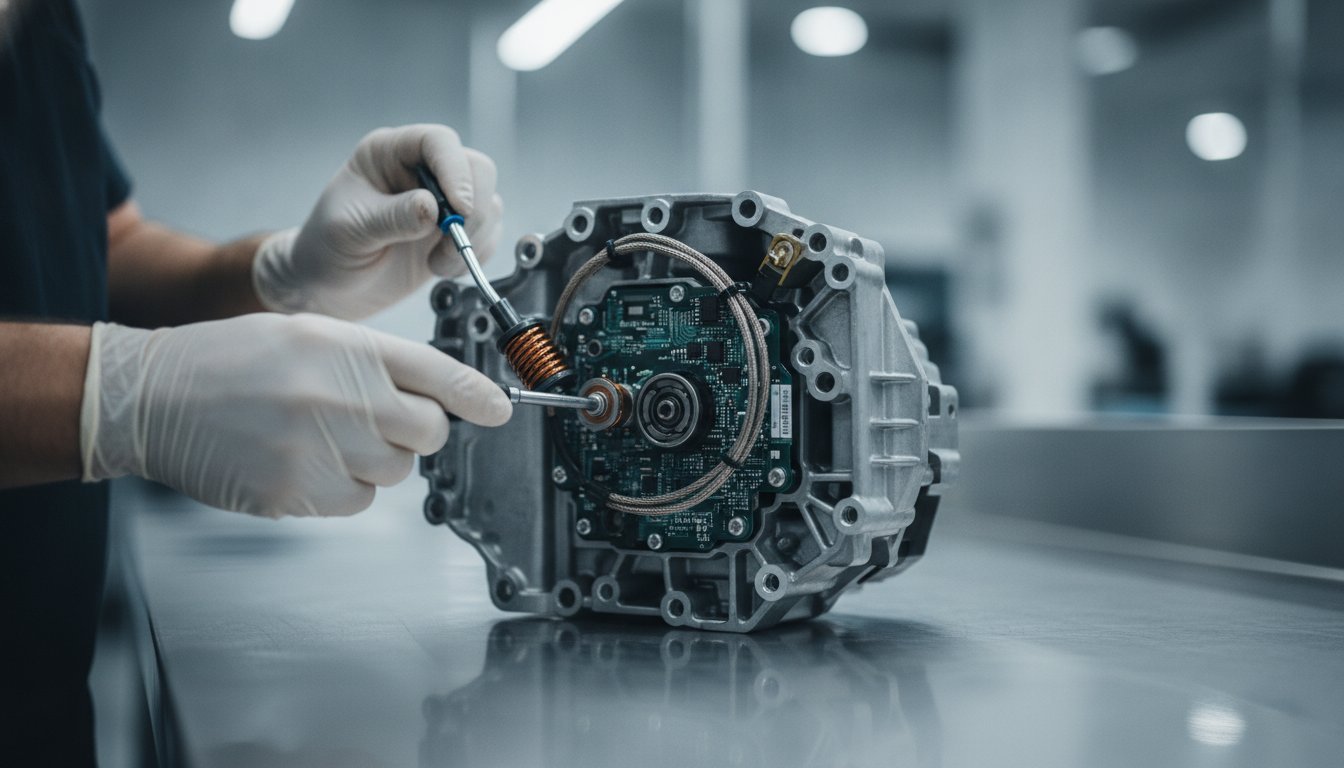
The mechatronic unit is the nerve centre of your performance machine, a complex assembly that dictates exactly how power translates to the road. It sits submerged in the transmission fluid, waiting to execute commands with a level of speed and precision that no human driver could ever replicate. When your car is at its peak, the shifts are telepathic; they are smooth, urgent, and perfectly timed to keep you in the power band. This is the magic of the Direct-Shift Gearbox (DSG), a system designed to bridge the gap between manual engagement and automatic convenience.
In Melbourne, we see a diverse range of these units, each with its own character and common failure points. Whether you are driving a Volkswagen with the DQ200 dry-clutch system, a performance Audi featuring the DL501, or the ubiquitous DQ250 six-speed, the mechatronic unit remains the critical component. If this “brain” falters, the entire driving experience collapses. Finding a specialist for DSG mechatronic repair Melbourne becomes essential when those lightning-fast sub-100ms shifts turn into hesitant, clunky nightmares.
The Hydraulic and Electronic Symbiosis
Inside the unit, a sophisticated dance occurs between high-speed electronics and raw hydraulic pressure. The Transmission Control Unit (TCU) acts as the brain, processing thousands of data points from engine sensors and driver inputs every second. It then sends electrical pulses to the solenoids, which serve as the “muscles” of the system. These solenoids physically move the gear forks and engage the clutches. Because these tolerances are incredibly tight, clean DSG fluid is non-negotiable for mechatronic longevity. Contaminants or degraded oil can cause these delicate valves to stick, leading to the very issues that necessitate DSG mechatronic repair Melbourne drivers often fear.
Why Melbourne Traffic is Tough on Your DSG
Melbourne’s unique geography and traffic patterns place immense stress on these sophisticated systems. Crawling along the Nepean Highway during the afternoon rush or navigating the stop-start grind of the Monash Freeway generates significant heat within the transmission. This heat is the primary enemy of electronic components and hydraulic seals alike. Frequent low-speed shifting requires the solenoids to cycle constantly, accelerating wear on the internal components. The DSG mechatronic unit is an electro-hydraulic control module. It is built for performance, but the constant friction and thermal cycles of urban commuting can eventually push it past its breaking point.
Signs of Failure: When the Rhythm of the Drive Breaks
When the mechatronic unit begins to falter, the symphonic precision of your car turns into a discordant mess. One of the most jarring signals is the “Death Flash,” where the PRNDS lights on your dashboard or a small spanner icon start blinking rhythmically. This is not just a suggestion to pull over; it is a critical alert that the control module has detected a catastrophic loss of hydraulic pressure or an electronic internal failure. Understanding how a dual-clutch transmission works helps you realise that when these signals appear, the “brain” can no longer safely manage the two separate clutches that handle your gear changes.
You might also experience “Missed Beats,” where the gearbox suddenly decides to ignore odd or even gears entirely. Because the DSG architecture separates gears onto two shafts, a failing mechatronic unit may lose the ability to shift into 1st, 3rd, and 5th, or conversely, 2nd, 4th, and 6th. This often precedes the gut-wrenching transition into Limp Mode. In this state, the car’s computer slashes power to protect the engine, leaving you struggling for momentum on the freeway. It is a defensive maneuver that demands immediate DSG mechatronic repair Melbourne expertise before a minor hydraulic leak becomes a total mechanical seizure. Understanding the full spectrum of common DSG problems Australia performance car owners face can help you act before these warning signs escalate into a complete gearbox emergency.
Audible and Physical Warning Signals
Your car often talks to you before the dashboard lights up. You might notice a metallic clunking sound during downshifts as you slow for a red light in South Yarra, or an unsettling shudder that vibrates through the chassis when pulling away from a standstill. This shudder is a sign that the mechatronic unit is struggling to find the “bite point” of the clutch. Another classic red flag is the “neutral-drop” sensation, where you press the accelerator, the revs climb with no movement, and then the gear slams home with a violent lurch. If you find yourself unable to back out of your driveway because you have lost reverse gear entirely, the hydraulic pressure inside the unit has likely reached a critical low.
Electronic Red Flags
Sometimes the failure is more subtle, manifesting as a “ghost in the machine.” You might see intermittent fault codes that vanish after you cycle the ignition, only to return during a spirited drive through the Dandenongs. These erratic shifting patterns and software glitches are often the first signs of heat-damaged circuitry within the TCU. Proactive maintenance is your best defence against these electronic gremlins. Booking a log book service Carrum Downs ensures that diagnostic scans catch these hidden faults before they leave you stranded. If your gear changes feel less than surgical, it might be time to have a professional assess your transmission health before the rhythmic drive breaks for good.
Repair vs. Replace: Navigating the Mechatronic Crossroads
Facing a failing gearbox often feels like staring down a massive dealership bill that could easily spiral toward five figures. Most factory service centres prefer the path of least resistance: binning your entire mechatronic unit and charging you for a brand-new replacement. However, choosing a specialist for DSG mechatronic repair Melbourne offers a surgical alternative that targets the root cause rather than just the symptoms. For many Victorian drivers, a targeted repair can cost significantly less than the total replacement quoted by a dealer, while often resulting in a more resilient gearbox.
Refurbishing your existing unit is not merely a cost-saving measure; it is an opportunity to engineer out factory flaws. Many original mechatronic units, particularly the pre-2014 DQ200 versions like the 0AM 927 769 series, possess known vulnerabilities in their hydraulic housings. By refurbishing these units with high-quality aftermarket kits, we can reinforce the pressure points that the original manufacturers missed. This approach is both financially savvy and environmentally responsible, keeping complex electronic waste out of Victorian landfills while restoring your car’s performance. Similarly, for those managing heavy-duty equipment, you can check out Storm Parts Australia for specialist Volvo and Caterpillar engine components that ensure long-term reliability.
The “Component Protection” headache is another factor that makes repair an attractive option. When you install a completely new mechatronic unit, it must be electronically “married” to your vehicle’s VIN through complex coding. This software handshake can be a significant hurdle for general workshops. Because Australia’s Competition and Consumer Amendment (Motor Vehicle Service and Repair Information Sharing Scheme) Act 2021 (MVIS) ensures independent repairers have access to this data, specialists can now handle these high-level tasks. Still, repairing your original unit often bypasses these coding complications entirely, as the car already recognises its own “brain.”
The Specialist Repair Advantage
At Veloce Tuning, we treat every mechatronic unit as a precision instrument. We don’t guess. Our team uses specialised DSG diagnostics and solenoid testing to identify exactly which valve or circuit has faltered. If only one solenoid is failing to maintain hydraulic pressure, we replace that specific component rather than the entire assembly. We use clean-room environments to ensure that not a single speck of dust interferes with the delicate internal valves. This meticulous local expertise ensures your car receives a level of care that a high-volume dealership simply cannot match.
When Replacement is the Only Option
There are instances where a unit is truly “too far gone” for a safe rebuild. If the Transmission Control Unit (TCU) has suffered a catastrophic electronic failure—often called “TCU death”—the board can no longer communicate with the rest of the vehicle. Similarly, if the internal hydraulic housing has developed severe cracks that cannot be safely machined or reinforced, a replacement becomes the only responsible path. While a specialist repair is typically much more affordable than a dealership replacement, we will always prioritise the long-term safety and reliability of your transmission over a quick fix.
The Veloce Tuning Approach to DSG Mastery
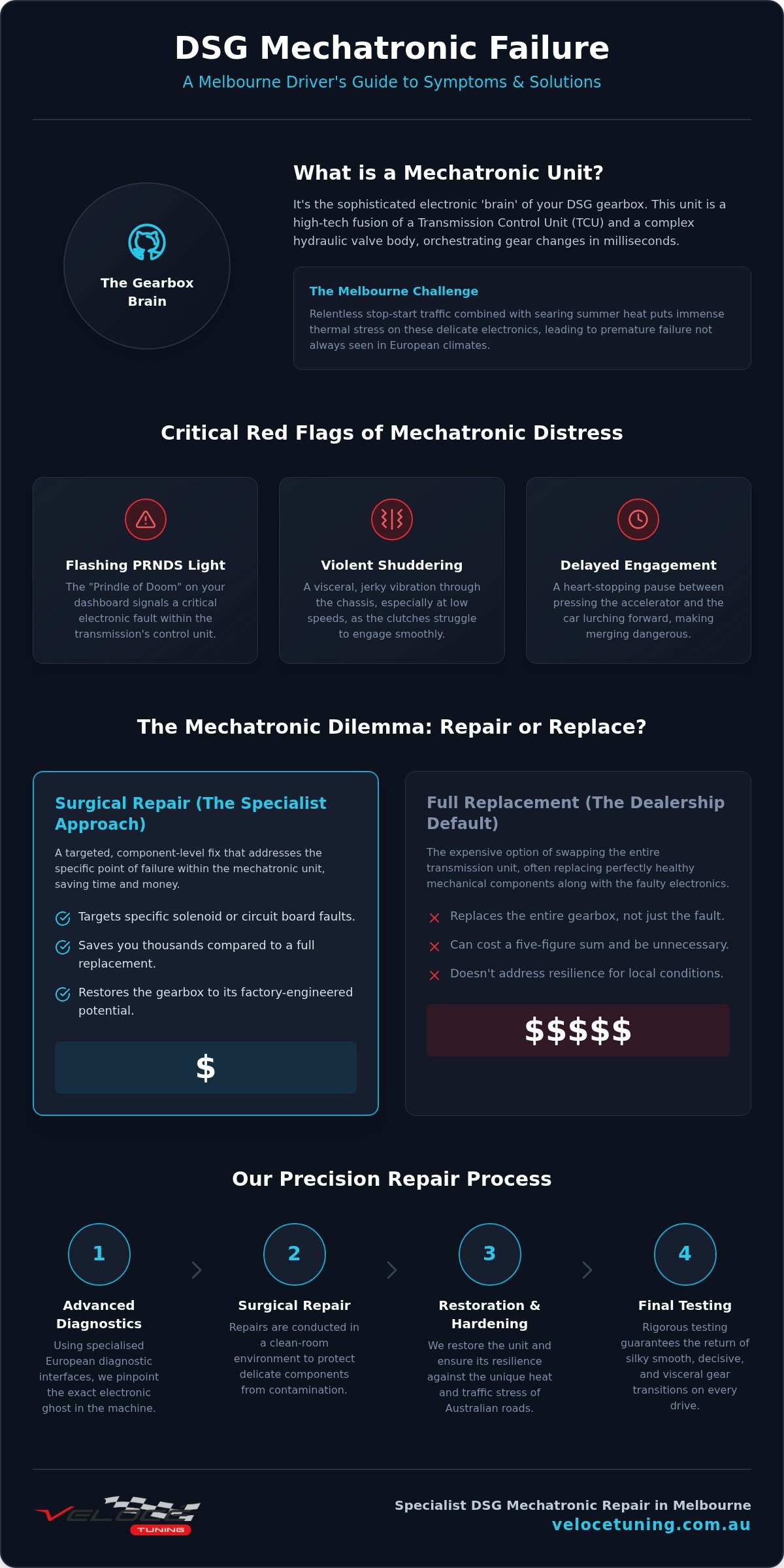
At Veloce Tuning, we don’t just clear fault codes; we restore the mechanical soul of your vehicle through a rigorous, five-step methodology designed for elite performance. It begins with deep-system diagnostics using performance-grade scanning tools to map out every hydraulic pressure drop and electronic hiccup within the system. Once the data confirms a fault, the mechatronic unit is removed within our sterile clean-room environment to prevent any particulate contamination from entering the delicate valve body. We then perform a surgical inspection of the solenoids, wiring looms, and pressure sensors, testing each component’s resistance under simulated operating temperatures. Precision reassembly follows, using high-grade DSG fluid and fresh filters, before we conclude with a comprehensive adaptation and road test to ensure the signature “Veloce feel” is fully restored.
This meticulous process ensures that our DSG mechatronic repair Melbourne service isn’t just a temporary fix but a long-term performance solution. We understand that your car is an investment in adrenaline. We treat it with the respect it deserves, ensuring every gear change is as sharp as the day it left the showroom floor.
Diagnostic Precision in Carrum Downs
Our workshop in Carrum Downs is equipped to look far beyond surface-level fault codes to find the true root cause of a transmission shudder. A vibration during take-off might be a mechatronic pressure issue, but it could also be a sign of worn clutches, which is why we meticulously test the transmission fluid for clutch material and debris. We also take a holistic view of the vehicle, ensuring that other modifications, such as a suspension lift kit Melbourne drivers often install on their performance SUVs, aren’t placing undue stress on the driveline. This level of detail is what sets our DSG mechatronic repair Melbourne apart from the “swap and hope” mentality of generalist mechanics.
Calibration and the Final Shift
The final phase of our process is where the technical work translates into the driving experience. We perform the “Basic Settings” procedure, a software-driven realignment that teaches the mechatronic unit exactly where the clutch bite points sit in relation to the gear forks. This calibration is vital for achieving that crisp, lightning-fast shift you expect from a dual-clutch system. A post-repair road test is a necessity to bed in components and confirm your car can handle the brutal stop-start grind from Frankston to the CBD without hesitation. If you want your performance machine to shift with surgical precision again, book your DSG diagnostic with our specialists today.
Beyond Repair: Optimising DSG Performance
Restoring your gearbox to its factory state is only the first step in the journey. While a DSG mechatronic repair Melbourne service fixes the immediate fault, custom DSG tuning offers a way to future-proof your transmission against the very stresses that caused the failure in the first place. By recalibrating the software that governs the hydraulic pressure and shift logic, we can create a more resilient system that thrives under pressure rather than just surviving it. This is where we transition from master craftsmen to performance partners, unlocking the hidden potential of your vehicle.
For those pushing higher torque through their driveline, increasing clutch clamping pressure is a necessity. Factory settings are designed for standard power levels; once you add a custom ECU tune, the mechatronic unit needs to work harder to prevent clutch slip. We also address the frustrations of the “kick-down” feature in manual mode. True driver control means the car stays in the gear you select, even at wide-open throttle. This transformation ensures that the mechatronic unit is no longer a bottleneck but a facilitator of raw, unadulterated power. For enthusiasts considering a more radical powertrain transformation, understanding the LS swap cost Melbourne specialists recommend can help you plan a complete V8 conversion with the same financial clarity you bring to a transmission rebuild.
DSG Software Upgrades
Our software upgrades are designed to harmonise with your engine’s specific mapping, creating a seamless flow of power from the crankshaft to the tyres. We optimise shift points to suit Melbourne’s unique driving conditions, ensuring the car isn’t constantly hunting for gears in the suburbs or lagging on the freeway merge. The result is a visceral sensory reward. You get faster shift times and a gearbox that finally keeps up with your right foot. It is the difference between a car that reacts and a car that anticipates your every move. Pairing these transmission upgrades with ECU tuning for fuel economy Melbourne drivers are increasingly choosing means you can simultaneously sharpen performance and reduce the cost of every kilometre driven.
Protecting Your Investment
Longevity in a high-performance machine is built on a foundation of meticulous maintenance. The 60,000km DSG service interval is non-negotiable for anyone serious about avoiding another DSG mechatronic repair Melbourne. Fresh fluid and filters are the lifeblood of the electro-hydraulic system. As your car’s performance increases, so does the demand on your stopping power. We often recommend a brake upgrade 4×4 Melbourne or performance equivalent to ensure your vehicle remains balanced and safe. At Veloce Tuning, our 24/7 breakdown service provides an ultimate safety net, ensuring that if the unexpected happens, you are never left stranded on the side of the road. We are here to keep your machine at the peak of its powers, mile after mile.
Reclaim Your Drive: The Path to Precision Performance
Your performance machine deserves better than a compromised gearbox or a generic “swap and hope” fix. We’ve detailed how identifying the specific failure point within the mechatronic unit can save your transmission while avoiding the staggering costs of a total dealership replacement. Choosing a dedicated partner for DSG mechatronic repair Melbourne ensures that your car’s command centre is handled by those who share your obsession with mechanical perfection.
From our precision Carrum Downs workshop, our specialist European and performance gearbox technicians apply surgical detail to every solenoid and circuit board. Whether you are currently stuck in limp mode and need our 24/7 emergency breakdown support, or you are simply ready to optimise your shift patterns for the open road, we are your technical allies. Stop settling for hesitant gear changes and unsettling shudders. Book Your DSG Diagnostic at Veloce Tuning Today and feel the difference of a gearbox that finally matches your ambition. The road is waiting. It’s time to restore the surgical, lightning-fast shifts your car was engineered for.
Frequently Asked Questions
How much does a DSG mechatronic repair cost in Melbourne?
Costs vary significantly depending on your car’s make, the specific model of the gearbox, and the extent of the internal damage. While a DSG mechatronic repair Melbourne specialist offers a more surgical and cost-effective alternative to a full dealership replacement, the final investment depends on whether your unit requires a solenoid refresh or a complete electronic board refurbishment. We focus on identifying the specific failure point to ensure you only pay for the restoration you actually need.
Can I drive my car with a faulty DSG mechatronic unit?
Driving with a failing unit is highly discouraged and can lead to catastrophic mechanical failure. A faulty mechatronic unit may attempt to engage two gears simultaneously or lose drive entirely while you are at highway speeds, creating a genuine safety risk for you and other road users. It is far better to utilise a 24/7 breakdown service than to risk a total gearbox seizure that could turn a repairable issue into a total transmission write-off.
What is the “Death Flash” on a VW or Audi DSG?
The “Death Flash” is the common term for the flashing PRNDS indicators or a spanner icon appearing on your instrument cluster. This visual alert signifies that the Transmission Control Unit has detected a critical internal error, such as a massive drop in hydraulic pressure or a sensor failure. It is the car’s way of telling you that the gearbox can no longer safely manage the shifts, often preceding a sudden transition into limp mode.
How long does it take to repair a DSG mechatronic unit at Veloce Tuning?
Most repairs are completed within a few business days once the vehicle is on the hoist in our Carrum Downs workshop. The total timeframe can be influenced by current component availability and the complexity of the software coding required for your specific VIN. We prioritise a meticulous, clean-room assembly process over a rushed job because precision is the only way to ensure the “Veloce feel” remains long after you leave the workshop.
Is a DSG mechatronic repair covered by warranty?
Warranty coverage depends on your vehicle’s age, its service history, and whether you have an active manufacturer or aftermarket protection plan. Under Australian Consumer Law, you may have rights regarding major failures even if the express manufacturer warranty has expired. We recommend reviewing your specific policy or discussing your situation with a specialist who understands the common failure patterns and consumer rights associated with these units.
Do I need a whole new gearbox if my DSG is shuddering?
A shuddering sensation rarely necessitates a completely new gearbox. This unsettling vibration is typically caused by failing mechatronic solenoids or worn clutch packs that can no longer find their bite point accurately. By replacing these specific internal components and performing a precise software adaptation, we can restore the smooth, urgent delivery of power without the massive expense of a total transmission replacement.
What is the difference between a DQ200 and a DQ250 mechatronic unit?
The DQ200 is a 7-speed “dry clutch” unit found in smaller engines, while the DQ250 is a 6-speed “wet clutch” system designed for higher torque applications. The DQ200 is more susceptible to hydraulic pressure leaks due to its high-pressure accumulator design, whereas the DQ250 relies on oil immersion for cooling and lubrication. Each unit requires a distinct diagnostic approach and specialised repair kits to address their unique factory vulnerabilities.
How often should I service my DSG gearbox to avoid mechatronic failure?
You should service your DSG gearbox every 60,000km to ensure the hydraulic fluid remains clean and effective. Skipping this vital interval allows metallic debris and clutch material to accumulate in the oil, which eventually clogs the delicate mechatronic solenoids and causes electronic overheating. Regular fluid and filter changes are the most effective insurance policy you can have against a premature DSG mechatronic repair Melbourne drivers want to avoid.


Pingback: The Ultimate Fleet Vehicle Management Checklist for Carrum Downs Businesses
Pingback: Brake Upgrade 4×4 Melbourne: Command Your Stopping Power
Pingback: ECU Tuning for Fuel Economy Melbourne: Maximise Your Range and Performance
Pingback: Log Book Service Cost in Australia: Protect Your Warranty and Performance
Pingback: Engine Conversion Specialist Melbourne: Unleash the Raw Power of Your Machine
Pingback: Common DSG Problems in Australia: The High-Performance Survival Guide
Pingback: Commercial Vehicle Repair Melbourne: Precision Fleet Care for Maximum Uptime