
A bigger brake setup isn’t automatically the answer when you’re towing a caravan. A brake upgrade for towing caravan use should start with the match between your vehicle, loaded caravan and travel needs, not a parts catalogue. If you’re unsure whether your standard brakes are suited to the job, that’s a sensible concern. The right choice depends on the whole combination.
This guide explains what to check before choosing parts, how to compare your vehicle and caravan specifications, and what brake and suspension considerations may affect your setup. Bigger or more expensive components aren’t necessarily the right fit.
You’ll also learn why an expert assessment is a useful first step and what to discuss with a qualified workshop before any work is recommended. Veloce Tuning offers brake upgrades at its Carrum Downs workshop. Start with your vehicle and caravan details, then discuss options that suit your setup.
Key Takeaways
- A brake upgrade for towing caravan use isn’t automatically needed. First consider whether your vehicle’s braking system suits your actual towing demands.
- Compare vehicle ratings, caravan figures and loaded weights, and check GVM and GCM in your vehicle documentation before choosing parts.
- Understand the different roles of brake pads, rotors and calipers, and why larger or performance-oriented components aren’t right for every setup.
- Prepare for an assessment by recording your towing use, vehicle modifications, brake symptoms, service history and typical loaded conditions.
- Ask a qualified workshop to inspect your vehicle and consider whether suspension factors also need attention before recommending brake work.
Brake upgrade for towing a caravan: when does your vehicle need one?
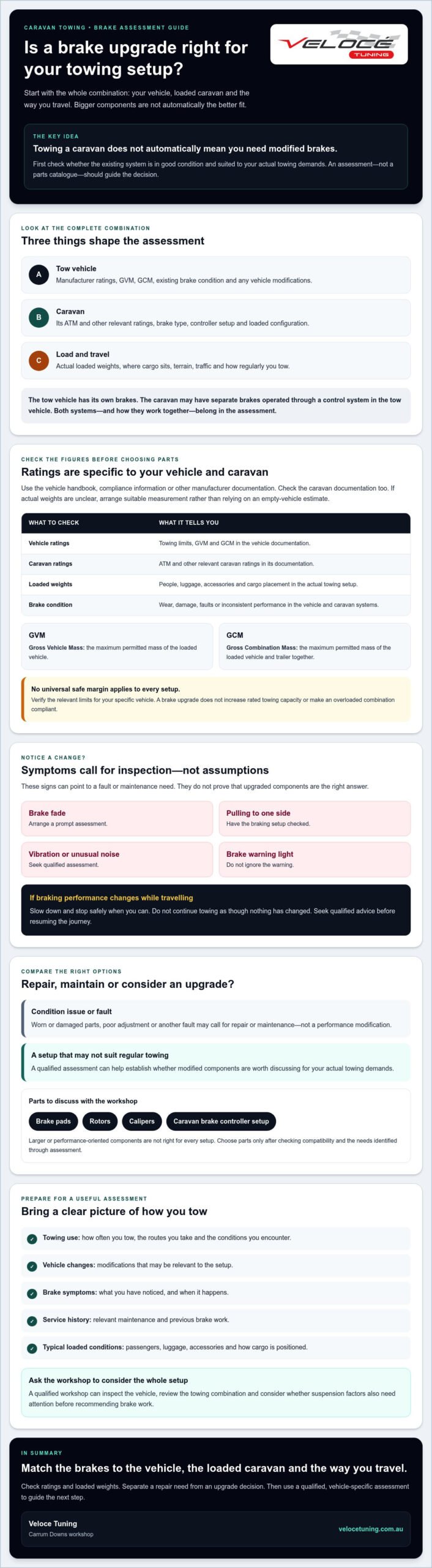
A towing brake upgrade changes the vehicle’s braking components to address needs identified through an assessment. It may be worth considering if the standard setup isn’t well suited to your regular towing demands, but towing a caravan doesn’t automatically mean you need modified brakes. A brake upgrade for towing caravan use should follow an inspection of the vehicle and its setup, not the assumption that bigger components are always better.
First, distinguish brake condition from an upgrade decision. Worn or damaged components, poor adjustment or another fault may call for repair or maintenance rather than a performance modification. Upgraded brakes also don’t increase the vehicle’s rated towing capacity or make an overloaded combination compliant. Check those limits separately.
What changes when a vehicle tows a caravan?
With a caravan attached, the combination carries more mass. Repeated braking on hills or in stop-start traffic can place extra demands on the braking systems. The tow vehicle has its own brakes, while the caravan may have separate brakes operated through a control system in the tow vehicle. A trailer brake controller is one way the driver controls caravan braking.
For example, a tow vehicle that feels composed on a solo commute may behave differently on a long descent with a loaded caravan. That calls for an assessment of the complete combination, not a promise that one component will deliver a particular stopping-distance improvement.
Signs that call for an inspection before an upgrade
Brake fade, pulling to one side, vibration, unusual noise or a brake warning light are reasons to arrange a prompt assessment. These symptoms can indicate a fault or maintenance need, but they don’t prove that upgraded components are the right answer.
If braking performance changes while you’re travelling, slow down and stop safely when you can. Don’t continue towing as though nothing has changed. Seek qualified advice before resuming the journey. An inspection can help establish whether the issue relates to condition, compatibility or a genuine need to consider modified components.
How vehicle, caravan and load determine towing brake requirements
A useful brake assessment starts with the whole combination, not a single figure in a brochure. Compare the vehicle’s ratings with the caravan’s ratings, then consider actual loaded weights, how the load is distributed and the condition of the existing brakes. This gives you a clearer basis for deciding whether a brake upgrade for towing caravan use is worth discussing with a qualified professional.
Which vehicle and caravan figures should you check?
Find the vehicle’s towing limits and mass ratings in its handbook, compliance information or other manufacturer documentation. Check the caravan’s Aggregate Trailer Mass (ATM) and loaded setup details against its documentation. If you’re unsure about actual weights, arrange suitable measurement rather than relying on an empty-vehicle estimate.
GVM, or Gross Vehicle Mass, is the maximum permitted mass of the loaded vehicle. GCM, or Gross Combination Mass, is the maximum permitted mass of the loaded vehicle and trailer together. Verify both figures, along with other relevant ratings, in the vehicle documentation. There’s no universal safe margin for every setup. Use the ratings for your specific vehicle and seek professional advice if the figures or limits aren’t clear.
| What to compare | What to check |
|---|---|
| Vehicle ratings | Towing limits, GVM and GCM in the vehicle’s documentation. |
| Caravan ratings | ATM and other relevant caravan ratings in its documentation. |
| Loaded weights | Actual towing setup, including people, luggage, accessories and cargo placement. |
| Brake condition | Signs of wear, damage, faults or inconsistent performance in the vehicle and caravan systems. |
Actual loading matters. Accessories, passengers and luggage add mass, while unevenly positioned cargo changes how the load is carried. A combination that appears suitable when empty may be different when packed for a trip. Record your typical touring load, not just the vehicle’s kerb weight.
How terrain, distance and driving style affect the assessment
Regular hill climbs and descents, stop-start traffic and long touring days can place different demands on a braking setup than occasional trips on flatter roads. The caravan’s brake type and controller setup also affect how the vehicle and trailer work together. Describe your usual routes and towing pattern when seeking advice.
Brake selection depends on the complete rated and loaded combination, its brake condition and the way it’s used. Check current requirements against authoritative Australian guidance, including relevant state or territory rules and vehicle and caravan information. A workshop assessment can help you interpret your setup. You can discuss Carrum Downs brake upgrade advice with Veloce Tuning.
Which brake upgrade options should caravan towers compare?
A suitable upgrade depends on the inspection findings, how you use the vehicle and which parts are compatible with its braking system. Pads, rotors and calipers each have a different role, and changing one doesn’t automatically mean replacing the others. A larger or performance-oriented part isn’t automatically better for towing. The right brake upgrade for towing caravan use is the one matched to your vehicle and its assessed needs.
Pads, rotors and calipers: what does each part do?
- Brake pads press against the rotor to create friction and slow the vehicle. Assess their material and suitability alongside the vehicle’s intended use.
- Rotors, also called discs, turn with the wheels and provide the surface the pads act on. Their condition, design and ability to manage heat are part of a vehicle-specific assessment.
- Calipers hold and move the pads against the rotors when the brakes are applied. Compatibility with the vehicle’s existing system matters. A caliper change isn’t a standalone shortcut to better towing performance.
These components work as a system, but an upgrade may involve only the parts that suit the vehicle. A specialist can assess material, heat management, fitment and intended use before recommending a change. Worn, damaged or unsuitable parts may need repair or replacement to restore proper function before any modification is considered.
Ask what the proposed component is intended to address, how it suits your vehicle and whether other parts need attention. If the reasoning is simply that a bigger part is “better”, ask for an explanation specific to your vehicle.
Tow-vehicle brakes and caravan brakes are not interchangeable
The tow vehicle’s pads, rotors and calipers belong to its own braking system. Caravan brakes are separate equipment on the trailer, operated through a control system in the tow vehicle where applicable. One system doesn’t replace the other. Upgraded tow-vehicle brakes aren’t a substitute for correctly functioning caravan brakes.
Include the caravan’s brake type, controller and electrical connection in the overall assessment. A qualified professional can check whether the controller and connection suit the setup and operate as intended. Don’t assume a fault or mismatch in the caravan system can be resolved by modifying the tow vehicle.
Before settling on parts, confirm that the workshop can assess your specific vehicle and proposed components. Veloce Tuning offers brake upgrades in Carrum Downs. Discuss your vehicle and towing setup first so any recommendation can be based on confirmed compatibility.
How to choose and prepare for a caravan towing brake upgrade
Good preparation helps a workshop assess the setup you actually drive, rather than an assumed one. Before buying parts or authorising installation, gather details about your towing use, vehicle and caravan, and note any symptoms you’ve noticed. A brake upgrade for towing caravan use should follow a qualified inspection and a clear explanation of why the recommended work suits your combination.
A pre-upgrade checklist for your tow vehicle
- Define your towing use. Note how often you tow, the roads and terrain you usually encounter, and whether you travel with a full touring load.
- Gather vehicle and caravan details. Record the vehicle’s make, model, year and configuration, along with relevant rating information from its documentation. Bring the caravan specifications and details of its usual loaded setup.
- Write down the history. Note brake symptoms, warning lights, service history and modifications, including changes to wheels, tyres, suspension or vehicle accessories.
- Request an inspection. Ask the workshop to assess the brakes, tyres, suspension and relevant warning systems for the vehicle and towing setup. Vehicle changes can interact, so mention any suspension work or modifications. Veloce Tuning also offers suspension and lift kits. Its suspension lift kit guidance may help explain why those changes belong in the wider setup discussion.
- Get the recommendation clarified. Ask for written details of the proposed work, component compatibility and any checks to complete after installation.
Questions to ask a brake-upgrade workshop
Ask what inspection findings support the recommendation, what alternatives were considered and whether the suggested parts suit your exact vehicle configuration and intended towing use. If the issue may be wear or a fault rather than a need for modified components, ask how the workshop reached that conclusion.
Before approving work, clarify how installation and testing will be handled, what post-fitment checks are appropriate, and whether the caravan’s brake controller or electrical connection needs separate attention. Confirm the workshop can assess your specific vehicle and setup before choosing components.
For a vehicle-specific discussion, contact Veloce Tuning about a brake upgrade assessment in Carrum Downs. Share your records and towing details so the conversation can start with the facts.
Get a vehicle-specific towing brake assessment with Veloce Tuning
A towing setup deserves more than a parts recommendation based on the vehicle model alone. Veloce Tuning is a Carrum Downs workshop offering brake upgrades. An informed discussion about a brake upgrade for towing caravan use should begin with the specific vehicle and caravan combination, followed by an inspection and confirmation that any proposed components suit that setup.
If you’re in Carrum Downs, Frankston, Patterson Lakes or nearby areas, bring details that explain how your vehicle is used. Discuss your specific vehicle and towing combination with the workshop before arranging work.
What to bring to a workshop assessment
Useful information helps the workshop understand both your vehicle’s condition and the demands of your usual trips. Gather:
- Vehicle and caravan specifications, including relevant ratings and details of the caravan’s usual loaded setup.
- Vehicle service records and information about previous brake repairs or other recent work.
- A clear description of any braking symptoms, when they occur and whether they’ve changed.
- Details of vehicle modifications and typical towing conditions, such as usual routes, terrain and load.
Ask the workshop to explain its inspection findings and recommended next steps in clear language. If a modification is suggested, ask how it relates to your specific setup and whether other issues need attention first.
Keep the braking system maintained after installation
Brake components need ongoing attention as they wear and as the vehicle’s use changes. Keep up with routine maintenance, and arrange an assessment if braking behaviour changes, you notice a warning light or new noise, or the vehicle pulls or vibrates under braking. Don’t assume an earlier upgrade means the system no longer needs inspection.
For regular vehicle maintenance, explore log book servicing in Carrum Downs. A brake change is only one part of a towing setup. The condition of the system still matters over time.
Ready to discuss your vehicle and caravan combination? Contact Veloce Tuning about a towing brake upgrade and ask about your specific setup.
Make your next towing decision with confidence
The right brake setup starts with the facts: your vehicle’s ratings, the caravan’s loaded weight, your usual towing conditions and the condition of both braking systems. A brake upgrade for towing caravan use isn’t a default fitment. It’s a decision that should follow an assessment of your specific combination. Suitable components may address an identified braking need, but they don’t increase rated towing capacity or resolve overloading.
Take your vehicle and caravan details, service history and any braking symptoms to a workshop before choosing parts. Veloce Tuning is a Carrum Downs automotive workshop offering brake upgrades and installation. Recommendations should follow an inspection and confirmation that the work suits your vehicle.
Veloce Tuning serves drivers in Carrum Downs, Frankston, Patterson Lakes, Mornington, Skye, Seaford and Sandhurst. Contact the workshop to discuss your towing brake setup and the next step for your vehicle.
Frequently Asked Questions
Is a brake upgrade necessary for towing a caravan?
It depends on your tow vehicle, caravan, loaded combination, brake condition and intended use. Some vehicles may need maintenance rather than modified components; others may benefit from a professionally assessed brake upgrade for towing caravan use. Check the manufacturer’s ratings and have the complete setup inspected before choosing parts. An upgrade can’t increase the vehicle’s rated towing capacity or make an overloaded combination safe, so confirm the weights and limits first.
Are bigger brakes better for towing a caravan?
No, bigger brakes aren’t automatically better for towing. Component size alone doesn’t establish whether parts suit your vehicle’s configuration, condition or intended use. An incompatible change may not address the actual issue. Ask a qualified workshop to inspect the system and explain the findings behind its recommendation. Also confirm that the caravan brakes and controller are operating as intended, since changing the tow vehicle’s brakes doesn’t resolve a fault in the caravan system.
How do I know if my tow vehicle needs a brake upgrade?
Brake fade, pulling, vibration, unusual noise or a warning light are reasons to arrange an inspection, not proof that an upgrade is required. The cause may be wear or a fault that needs attention rather than different components. Bring the vehicle and caravan specifications, loaded setup details and service history so the assessment reflects your real towing conditions. If braking changes while driving, stop safely and seek qualified advice before continuing.
Will upgraded brakes reduce my caravan stopping distance?
No upgrade should be treated as a guaranteed way to reduce stopping distance. Braking depends on both vehicle and caravan systems, their condition, the load, tyres, road surface and speed. A suitable modification may address an identified limitation, but whether it’s appropriate requires an assessment of your combination. Keep the vehicle and caravan within their applicable ratings, maintain both braking systems and follow qualified advice rather than relying on an assumed performance gain.
Do I need a brake controller when towing a caravan?
Whether a controller is needed depends on the caravan’s braking system, tow vehicle configuration and applicable requirements. A controller coordinates some types of caravan brakes with the towing vehicle, but the correct arrangement must be confirmed for your specific combination. Check the vehicle and caravan documentation, then ask a qualified professional to verify controller operation, wiring and compatibility before travelling. Don’t assume another vehicle’s setup will suit your own.
Can I upgrade my tow vehicle brakes without changing the caravan brakes?
The tow vehicle and caravan have separate braking systems, but both contribute to the performance of the towing combination. Vehicle-only work may be appropriate if an inspection supports it, but the decision should account for the caravan’s brake type and the condition of both systems. An upgrade to the tow vehicle isn’t a substitute for functioning caravan brakes. Have the combination assessed and check current requirements that apply to your setup.
Should I upgrade suspension and brakes together for caravan towing?
Not necessarily. The appropriate work depends on the vehicle’s condition, ratings, existing modifications and towing use. Suspension changes can affect the overall vehicle setup, so raise them during a brake assessment rather than assuming both upgrades are needed. Veloce Tuning offers brake upgrades and suspension work at its Carrum Downs workshop. Drivers from Frankston, Patterson Lakes, Mornington, Skye, Seaford and Sandhurst can discuss their vehicle combination with the workshop.