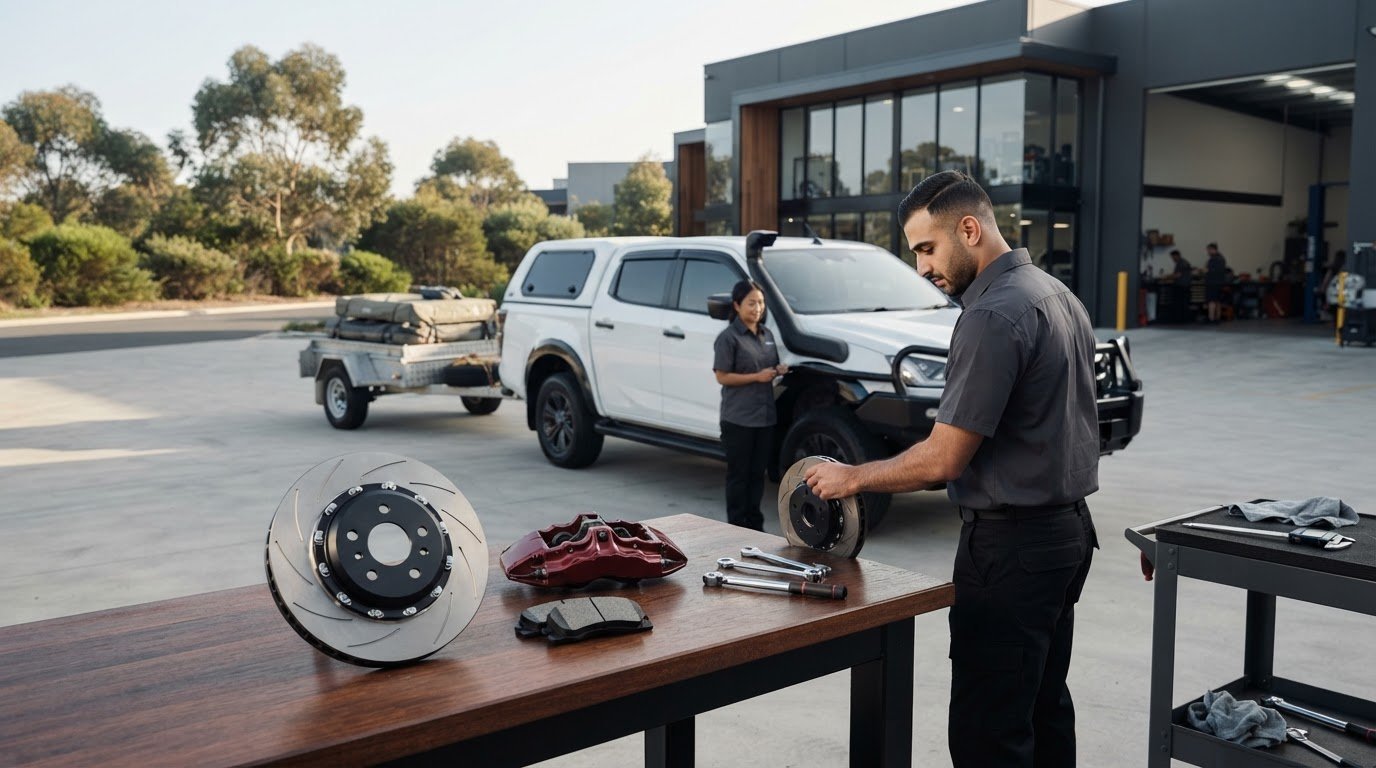
The biggest brake upgrade isn’t automatically the right one for your vehicle. Add a bull bar, canopy, touring gear or a regular trailer load and the demands on your brakes can change. That doesn’t mean every concern calls for a larger or more complex setup. If you’re researching heavy duty brake upgrades Carrum Downs, start by matching the braking system to your vehicle’s actual load and how you drive.
It can be difficult to know whether you need a repair or an upgrade, or how to compare pads and rotors with broader system changes. This guide explains which components may suit different uses, what vehicle and load details to bring to a workshop assessment, and what to ask before choosing a solution. It also covers how to find a local provider who makes a vehicle-specific recommendation rather than assuming one upgrade suits every setup. Veloce Tuning’s Carrum Downs workshop offers brake enhancements, giving local drivers a place to discuss options with a team led by a head engineer. The aim is to make a considered choice based on your vehicle and the work it actually does.
Key Takeaways
- Distinguish a brake fault that needs attention from a working system facing greater demands, such as regular towing or heavy work loads.
- Understand how pads, rotors, callipers and brake fluid contribute, and why an upgrade may involve selected components rather than a complete system change.
- Compare standard replacements, selected component upgrades and broader system changes against your driving needs, including potential trade-offs.
- Before discussing heavy duty brake upgrades Carrum Downs, note your vehicle’s make, model, year, modifications, usual loads and any recent brake symptoms.
- Ask a workshop to explain how its recommendation reflects your vehicle, inspection findings and intended use before agreeing on next steps.
When do heavy-duty brake upgrades make sense for Carrum Downs drivers?
A brake fault needs diagnosing. A working brake system facing demands beyond its usual workload may warrant an upgrade assessment. That distinction matters. Replacing worn or faulty components can address a repair need, while heavy duty brake upgrades Carrum Downs drivers consider should be matched to how the vehicle is actually used. An upgrade isn’t an automatic fix for noise, vibration or poor braking, and heavier-duty parts don’t guarantee shorter stopping distances.
Heat is one factor to discuss, particularly if you regularly tow or carry heavy loads. Repeated braking under load can contribute to what brake fade is, a reduction in braking effectiveness associated with heat. The right response depends on the vehicle and its condition, not just the type of parts fitted.
Which driving demands can justify a brake assessment?
Consider your vehicle type, usual load, towing frequency and driving conditions. A car that tows occasionally may have different needs from a work vehicle that carries heavy gear day after day. Frequent steep routes, sustained loaded driving or performance-focused use can also change the demands placed on the brakes. Share your regular driving pattern with a workshop rather than assessing the vehicle by its accessories alone.
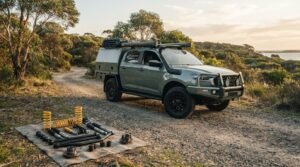
For a 4WD, explain how it’s set up and used, including whether towing or loaded touring is routine. The assessment should focus on that specific vehicle and its demands. No single upgrade suits every 4WD.
Is a brake upgrade the answer to noise or poor braking?
Not necessarily. Pulling to one side, vibration, unusual noise, a warning light or a change in pedal feel are reasons to arrange an inspection. These symptoms don’t prove that an upgrade is needed, and they can’t be diagnosed reliably from a description alone. A qualified workshop can assess the system and advise whether the issue calls for repair, replacement or further consideration.
Start by checking the condition of the existing brakes. If they’re worn or faulty, the immediate priority is understanding and addressing the fault. If the system is working but your regular load or driving has changed, ask whether a vehicle-specific upgrade assessment makes sense. That keeps the decision grounded in inspection findings and intended use, rather than the assumption that heavier-duty parts automatically solve every braking concern.
What does a heavy-duty brake upgrade change in the braking system?
A heavy-duty brake upgrade is a vehicle-specific change to braking components, selected to suit the vehicle’s intended use. It isn’t a fixed package that automatically replaces every part. Depending on the vehicle, its condition and the loads it handles, a recommendation might focus on one area or consider several components together.
Each component has a different job. Brake pads provide the friction material, while rotors are the surfaces the pads press against. Callipers apply pressure to bring them together, and brake fluid transfers force through the hydraulic system. Changing one component can affect how the system works as a whole, so compatibility matters more than choosing the largest or most heavy-duty part available.
How do pads, rotors and callipers contribute?
Pads and rotors work together to create friction and manage heat during braking. Callipers apply pressure to the pads, but larger callipers aren’t automatically better for every vehicle. Parts need to be compatible with the vehicle and its existing braking setup. Their condition matters too. An upgrade recommendation should account for what’s already fitted rather than treating a component in isolation.
That’s why an assessment should establish what the vehicle needs before settling on a change. If you’re comparing heavy duty brake upgrades Carrum Downs options, ask the workshop which components it recommends, why they suit your use and how compatibility will be considered.
Why assess tyres, ABS and brake fluid as well?
Braking depends on more than the brake components themselves. Tyres provide contact with the road, so their grip affects how braking force is transmitted. Vehicle mass and load also shape the demands on the system. Suspension changes can alter the vehicle setup and should be part of the wider picture. An assessment that ignores these factors may miss important context.
The workshop should also consider the vehicle’s anti-lock braking system (ABS) and any other factory systems when assessing changes. Brake fluid condition and the existing system are inspection points, not automatic upgrade items. The aim is to understand how the parts work together, not to add components without a vehicle-specific reason.
For heavy vehicles, the National Heavy Vehicle Regulator provides heavy vehicle standards guides. Check whether its guidance applies to your vehicle and circumstances. If you’re weighing up a change, you can also discuss your vehicle and intended use with Veloce Tuning’s Carrum Downs workshop, which offers brake enhancements. A considered recommendation starts with the whole setup.
How do brake upgrade options compare for towing, work and everyday driving?
There isn’t one brake setup that suits every driver. A vehicle used for everyday commuting has different demands from one that regularly tows, carries work gear or is driven hard for performance. Compare options by the use they’re intended to address, then ask the workshop to explain the reasoning for your vehicle.
Use this guide to frame the discussion, not as a parts prescription. The right recommendation depends on inspection findings and the full vehicle setup.
| Option | Intended use | Assessment focus | Potential trade-off | Ask the workshop |
|---|---|---|---|---|
| Standard replacement parts | Everyday driving or replacing worn components | Condition of existing brakes and whether replacement parts suit the vehicle | Restoring the standard setup may not address demands from regular heavy loads | Is this a repair or replacement, and will it suit my usual use? |
| Selected component upgrade | A specific concern or changed use, such as regular towing | Which component needs attention and how it works with the rest of the system | Changing one part may not resolve an issue elsewhere | Why this component, and what else have you checked? |
| Broader system review | Repeated demanding use, commercial loads or performance-focused driving | Vehicle mass, usual load, existing components and overall compatibility | A wider scope may not be necessary if a targeted change is suitable | What supports a broader change over a targeted one? |
What should towing and loaded work vehicles prioritise?
For a towing vehicle or work ute, describe its usual load, how often it’s carried, towing frequency and the condition of the existing brakes. An occasional trailer trip and a vehicle that spends most days loaded are different use cases. The assessment should reflect the regular pattern, not just a single maximum-load scenario. Ask for the complete setup to be considered, not towing capacity in isolation. A brake upgrade does not change the vehicle’s legally rated towing or load capacity.
When is a broader brake-system upgrade worth discussing?
Repeated demanding use can justify asking whether a broader review is appropriate, but it doesn’t automatically mean every component needs changing. A targeted component change may suit the issue; in other cases, a wider assessment may better account for the vehicle and its existing parts. Pads alone, for example, won’t necessarily address a concern elsewhere in the braking system. Ask what inspection findings support the recommendation and what alternatives were considered.
For drivers researching heavy duty brake upgrades Carrum Downs, a clear conversation about everyday driving, towing and loaded work helps a workshop compare options without assuming one setup fits everyone.
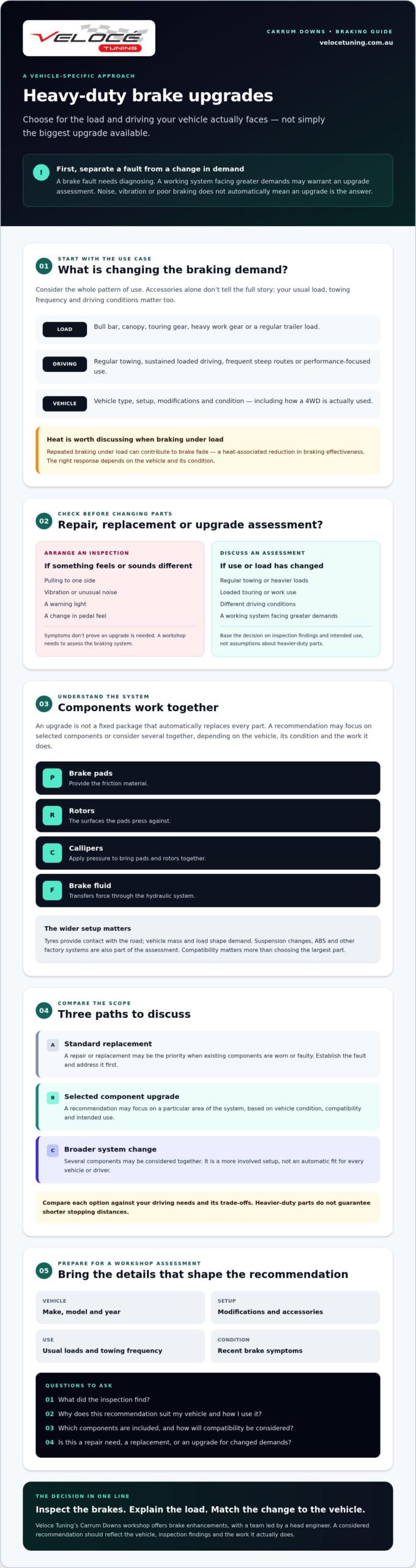
What should you ask a brake-upgrade workshop in Carrum Downs?
A useful workshop conversation starts with how you drive, not a particular part or package. Describe the vehicle’s everyday role, share its details and ask for an inspection before comparing recommendations. This gives the workshop context to assess the current system and explain whether the next step is repair, replacement or an upgrade.
Bring a simple record of:
- Make, model and year, plus existing modifications.
- Typical passengers, cargo and towing loads, and how often you carry or tow them.
- Any brake symptoms, including when they occur and whether a warning light has appeared.
- Relevant service history and details of previous brake work, if available.
What information helps a workshop assess your vehicle?
Be specific about your usual driving pattern. For example, explain whether the vehicle is loaded daily, tows occasionally or regularly travels on steep routes. Note when you experience noise, vibration, pulling or a change in pedal feel, rather than trying to diagnose the cause. Accurate details help the workshop inspect the vehicle in context, but they don’t replace an assessment.
Which questions make recommendations easier to compare?
Ask the workshop to connect its recommendation to what it found during inspection. These questions can help clarify the scope:
- Which components do you recommend changing, and what inspection findings support that choice?
- How will the proposed parts suit my vehicle, existing setup and usual loads?
- What does the work include, and are there compatibility considerations?
- Are any follow-up checks or bedding-in steps required, and what should I expect after the work?
- If you mention roadworthiness, modification or compliance requirements, which official guidance applies to my vehicle and proposed changes?
That last question is worth asking before approving modified components. Requirements can depend on the vehicle and the change, so don’t rely on a general statement instead of checking the relevant, current Victorian guidance.
Compare recommendations by their reasoning, not just by the number of parts involved. A clear explanation should link the vehicle’s condition, your intended use and the proposed work, while identifying anything that needs confirmation before proceeding.
If you’re in Carrum Downs and want to discuss a vehicle-specific brake assessment, contact Veloce Tuning about brake upgrades. Share your vehicle details and intended use so the conversation starts with the right context.
Arrange a vehicle-specific heavy-duty brake assessment with Veloce Tuning
Choosing a brake upgrade is a considered decision. The right direction depends on the vehicle, its current setup and what it’s expected to do. Veloce Tuning is a Carrum Downs automotive workshop offering brake enhancements alongside mechanical and performance services. Its head engineer and team of automotive enthusiasts can discuss your requirements and help you understand what information is needed to consider a vehicle-specific recommendation.
You don’t need to arrive with a preferred product or a predetermined parts list. Start with the demands you want your vehicle to handle, then ask what assessment and next steps are appropriate. The aim is to make an informed choice, not assume a particular package or outcome before the vehicle has been considered.
What to expect when discussing a brake upgrade
Be ready to describe the vehicle’s make, model and year, any modifications, its usual passenger or cargo load, and whether you tow. Explain why you’re considering an upgrade, such as a change in use or a concern with the current brakes. If you’ve noticed a symptom, share when it occurs and any relevant service history. These details help frame the conversation.
Ask how the existing braking system will be assessed before components are recommended. A suitable proposal should relate the vehicle’s condition and intended use to the suggested work. Product, fitment and availability details need to be confirmed for your specific vehicle. Don’t assume a component that suits one model will suit another.
Take the next step from Carrum Downs
Whether you’re based in Carrum Downs or travelling from nearby Frankston, Seaford or Patterson Lakes, make your first enquiry straightforward: have your vehicle details and typical loads on hand, and explain what you want the brakes to handle. You can ask what information to provide next and how to proceed with a vehicle-specific assessment.
For heavy duty brake upgrades Carrum Downs drivers can discuss with a local workshop, contact Veloce Tuning about your vehicle and intended use. The conversation starts with your setup, then moves to options that can be considered for it.
Contact Veloce Tuning about a brake assessment to discuss your requirements and next steps.
Choose brakes that match the way you drive
The right brake decision starts with your vehicle’s condition and the demands you place on it. A fault may need repair rather than an upgrade, while regular towing, heavy loads or performance-focused driving can make a vehicle-specific assessment worthwhile. Pads, rotors and other components should be considered as part of a compatible system, not selected in isolation.
If you’re comparing heavy duty brake upgrades Carrum Downs, bring your vehicle details, modifications, usual loads and any brake symptoms to the discussion. Ask what the inspection found, which changes are recommended and why they suit your use.
Veloce Tuning is based in Carrum Downs and offers brake enhancements. Its workshop is led by a head engineer and supported by a team of automotive enthusiasts, ready to discuss your vehicle and requirements without assuming one solution fits all.
Talk to Veloce Tuning about a vehicle-specific brake assessment, and take the next step towards a setup considered for the work your vehicle does.
Frequently Asked Questions
Are heavy-duty brake upgrades worth it for a car that tows regularly?
They may be worth assessing if regular towing places greater demands on your vehicle’s brakes. The right option depends on your vehicle, its current brake condition, typical trailer and cargo loads, and how often you tow. An upgrade isn’t automatically needed, and it won’t increase your vehicle’s rated towing capacity. Ask a workshop to inspect the existing system and explain how any recommendation relates to your actual towing use.
Can I upgrade brake pads without changing the rotors?
Possibly, but check the rotors’ condition and compatibility with the proposed pads first. A pad change alone may be suitable in some circumstances, while worn, damaged or unsuitable rotors may need attention too. Different pads can also affect braking feel and operation. Ask the workshop to inspect the existing parts and explain why the recommended combination is appropriate for your vehicle and intended use.
How do I know whether my vehicle needs a brake upgrade or a repair?
An inspection is needed to distinguish a repair from an upgrade. Noise, vibration, pulling, a warning light or a changed pedal feel can signal a concern, but none proves that an upgrade is required. If a component is worn or faulty, the priority is identifying the cause and addressing it. An upgrade may be worth discussing if the system is working but your regular loads or driving demands have changed.
Will a heavy-duty brake upgrade affect ABS or other factory systems?
It can be a consideration, so the workshop should assess ABS and other factory systems when evaluating component changes. Compatibility depends on the vehicle and the proposed parts, not just whether a component is described as heavy-duty. Ask which systems have been considered, how fitment will be checked and whether follow-up checks are required. Don’t assume a change is suitable simply because it fits physically.
What should a workshop check before recommending a brake upgrade?
A workshop should consider your vehicle details, existing brake condition, modifications and intended use before recommending changes. Explain your usual passengers, cargo or towing loads, how often you carry them, and any symptoms or recent brake work. Ask which components the recommendation involves, what inspection findings support it, how compatibility will be addressed and whether follow-up checks are needed. This gives you a clearer basis for comparing options.
Can a brake upgrade increase my vehicle’s legal towing capacity?
No, a brake upgrade by itself doesn’t authorise you to tow beyond the vehicle’s applicable rated capacity. Brakes are only one part of a vehicle and trailer setup, and changing components shouldn’t be treated as approval to exceed a rating. Check your vehicle’s manufacturer information and seek advice from an appropriate authority if you’re unsure how a modification affects your vehicle’s requirements.
Where can I get heavy-duty brake upgrades near Carrum Downs?
Veloce Tuning is a Carrum Downs workshop offering brake enhancements, led by a head engineer and supported by a team of automotive enthusiasts. Drivers in Carrum Downs, Frankston, Patterson Lakes, Mornington, Skye, Seaford and Sandhurst can discuss their vehicle and intended use with the workshop. A suitable recommendation depends on the vehicle details and inspection findings, so ask what assessment and next steps are appropriate for your setup.