The cheapest software flash is almost always the calibration that costs you the most down the track. When you begin researching how much does an ECU remap cost in Australia, the wild spread between workshop quotes can be genuinely bewildering. You already know the irritation of sluggish factory throttle response, lazy passing power, and hollow flat spots under load. Yet, the fear of melting a piston or torching a turbocharger with an untested generic file is entirely justified; catastrophic engine failures aren’t cheap. You want crisp pedal response and muscular torque delivery without compromising mechanical reliability.
This guide unpacks the real factors driving ECU remapping costs in Australia so you can invest wisely in genuine performance. We break down the stark differences between generic off-the-shelf files and bespoke live dyno calibration, detailing what specialised labour, in-depth vehicle health diagnostics, and local thermal testing actually involve. Here is how to look past the marketing noise, protect your investment, and evaluate workshop quotes with unshakeable confidence.
Key Takeaways
- Learn how much does an ECU remap cost in Australia when factoring in specialised engineering hours, pre-tune diagnostic testing, and tailored dyno development.
- Uncover the critical reliability differences between risky, generic off-the-shelf flash files and bespoke live calibrations tuned to your engine’s individual health.
- Understand how Stage 1 calibrations unlock latent potential on factory components, whilst Stage 2 software coordinates with upgraded intercoolers and free-flowing exhausts.
- Identify the real-world performance returns for Australian driving, including muscular low-end towing torque, crisper throttle response, and lower thermal strain under heavy loads.
- Equip yourself with an essential buyer’s checklist to confirm your chosen workshop uses dedicated chassis dynamometers and conducts thorough live data logging.
What Determines the Cost of an ECU Remap in Australia?
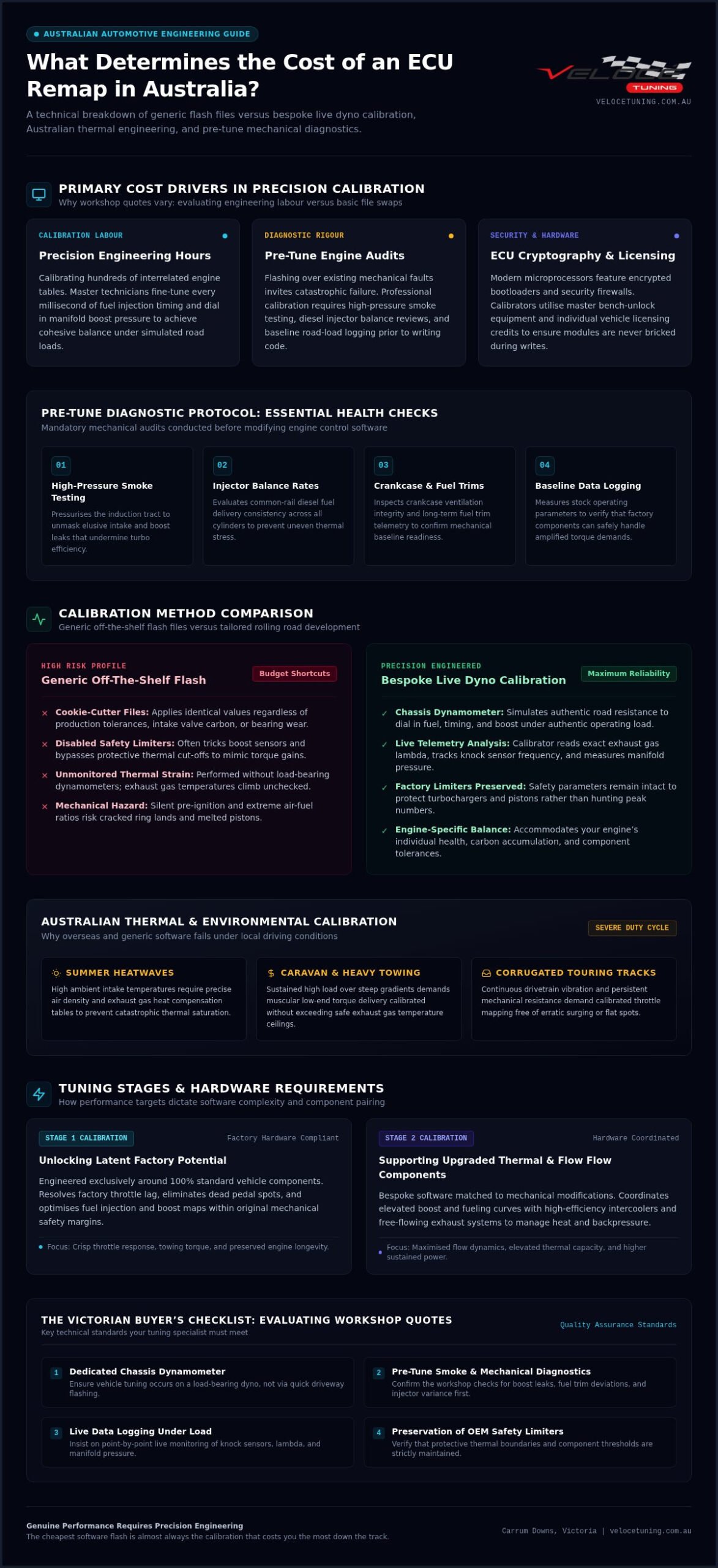
Tuning isn’t just a high-tech file swap; it’s a meticulous calibration of thermodynamics, fluid dynamics, and mechanical tolerances. When assessing how much does an ECU remap cost in Australia, you aren’t paying for raw computer code. You’re investing in the precision hours of an experienced calibration technician. A master tuner examines how your vehicle breathes, commands boost, and injects fuel under simulated road loads. They adjust hundreds of interrelated engine tables; every millisecond of injection timing and pound of manifold pressure is dialled into a cohesive balance. Precision calibration demands time, extensive technical expertise, and heavy equipment overheads. That diligence directly shapes workshop rates.
Operating conditions in Australia amplify these requirements. Scorching summer ambient temperatures, relentless corrugated touring tracks, and heavy caravan towing push drivetrains to their thermal limits. Calibrating an engine control unit requires careful compensation tables for intake air temperatures and exhaust gas heat. The foundational principles of chip tuning and ECU remapping demand that safety parameters protect pistons and turbochargers under extreme local stress, rather than simply hunting for aggressive peak dyno numbers.
Pre-Tune Diagnostics and Mechanical Health Checks
Flashing software onto an unhealthy engine invites mechanical disaster. Dedicated workshops like Veloce Tuning in Carrum Downs run extensive mechanical health audits before modifying a single line of software code. Technicians execute high-pressure smoke tests to unmask elusive intake boost leaks, evaluate common-rail diesel injector balance rates, inspect crankcase ventilation systems, and review long-term fuel trims. Baseline data logging establishes whether current mechanical components can handle increased torque demands. Any underlying boost leak, clogged sensor, or failing fuel pump must be rectified first. That diagnostic rigour prevents premature component failure.
ECU Architecture, Encryption, and Licensing Protocols
Modern vehicle security also dictates quote complexity when asking how much does an ECU remap cost in Australia. Late-model microprocessors feature sophisticated cryptographic firewalls and locked bootloaders that prevent simple OBD-II port flashing. Calibrators must remove the module to execute delicate bench unlocks using specialised master communications hardware. Furthermore, licensed tuning platforms demand individual vehicle credits to maintain secure flashing protocols, ensuring your sensitive vehicle electronics are thoroughly protected against bricking throughout the entire calibration process.
Generic Flash Files vs. Custom Dyno Tuning: Price vs. Performance
Every engine tells a unique mechanical story. Production tolerances vary, carbon deposits accumulate differently across intake valves, and wear patterns diverge across turbocharger bearings. Despite these mechanical realities, generic off-the-shelf flash tunes treat every engine like an identical twin. These cookie-cutter files write pre-set values across fuel and timing tables without validating actual operating parameters. When calculating how much does an ECU remap cost in Australia, choosing between a cheap file flash and tailored rolling road development represents the divide between risking your engine and securing lasting performance.
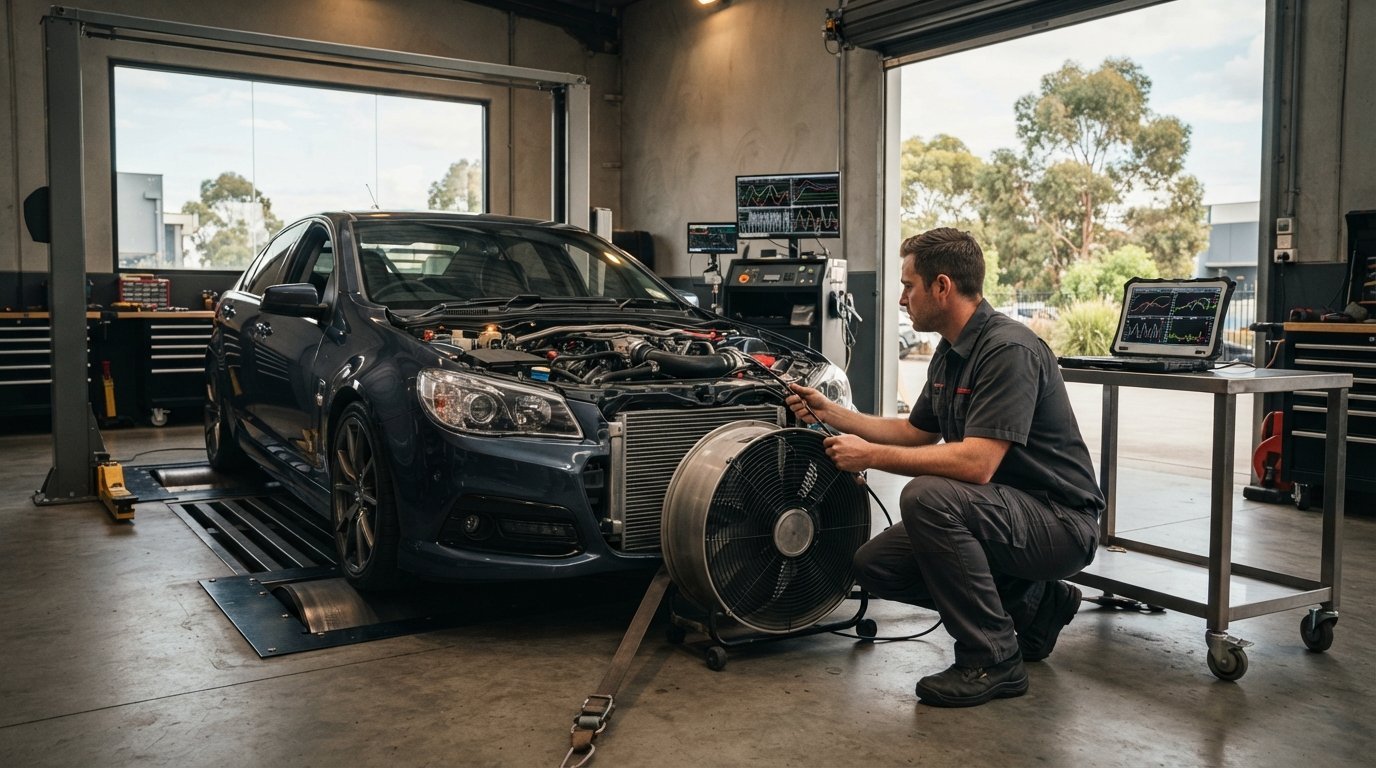
Real-time mechanical feedback changes everything. Investing in bespoke custom dyno tuning pairs your vehicle with a load-bearing chassis dynamometer to simulate authentic road resistance. The calibrator reads exact exhaust gas lambda, monitors knock sensor frequency, and measures manifold pressure point by point. Real telemetry drives every decision. An upfront saving on an unverified file quickly evaporates if an unmonitored air-fuel ratio torches a piston; true value lies in precision engineering that protects your hardware while transforming drivability.
The Hidden Pitfalls of Budget Mobile Flash Tunes
Convenient driveway flashing often hides severe mechanical shortcuts. Low-cost files frequently disable factory safety limiters, tricking boost sensors to force artificial torque spikes that strain drivelines. Without a chassis dyno to load the engine, exhaust gas temperatures climb unchecked under heavy acceleration. Destructive pre-ignition occurs silently inside the cylinders, cracking ring lands before a driver ever notices a warning light.
Bespoke Dyno Calibration: The Master Craftsman Approach
Dedicated chassis dyno tuning measures how your specific modifications breathe. Calibrators sculpt progressive torque curves that respect transmission clutch packs and internal bearings, matching power delivery to your tyre diameter and gear ratios. For drivers seeking this exact mechanical harmony, partnering with master craftsmen who deliver precision custom ECU tuning ensures peak power never compromises long-term thermal reliability.
Evaluating how much does an ECU remap cost in Australia ultimately hinges on whether you want a generic electronic band-aid or a finely honed calibration. Bespoke dyno tuning guarantees that heightened throttle response and muscular mid-range power work within safe engineering thresholds across every kilometre.
Tuning Stages Explained: How Performance Targets Impact Price
Performance builds follow an escalating engineering ladder. The scope of your build dictates the bench time, logging requirements, and sensor monitoring needed on the rolling road. When asking how much does an ECU remap cost in Australia, the target stage serves as the primary technical baseline. Unlocking modest reserves within factory component tolerances differs fundamentally from coordinating large-diameter induction pipes, upgraded high-pressure fuel systems, and high-strung turbochargers. Every increment in mechanical complexity multiplies the calibration labour required to ensure seamless reliability.
All software modifications must also operate within national environmental and roadworthy frameworks. Professional tuning respects emissions limits outlined by the Australian Design Rules, ensuring heightened output does not bypass essential tailpipe standards or compromise vehicle legality under state transport guidelines.
Stage 1 Calibrations: The Pure Software Transformation
Stage 1 focuses entirely on software refinement without mechanical alterations. Technicians optimise wastegate duty cycles, sharpen fly-by-wire pedal curves, and reshape torque maps to extract safe reserves from standard factory hardware. It serves as the ultimate gateway to responsive performance. Lazy low-speed dead spots vanish. Mid-range passing punch arrives with immediate, muscular authority, transforming daily drivability while preserving long-term component longevity.
Hardware Prerequisite Investments for Stage 2 and Beyond
Advancing past Stage 1 demands dedicated thermal and mechanical hardware to sustain elevated performance:
- Exhaust Gas Evacuation: Free-flowing downpipes and high-flow sports catalytic converters reduce turbocharger backpressure, lowering exhaust gas temperatures.
- Charge Air Cooling: Enlarged bar-and-plate intercoolers counter intense heat soak during extended high-load pulls and outback touring.
- Fuel Delivery Hardware: Uprated high-pressure fuel pumps and precision injectors maintain commanded rail pressures at high engine speeds.
Synchronising Transmission Control Units (TCU) with Engine Output
Generating massive engine torque means nothing if your gearbox cannot harness the twist. Factory transmission computers use rigid internal torque limits. When an engine exceeds those factory boundaries, the gearbox fights back by cutting throttle, slipping clutches, or short-shifting erratically. Calibrating the transmission control unit elevates clutch pack clamping pressures, tightens shift transition speeds, and harmonises shift points with your newly sculpted torque curve.
For vehicles running complex dual-clutch systems, gearbox calibration prevents excessive friction wear and clutch burn. Integrating an engine remap with specialised DSG mechatronic repair Melbourne expertise ensures your electro-hydraulic valve bodies and clutch assemblies handle aggressive torque spikes smoothly, delivering bulletproof durability on both the street and open highway.
Factor these powertrain requirements in when calculating how much does an ECU remap cost in Australia. Matching software depth to mechanical upgrades guarantees exceptional drivability without breaking driveline components.
The True Return on Investment: Fuel Economy, Towing, and Reliability
Calculating the true value of performance software extends far beyond the initial dyno session. When evaluating how much does an ECU remap cost in Australia, smart vehicle owners look at the long-term return on investment across reduced fuel consumption, relaxed touring capability, and component longevity. A vehicle recalibrated for optimal thermal efficiency converts fuel into motive force rather than wasted exhaust heat. By reshaping low-end torque delivery, an engine no longer requires wide throttle openings to maintain speed, unlocking tangible range extensions explored in detail through ECU tuning for fuel economy Melbourne.
Diesel Touring and Heavy Towing Dynamics
Factory turbo-diesel calibrations often leave modern utes and four-wheel drives starved of mid-range torque. Hitching a three-tonne off-road caravan exacerbates the issue, forcing automatic transmissions into frantic gear hunting on standard highway inclines. Bespoke remapping fattens the torque curve directly between 1,500 and 2,800 RPM. This broad plateau allows your vehicle to hold taller gears cleanly up steep ascents with lower pedal input. Exhaust gas temperatures remain tightly regulated through custom thermal limiters, reducing mechanical fatigue on long-haul outback journeys.
Protecting Expensive Exhaust and Aftertreatment Systems
Amateur tuning files present massive financial risks to modern emissions hardware. Crude maps often inject excessive fuel down low, generating thick, unburnt particulate soot that rapidly saturates and chokes the exhaust filter. If thermal stress causes irreversible blockages, drivers often require specialised DPF replacement Melbourne solutions to restore proper exhaust flow. Clean, balanced combustion cycles ensure factory soot regeneration operates smoothly, protecting sensitive pressure sensors and safeguarding turbocharger bearings.
Sustaining these performance gains requires consistent mechanical discipline. Pairing custom calibration with rigorous log book service Carrum Downs regimes protects internal tolerances and factory warranties through fresh, high-grade lubricants and clean filtration. When you measure how much does an ECU remap cost in Australia against the thousands saved in avoided breakdowns, refined drivability, and lower fuel bills, precision dyno development pays for itself. Ready to transform your vehicle’s capability? Schedule your bespoke dyno calibration session with the craftsmen at Veloce Tuning today.
How to Choose an ECU Remap Specialist in Victoria: A Buyer’s Checklist
Selecting a calibration partner requires the same calculated scrutiny you apply to the mechanical components themselves. When comparing quotes to discover how much does an ECU remap cost in Australia, the real differentiator is workshop infrastructure and engineering accountability. Any mobile operator can plug an OBD dongle into your dash in a suburban driveway. Real dyno calibration, however, demands high-capacity rolling roads, precision diagnostic rigs, and master technicians who write software around mechanical reality rather than blind luck.
Never hand over your keys without auditing the workshop’s equipment and testing processes. Demand proof of an in-house all-wheel-drive or two-wheel-drive load-bearing dynamometer. Ensure the calibrator writes bespoke tables tailored to your individual engine rather than dumping a pre-packaged overseas file that fails to account for regional fuel qualities or scorching summer conditions.
Essential Technical Questions to Ask Your Tuner
Separate true master calibrators from software resellers by asking targeted, technical questions during your initial enquiry:
- Live Telemetry: Do you record real-time data logs of ignition knock retard, manifold boost deviation, rail pressure, and fuel trims under simulated road resistance?
- Documented Verification: Will you supply comprehensive before-and-after dyno printouts displaying genuine power and torque curves across the entire rev range?
- Environmental Calibration: How do your software maps adjust ignition advance and charge-air thresholds for Australian 98 RON fuel and intense 40°C ambient heat?
- Ongoing Reversibility: Can you store a complete baseline backup of my factory software and revert the vehicle to standard if needed?
The Veloce Tuning Standard in Carrum Downs
Veloce Tuning bridges the divide between meticulous European performance engineering and punishing Australian driving demands. Operating out of a cutting-edge facility in Carrum Downs, our technicians bring decades of enthusiast dedication to performance builds, transmission care, and diagnostic evaluations. We serve performance motorists across Frankston, Patterson Lakes, and the Mornington Peninsula who demand unmatched dynamometer precision.
Understanding how much does an ECU remap cost in Australia means looking past bargain-basement figures to choose verifiable mechanical craftsmanship. When you demand sharp throttle response, refined power curves, and unflinching reliability, invest in calibrations developed by mechanics who live and breathe high performance.
Unlock Your Vehicle’s True Potential with Confidence
Investing in your vehicle’s performance isn’t about hunting down the lowest sticker price; it’s about unlocking responsive power, thermal balance, and lasting reliability. As you weigh how much does an ECU remap cost in Australia, remember that genuine value stems from bespoke dyno development, comprehensive pre-tune mechanical diagnostics, and strict component safeguards. Generic flash files gamble with engine longevity, but precision calibration delivers crisp throttle response, muscular towing torque, and refined highway economy without compromise.
At Veloce Tuning in Carrum Downs, our European-trained technical calibration specialists blend motorsport passion with engineering discipline. Equipped with a state-of-the-art in-house dynamometer diagnostic and testing facility, we provide complete mechanical backing for drivers across Frankston, Mornington, and southeastern Melbourne. We don’t settle for guesswork, and your pride and joy shouldn’t either. Ready to transform your daily commute or next outback expedition? Experience the raw thrill of bespoke dyno calibration at Veloce Tuning and enjoy performance engineered specifically for your journey.
Frequently Asked Questions
Will an ECU remap void my new car manufacturer warranty in Australia?
A dealership cannot automatically cancel your entire vehicle warranty under Australian Consumer Law simply because an ECU has been modified. However, if a major mechanical driveline failure occurs, the manufacturer can legally deny coverage if diagnostic logs prove non-standard software caused the breakdown. Modern onboard computers track flash counter histories and altered checksums, meaning technicians immediately identify calibration modifications during dealer servicing.
Can a professional ECU remap be reversed back to factory settings?
Yes, reputable performance workshops always read and store a complete binary backup of your original factory software before making alterations. Technicians can re-flash this original calibration back onto the processor whenever required, returning torque limiters, boost targets, and injection timing to showroom specifications. This reversibility gives vehicle owners peace of mind when preparing to sell the car or completing dealership updates.
What is the mechanical difference between a plug-in chip and an ECU remap?
A plug-in tuning module intercepts and distorts physical electrical signals between engine sensors and the computer, tricking the factory brain into dumping extra fuel or boost blindly. An ECU remap rewrites the internal calibration maps directly. It recalibrates hundreds of underlying tables, maintaining active knock mitigation, electronic throttle control, and critical exhaust temperature safeguards.
Does an ECU remap make my car illegal under Australian roadworthy rules?
A calibration remains completely street-legal provided it maintains ADR tailpipe emission requirements and keeps power gains within legal limits. Under Victorian regulations, power increases exceeding 20 percent above manufacturer figures require engineering certification through a VASS engineer. Additionally, deliberately removing emissions hardware like diesel particulate filters or catalytic converters remains strictly illegal for road-registered vehicles across Australia.
How long does a proper custom ECU remap take to complete?
A thorough, professional dyno calibration typically requires four to eight hours of dedicated workshop time. The process encompasses physical smoke testing, initial baseline runs, real-time table adjustments on a loaded rolling road, and comprehensive cool-down verification logs. Rushed driveway services take less than thirty minutes, but they skip the crucial diagnostic steps that guarantee long-term mechanical safety.
Why do quotes for European vehicle tuning often differ from Japanese utes?
Microprocessor complexity and controller access protocols explain why pricing structures vary between vehicle platforms. When asking how much does an ECU remap cost in Australia, late-model European platforms usually feature encrypted Bosch or Continental controllers that require physical removal and bench unlocking. In contrast, many Japanese turbo-diesels communicate via standard OBD ports, requiring fewer tooling licences and bench labour hours to interface safely.
Will an ECU remap increase my vehicle’s ongoing maintenance requirements?
Higher combustion pressures and elevated torque output do not cause harm, but they demand strict adherence to high-quality servicing schedules. Because modified engines work harder under full acceleration, motor oil shears down faster and spark plugs or fuel filters foul earlier. Maintaining routine log book servicing with premium synthetic lubricants ensures your calibrated powertrain delivers muscular performance without premature component wear.