Want your Amarok to feel more responsive when you accelerate, tow or carry touring gear? An Amarok performance tune Seaford drivers can access nearby starts with the details of your ute and how you use it, not a generic power claim. The right tuning discussion takes your model, engine, condition and priorities into account.
This guide explains what a custom ECU remap can change, why the exact Amarok model and engine matter, and what to prepare before tuning. It also covers how dyno testing and before-and-after graphs can help you understand measured changes on your vehicle.
Veloce Tuning’s Carrum Downs workshop offers custom ECU tuning, diesel and petrol tuning, and dyno testing with before-and-after graphs. Whether your Amarok is a daily driver, a tow vehicle or a touring ute, sharing its real-world job helps make the tuning conversation more specific. Here’s what to consider before you make a change.
Key Takeaways
- An ECU remap adjusts the engine control unit’s calibration. The driving changes depend on the Amarok and its existing setup.
- For an Amarok performance tune Seaford drivers can access nearby, Veloce’s Carrum Downs workshop offers custom tuning and on-site dyno testing.
- Before discussing a tune, note your Amarok’s model and engine details, condition and any existing modifications.
- Explain how you use your ute, from everyday driving to towing or touring, so the tuning discussion can take its real-world role into account.
- Veloce’s 4×4 & Ute Specialists service Amarok vehicles, with Diesel & Petrol Tuning available at the one-stop workshop.
What does an Amarok performance tune change for Seaford drivers?
An ECU tune changes how the engine responds, but the effect depends on the vehicle and the calibration. You may notice a difference in how power builds, the torque available through the rev range or the engine’s response to the accelerator. Fuel economy can also be affected, but a tune does not automatically reduce fuel use. The outcome depends on the vehicle, the tune and how you drive.
ECU remapping adjusts selected settings programmed into the engine control unit, or ECU. Those settings influence engine operation. A custom tune is developed with the individual Amarok and its intended use in mind, rather than assuming that one calibration suits every vehicle. For a general overview of engine tuning and ECU remapping, Wikipedia outlines common goals and methods.
What happens during an Amarok ECU remap?
The ECU uses programmed calibration settings to manage engine operation. A remap adjusts selected settings to change how the engine delivers performance. The specific adjustments and their effect depend on the Amarok’s model, engine and condition, as well as the owner’s priorities. An older vehicle or one with existing modifications may respond differently from another Amarok, even if the two appear similar on paper.
That’s why an online power claim should not be treated as a promise for your ute. A quoted result may relate to a different model or setup, and may not describe how your Amarok will feel in everyday driving. Start with the vehicle’s details and what you want it to do, then assess any claims against that context.
Which Amarok driving priorities can a tune address?
Think about the situations where you’d most like your Amarok to feel different. Is your priority everyday traffic, merging onto a busy road, carrying touring gear or towing? These use cases help frame the tuning conversation. Someone looking for a sharper accelerator response may have different priorities from a driver who regularly travels with a load and wants power delivery suited to that work.
Before discussing an Amarok performance tune Seaford drivers can access locally, consider which changes matter most to you:
- Everyday driving: Describe the response you want in normal traffic and on open roads.
- Towing: Explain how often you tow and the sort of driving the vehicle does while loaded.
- Touring: Mention the gear you carry and the conditions you typically travel in.
- General drivability: Identify whether you’re focused on smoother delivery, throttle response, torque or another aspect of performance.
ECU remapping adjusts an engine’s programmed calibration to suit a vehicle and its intended use, but it doesn’t guarantee a particular power, response or economy result. Clear priorities give the tuner a practical starting point for discussing a setup that fits your Amarok, rather than chasing a headline figure that may not reflect your needs.
How Veloce’s Amarok dyno tuning measures a custom result
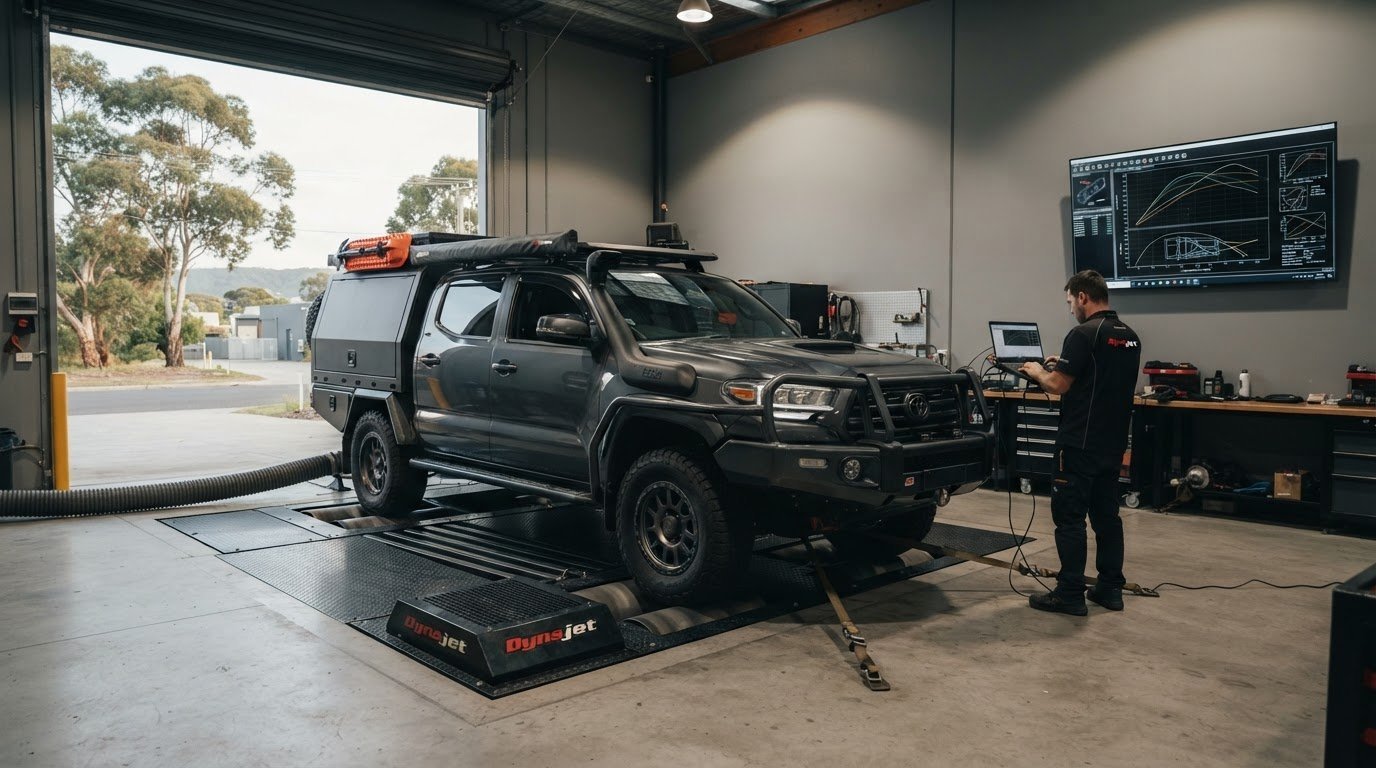
A tune is easier to evaluate when it’s measured on the vehicle being assessed. At Veloce’s Carrum Downs workshop, custom Amarok tuning can begin with the ute’s details and your priorities, then use the on-site dyno to record performance before and after tuning. The graphs provide a vehicle-specific reference, rather than relying only on a figure from a different ute.
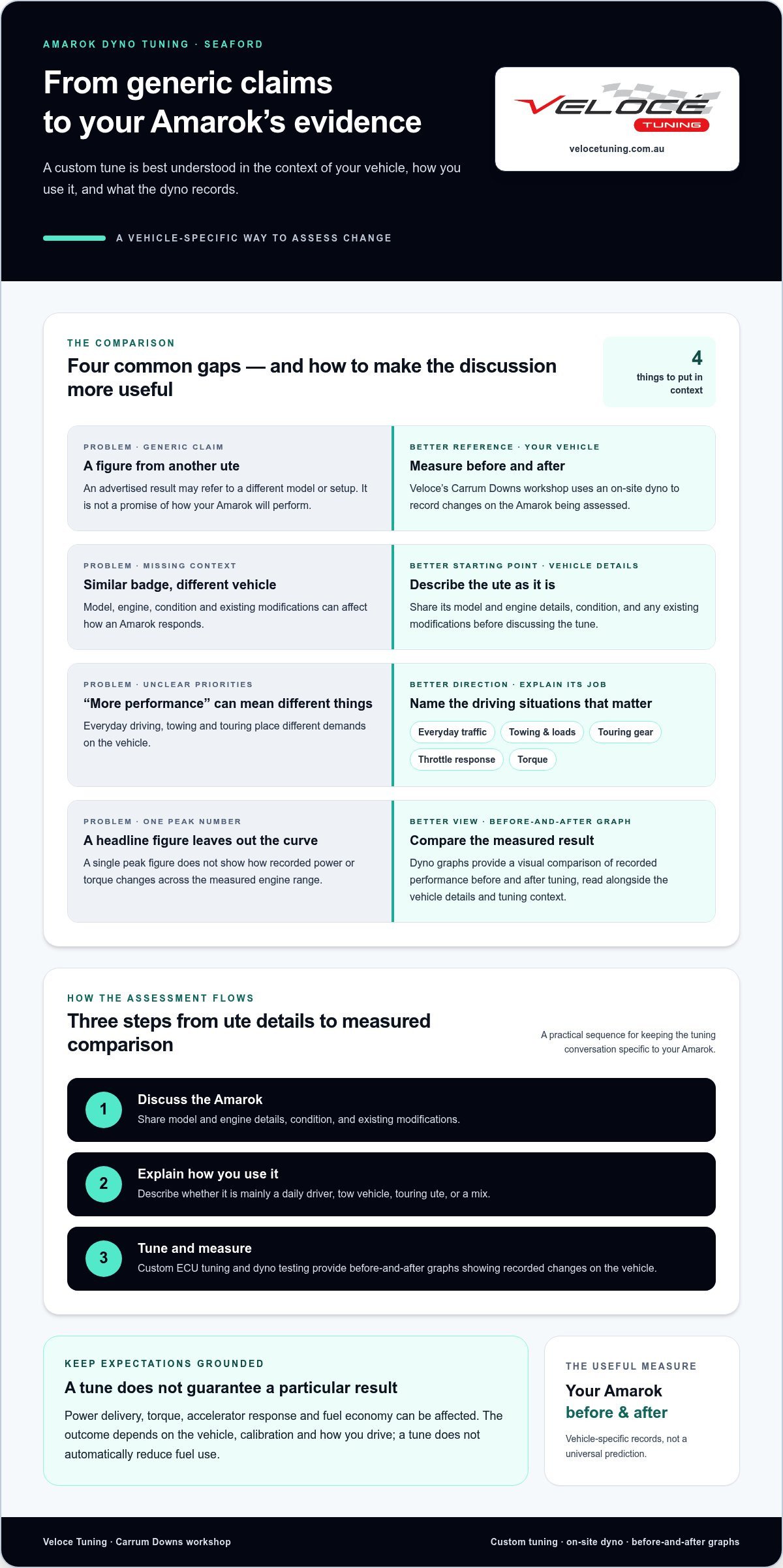
- Discuss the Amarok. Share its model and engine details, condition and any existing modifications.
- Explain how you use it. Describe whether it’s mainly a daily driver, tow vehicle, touring ute or a mix.
- Tune and measure. Veloce’s custom ECU tuning and dyno testing provide before-and-after graphs to show recorded changes on the vehicle.
This keeps the discussion focused on your Amarok. For Seaford drivers, it also provides a practical way to understand what a custom tune means for their own vehicle, without treating another ute’s result as a prediction.
What a before-and-after dyno graph tells you
A dyno graph gives a visual comparison of measured performance before and after tuning. It can show how recorded power or torque changes across the measured engine range, rather than reducing the result to one peak figure. Read alongside the vehicle details and tuning context, the graphs make the comparison easier to interpret.
A dyno graph puts tuning claims in context by showing measured changes on the vehicle being assessed, not a universal result for every Amarok. Veloce provides before-and-after graphs from its on-site dyno, giving owners recorded results to discuss alongside their driving priorities.
Why model-specific advertised gains are not a guarantee
Advertised figures can provide an example, but they relate to the vehicle and tuning service behind them. For instance, Ultimate Diesel Tuning presents TDI 580 figures of 190 kW and 580 Nm as standard, then 240 kW and 750 Nm after its tune. The company labels these figures as estimates and says results vary by vehicle.
Those are that provider’s figures, not a forecast for a Veloce-tuned Amarok. Model, engine, condition, modifications and tuning approach all matter. Even vehicles with the same variant name may not produce identical results. For an Amarok performance tune Seaford owners are considering, a vehicle-specific dyno measurement is a more relevant reference than assuming another ute’s advertised gains will apply.
Veloce’s on-site dyno and before-and-after graphs make measured results part of its one-stop workshop service. If you’re weighing up a tune, explore Veloce’s tuning services and consider how a custom assessment relates to your Amarok’s intended use.
Custom Amarok tune versus generic claims: what should you compare?
A percentage can look precise, but it doesn’t show whether the same change applies to your Amarok. A published gain may describe one provider’s example, measured or estimated for a particular vehicle and setup. It isn’t a universal benchmark for every ute with the same badge. Use the comparison below to assess the type of evidence being presented, not as a claim that every generic tune or advertised figure is alike.
| Evidence | What it can tell you | What it can’t promise |
|---|---|---|
| Vehicle-specific calibration | The tuning approach takes the individual Amarok and its intended use into account. | A specific power, torque, response or economy result for every vehicle. |
| Dyno measurement | Recorded performance on the vehicle being assessed, with before-and-after graphs to help compare the measured result. | That another Amarok will record the same result under different conditions. |
| Generic advertised claims | An example of what a particular source says its tune achieved or estimates for a specified model. | That the figure applies to your vehicle or will be reproduced by another tune. |
Custom calibration and generic tune claims are not the same evidence
Custom tuning considers calibration in relation to the specific vehicle, rather than treating a model name as a complete description of its condition and setup. Generic figures serve a different purpose: they describe a source’s example, not a guaranteed result for your ute. A shared badge or engine description does not make two vehicles identical.
For an Amarok performance tune Seaford drivers are weighing up, focus on how the process relates to your vehicle and how the outcome is documented. Veloce’s on-site dyno and before-and-after graphs provide a way to compare measured changes on the individual Amarok, rather than relying only on a headline claim.
How to interpret power, torque and economy statements
Power describes the rate at which an engine can do work, while torque describes its turning force. In practical driving, changes to either may influence how an Amarok accelerates or feels under load, but what you notice depends on the vehicle and tune. Throttle response is a separate consideration. A sharper-feeling accelerator, by itself, does not prove a particular power gain.
Read fuel economy claims just as carefully. A tune should not be assumed to reduce fuel use. The outcome can depend on the vehicle, calibration and driving conditions. Compare like with like, and distinguish a measured result from an estimate or marketing percentage.
An advertised estimate describes its source’s example; an individual dyno result describes the vehicle measured. That distinction helps keep expectations grounded. For a Veloce custom tune, compare the Amarok’s own documented before-and-after performance and consider it alongside your priorities, rather than expecting a result borrowed from another provider’s figures.
Prepare your Amarok for a performance tune near Seaford
A useful tuning discussion starts with a clear picture of your Amarok’s engine, condition and day-to-day job. That makes it easier to explain what you want from a tune and avoid relying on broad assumptions. A little preparation helps connect the conversation to your actual ute, whether it’s a commuter, tow vehicle or touring rig.
Vehicle and use details to have ready
Note the model year, engine details and odometer reading. If you’re unsure of the exact engine description, check your vehicle documents or service records. Include any changes made since purchase, as existing upgrades may be relevant when considering the vehicle’s current setup.
It also helps to describe how you use the Amarok in a typical week and on longer trips. Consider noting:
- Whether most driving is in town, on the highway or across a mix of conditions.
- How often you tow and whether the ute is usually loaded.
- Whether touring gear or other equipment is regularly carried.
- Any existing modifications that may affect the engine or vehicle setup.
Be specific about what you’d like to feel change. For example, you might want more responsive everyday acceleration or power delivery that better suits regular towing. These are priorities to discuss, not guaranteed outcomes. If fuel use is a concern, mention it too. Tuning doesn’t automatically improve economy, and your driving pattern is part of the context.
Keep the rest of the Amarok in view
A tune is one part of vehicle care, not a substitute for broader mechanical maintenance. Note any drivability concerns, warning lights, unusual sounds or changes you’ve noticed, along with relevant service history. Sharing these details gives the workshop a fuller picture of the Amarok being considered for custom tuning.
Veloce’s one-stop workshop in Carrum Downs brings performance work together with vehicle servicing and repairs, including logbook servicing. Having your servicing information handy can help put the tuning discussion in context. If you’re considering a tune partly because of fuel use, separate what you hope the calibration might change from factors that shape everyday consumption, such as the work the vehicle does and how it’s driven.
Keep the conversation focused: identify the ute, explain its job and outline what you’d like to improve. For an Amarok performance tune Seaford owners can discuss locally, Veloce’s 4×4 & Ute Specialists service Amarok vehicles and offer Diesel & Petrol Tuning. Discuss your Amarok tuning requirements with Veloce’s Carrum Downs workshop.
Book an Amarok performance tune from Seaford with Veloce
For Seaford drivers looking for Amarok tuning nearby, Veloce’s Carrum Downs workshop brings servicing, repairs and performance upgrades together under one roof. Its 4×4 & Ute Specialists service Amarok vehicles and offer Diesel & Petrol Tuning. You can start by discussing your vehicle and what you need it to do, rather than relying on a one-size-fits-all promise.
What to expect from Veloce’s local workshop
Veloce has been in business for 19 years and offers custom ECU tuning and dyno tuning as part of its workshop services. The on-site dyno produces before-and-after graphs, giving you documented measurements to discuss when considering what changed on your Amarok. These results can be considered alongside your priorities, whether your ute is used for daily driving, towing or touring.
The workshop also brings broader vehicle care and performance upgrades together. If you’re planning changes beyond tuning, such as suspension work for a 4×4 setup, consider how each upgrade fits the vehicle’s intended use. Veloce’s one-stop approach keeps servicing, repairs and performance work in the same workshop.
Veloce has a 4.8-star rating from 52 Google reviews. Alongside its years in business and on-site dyno graphs, this gives Amarok owners useful context when considering a local workshop.
Make an enquiry or book your Carrum Downs visit
Veloce is at Unit 28/34 Brett Drive, Carrum Downs, VIC. The workshop is open Monday to Friday, 8:00 am to 5:00 pm. Call 0422 593 875 to discuss your Amarok or arrange a visit.
To make the conversation useful, have your model and engine details ready, along with a clear picture of how you use the ute. Mention any existing modifications, your regular driving and whether towing or touring is part of the brief. These details give the team a practical starting point for discussing a tune shaped around your vehicle and its real-world role.
Payment options include Afterpay, humm, Zip, cash, EFTPOS, Visa, Mastercard and American Express. If you’re ready to explore an Amarok performance tune Seaford drivers can access locally, enquire about Amarok ECU tuning with Veloce. Call 0422 593 875 to discuss your ute and take the next step.
Turn your Amarok’s priorities into a tuning plan
The useful starting point isn’t chasing the biggest number on a screen. Decide what you want your Amarok to do better, then discuss how that goal fits your vehicle and the way you use it. A more responsive daily drive, a ute used for regular towing or a touring vehicle carrying extra gear each brings a different brief to the conversation.
If you’re considering an Amarok performance tune Seaford drivers can access nearby, take your priorities to Veloce and start with the details that matter. Explain what the ute does, what you’d like to improve and what changes it already has. That gives the tuning discussion a practical direction without assuming another Amarok’s advertised result will be yours.
Book your Amarok tuning enquiry with Veloce and take the next step towards a setup shaped around your vehicle and its real-world job. Call 0422 593 875 to get started.
Frequently Asked Questions
Can an ECU tune be tailored to my Amarok’s engine and model?
Yes. A custom ECU tune can take your Amarok’s specific engine and model into account, rather than assuming every version responds alike. When discussing an Amarok performance tune Seaford owners can access at Veloce, share the exact vehicle details and what you want from it. The tuning discussion can then be based on that context, without treating another model’s advertised result as a promise for yours.
Does an Amarok performance tune always improve fuel economy?
No. A tune doesn’t automatically reduce fuel use. Any effect depends on factors such as the individual vehicle, its calibration and how it’s driven. Regular towing, heavy loads or frequent stop-start trips can make your consumption different from another driver’s. If economy is a priority, explain how and where you drive, and treat any expected change as something to assess, not assume.
What information should I provide about my Amarok before tuning?
Provide the model year, engine details and odometer reading, then describe the ute’s typical work. Include whether it’s used for short commutes, highway travel, towing or touring, and list modifications or accessories that may affect its setup. Mention any drivability concerns, warning lights or recent repairs, too. Vehicle documents or service records can help you provide accurate details.
Can an Amarok with existing modifications still be considered for a custom tune?
Yes. Existing modifications can be part of a custom tuning discussion. Make a clear list of changes, including parts fitted to the engine or other components that may influence how the vehicle operates. If you have invoices, product details or records of previous work, bring them along. This helps the tuner understand the Amarok’s current configuration and consider the tune in relation to the vehicle as it stands.
What does an Amarok dyno graph measure?
A dyno graph records measured vehicle performance during a dyno test, commonly displaying power and torque across the engine’s operating range. Comparing before-and-after graphs can show how those recorded figures differ following tuning. The result relates to the Amarok tested. It does not guarantee identical performance on another ute or directly measure fuel use in everyday driving.
How do I identify my Amarok’s engine variant?
Start with the vehicle documents, service records or owner’s manual, which may state the model and engine information. The VIN can also help identify the vehicle’s specification when interpreted through suitable vehicle records. If you’re unsure, note the model year and any engine description you can find instead of guessing based on badges alone. Accurate details give the tuning discussion a more reliable starting point.
Can Veloce service and tune an Amarok at the same workshop?
Yes. Veloce is a one-stop workshop offering logbook and general servicing alongside custom ECU tuning, and its 4×4 & Ute Specialists service Amarok vehicles. You can discuss maintenance and performance needs at the same workshop. Share your servicing history and tuning priorities so the team has a fuller picture of the vehicle and the work you’re considering.