The best Hilux tune isn’t necessarily the one chasing the biggest dyno number. It’s the one that suits how you use your ute, whether that’s towing, touring, work or everyday driving. If you’re considering Hilux ECU tuning Mornington, it helps to understand what can change, how a tune is assessed and what information to have ready.
A custom ECU tune adjusts engine settings to shape power, torque, response and economy around the vehicle and its intended use. That differs from relying on a generic plug-in module. Your Hilux’s condition, engine and modifications all matter, so share those details when discussing tuning.
At Veloce in Carrum Downs, custom ECU tuning is supported by an on-site dyno and before-and-after graphs. This article explains what a tailored tune may influence, how dyno testing helps you review the results and what to consider before bringing your Hilux to the workshop.
Key Takeaways
- Hilux ECU tuning Mornington owners consider should reflect how the ute is used, whether for towing, touring, work or everyday driving.
- A custom remap changes engine-management calibration. The article explains how this differs from a plug-and-play module.
- Veloce’s on-site dyno testing and before-and-after graphs let you review measured changes to your Hilux.
- Before tuning, note your Hilux’s year, engine details, modifications and workload, and mention any symptoms.
- Veloce’s workshop is at Unit 28/34 Brett Drive, Carrum Downs, VIC.
Hilux ECU Tuning Mornington: What a Custom Remap Can Change
If you’re looking into Hilux ECU tuning Mornington, begin with how you want your ute to perform, rather than a promised figure. A custom remap changes the engine-management calibration, the software instructions that guide engine operation. Veloce provides custom ECU tuning for petrol and diesel vehicles, including Hilux utes, at its Carrum Downs workshop.
What does a Hilux ECU remap adjust?
The engine control unit, or ECU, is the vehicle’s electronic system for managing engine operation. This Engine Control Unit (ECU) uses programmed instructions to coordinate how the engine responds as you drive. A remap revises aspects of that calibration to shape engine performance. The specific changes depend on the Hilux and its existing setup.
A remap adjusts the ECU’s calibration. It isn’t an engine replacement or a mechanical rebuild. Instead, it changes how the existing engine is managed. Depending on the ute and your priorities, tuning goals may include power delivery, torque response, drivability or economy. These are goals to discuss, not guaranteed outcomes. Results depend on the vehicle, its condition, engine and modifications.
That distinction matters when comparing headline figures. A result quoted for one Hilux, with a particular model or engine configuration, doesn’t establish what another ute will achieve. The tune should be considered for the vehicle in front of the technician, rather than assuming every Hilux is the same.
Start with how you use your Hilux
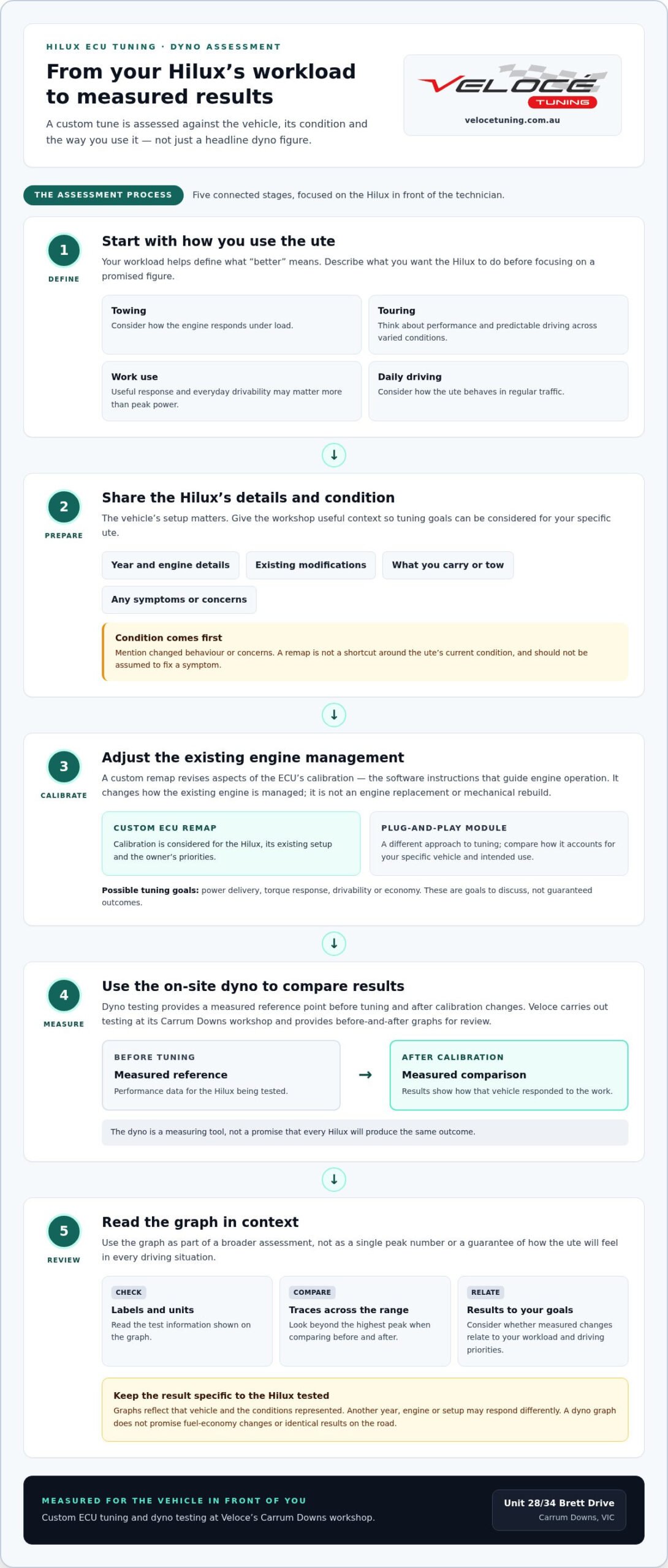
Your workload helps define what “better” means. If you regularly tow, you may be focused on how the engine responds under load. A touring Hilux might need to balance performance with predictable driving across varied conditions. If you carry tools or equipment for work, useful response and everyday drivability may matter more than peak power. For a daily driver, you may prioritise how the ute behaves in regular traffic.
Use these priorities to guide the tuning discussion. Describe how you drive, what you carry or tow and any modifications already fitted. That context helps the workshop understand your goals, while the vehicle’s condition helps inform what is appropriate. One target won’t necessarily suit every Hilux or owner.
Tuning goals should reflect the vehicle’s workload and condition.
Custom tuning is a considered adjustment, not a shortcut around the ute’s current condition. If its behaviour has changed or you’ve noticed a concern, mention it rather than assuming a remap will fix it. Understanding your Hilux and its day-to-day demands is a useful starting point for a tune shaped around real use.
How Veloce’s Hilux Dyno Tuning Measures the Change
A dyno provides a measured reference point, so the tuning discussion isn’t based on driving impressions alone. It tests vehicle performance and produces data that can be compared before and after changes. For Hilux ECU tuning Mornington drivers are considering, that evidence relates to the ute tested, not to what another Hilux might achieve.
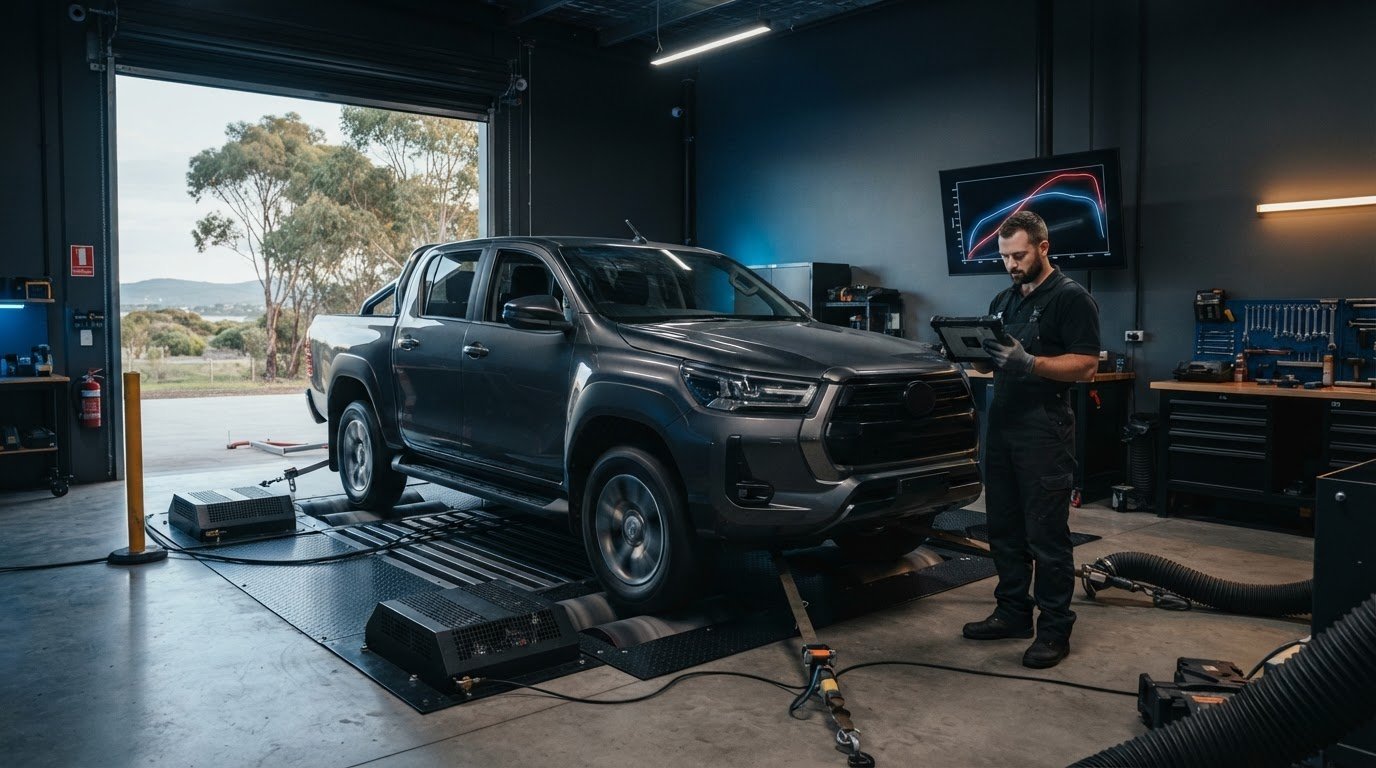
Veloce has an on-site dyno at its Carrum Downs workshop and provides before-and-after graphs. Testing and tuning can be carried out at the same workshop, and the graphs give you information to review alongside your Hilux’s intended workload.
What happens during a dyno tuning session?
Dyno testing gives a measured view of the Hilux’s performance before tuning and after calibration changes. Comparing the results helps show how that vehicle responded to the work. The dyno is a measuring tool, not a promise that every ute will produce the same outcome.
At Veloce, testing is carried out on-site at Carrum Downs, with before-and-after graphs to review. The figures reflect the Hilux being tested and the conditions represented in its results.
How to read a before-and-after dyno graph
Start with the labels, units and test information shown on the graph. Compare the before-and-after traces across the measured range instead of focusing only on the highest peak. Peak figures can be useful, but they don’t describe every part of engine performance or how the ute feels in every driving situation.
Before-and-after graphs document measured results for the vehicle tested. They show that Hilux under the conditions represented, not what a different year, engine or setup will achieve. Keep that in mind when you see figures for a particular model elsewhere. They may not match your vehicle and shouldn’t be treated as a guaranteed result.
Use the graph as part of a broader assessment. Consider whether the measured change relates to your goals, such as response under load or performance in everyday driving, then weigh it alongside your experience of the ute. A peak number can’t capture every aspect of drivability, and a dyno graph doesn’t promise fuel-economy changes or identical results on the road.
For owners who want a clearer picture of a tailored tune, Veloce’s custom ECU tuning and dyno testing brings calibration and measured comparison together at the Carrum Downs workshop. The graphs give you a useful basis for discussing the results for your Hilux.
Custom Hilux Tune or Plug-and-Play Module: What Should You Compare?
A plug-and-play module and a custom ECU remap approach tuning differently. Compare how each relates to your specific Hilux, whether it takes your intended use into account and what evidence is available to assess the result. For Hilux ECU tuning Mornington owners are considering, these points are more useful than relying on another ute’s advertised figures.
Which comparison points matter for a Hilux?
Consider whether the tuning approach is tailored to your vehicle and its setup, and whether your priorities, such as towing or daily driving, are part of the discussion. Also consider how the changes are assessed. Veloce offers custom ECU tuning with on-site dyno testing and before-and-after graphs, giving you measured results for the Hilux tested. These are features of Veloce’s workshop, not claims about every module or other provider.
| Comparison point | Custom ECU remap | Plug-and-play module |
|---|---|---|
| Calibration approach | Adjusts the vehicle’s engine-management calibration. | Uses a separate device. Its method and functions depend on the specific module. |
| Vehicle and use | Can be discussed in relation to the individual Hilux, its setup and intended workload. | How closely it accounts for the vehicle and use depends on the specific product. |
| Evidence of change | Veloce provides on-site dyno testing with before-and-after graphs. | Evidence varies by product and the information supplied with it. |
This comparison is a way to organise your decision, not a blanket verdict on every device. Products differ, and a module’s specifications should be understood on their own terms. Focus on what is known about the particular approach rather than making assumptions based on category labels.
Why one Hilux result is not a universal benchmark
A published N80 Hilux example describes that vehicle and service, not every Hilux. Engine, condition and configuration can all influence tuning results, so figures from another ute aren’t a reliable prediction for yours. A measured graph is more useful when read alongside the vehicle and test it represents. Even then, a peak figure won’t capture every aspect of how the ute performs on the road.
If fuel use is one of your priorities, treat it as a goal to discuss rather than an automatic outcome of tuning. Driving conditions and vehicle use matter. Veloce’s separate ECU tuning for fuel economy discussion explores that objective, while the assessment of your Hilux remains specific to your vehicle.
Prepare Your Hilux for ECU Tuning Near Mornington
A useful tuning discussion starts with the ute you own and the work you ask it to do. Before arranging Hilux ECU tuning Mornington owners can note a few details about their vehicle and how it’s used. This gives the workshop a clearer starting point than relying on assumptions based on the model name alone.
Information to bring to the tuning discussion
Make a short note of your Hilux’s year, engine details and any modifications. Include its main job, such as towing, touring, carrying work gear or everyday driving. You don’t need technical readings or a specific power target. A clear description of what you’d like the ute to do better is a practical place to begin.
- Vehicle details: Hilux year and engine information.
- Existing setup: Modifications you know are fitted.
- Typical workload: Towing, touring, work use or daily driving.
- Main concern or goal: What you’ve noticed or what you want the ute to do more comfortably.
Keep your notes straightforward. For example, “regularly carries work equipment” or “used for touring” is more useful than guessing at a technical cause for a change in performance. This context helps keep the conversation focused on your priorities.
When your Hilux has another issue or modification
If the ute has a symptom, such as a change in how it runs, describe when it happens and how long you’ve noticed it. Don’t assume a remap is the answer to an issue that may need separate attention. Veloce provides diagnostics and software services as well as custom ECU tuning, so you can discuss an existing concern before treating tuning as the solution.
Routine condition matters too. If your Hilux is due for maintenance, keeping servicing up to date helps clarify its history and current needs. Veloce provides logbook servicing in Carrum Downs alongside broader workshop care.
Modifications can change the setup the tune needs to work with. If your Hilux has suspension modifications or a lift kit, include that information and explain how you use the ute. Veloce’s Hilux suspension and lift-kit guidance offers related 4×4 setup information.
With your vehicle details, modifications, workload and any symptoms noted, you’ll be ready for a more informed tuning conversation at Veloce’s Carrum Downs workshop. Arrange a Hilux ECU tuning discussion and bring those details along.
Book Hilux ECU Tuning at Veloce’s Carrum Downs Workshop
Searching for Hilux ECU tuning Mornington can lead you to Veloce in Carrum Downs, where the workshop provides custom ECU tuning and dyno testing for Hilux utes. The address is Unit 28/34 Brett Drive, Carrum Downs, VIC. From Mornington, plan your visit to discuss a tune around your vehicle and how you use it.
What makes Veloce’s workshop a practical local option?
Tuning sits alongside servicing, repairs and performance upgrades at Veloce, so you can discuss your Hilux as a whole vehicle rather than treating the ECU in isolation. The on-site dyno supports testing, and before-and-after graphs let you review measured results for the ute being assessed. This connects the tuning work with evidence specific to your vehicle.
Veloce has been in business for 19 years, and the workshop has a 4.8-star rating based on 52 Google reviews. These details offer useful context as you consider where to bring your Hilux. The dyno graphs give you a way to discuss the tuning results themselves. Keep the focus on your vehicle, its condition and intended use rather than assuming another ute’s figures will apply.
How to take the next step
Before getting in touch, gather your Hilux’s year, engine information, modifications and typical use. Whether you tow, tour, carry work equipment or mainly drive around town, explaining your priorities gives the conversation a useful starting point. Mention any existing symptoms too, so they can be considered separately from your tuning goals.
Veloce’s Carrum Downs workshop is open Monday to Friday, 8:00 am to 5:00 pm. Call 0422 593 875 or use the online enquiry and booking option to take the next step. Share what you drive and what you’d like the Hilux to do, and the team can discuss custom tuning and dyno assessment in the context of your ute.
Veloce is at Unit 28/34 Brett Drive, Carrum Downs, VIC. Bring your questions and your Hilux’s details to start a conversation about a tune suited to the work your ute does.
Set Your Hilux Up for the Work Ahead
Your ute’s role can change over time. A Hilux that once handled mostly commuting might take on regular towing or touring, while a work vehicle could carry different loads. Let those real-world demands guide your tuning priorities instead of chasing a number that may not reflect how you drive.
If you’re considering Hilux ECU tuning Mornington, think about what you want your ute to do more confidently and what matters most in everyday use. Clear priorities make the next conversation more productive and keep the focus on a setup that suits your Hilux, rather than a one-size-fits-all expectation.
Ready to discuss your ute and its workload? Book or enquire about Hilux ECU tuning with Veloce and take the next step towards a Hilux better matched to the work ahead.
Frequently Asked Questions
Can ECU tuning fix a sluggish Hilux?
Not necessarily. Sluggishness can have different causes, so a remap alone isn’t a diagnosis or a guaranteed fix. If your Hilux feels less responsive than usual, note when you notice it, such as during acceleration or while carrying a load, and describe it to the workshop. Veloce offers diagnostics and software services, making assessment a sensible first step before deciding whether tuning is relevant.
Does every Hilux get the same result from ECU tuning?
No. A result from one Hilux isn’t a universal benchmark. The vehicle’s year, engine, condition, configuration and intended use all shape the tuning discussion. Veloce’s on-site dyno and before-and-after graphs document the vehicle tested, helping you review its measured changes. Those results relate to that ute and its test, not a promise of the same outcome for another Hilux.
Is ECU remapping the same as dyno tuning?
No. Remapping means changing the engine-management calibration, while a dyno is equipment used to test and measure vehicle performance. The terms are related, but they describe different parts of the work. Veloce offers custom ECU remapping and on-site dyno tuning with before-and-after graphs. A remap doesn’t automatically mean dyno testing is included everywhere, so don’t assume the terms mean the same thing.
Can a Hilux with a DPF issue go straight to ECU tuning?
A DPF concern should be treated separately, rather than assuming an ECU tune will resolve it. If a warning appears or the vehicle’s behaviour changes, describe what you’ve noticed so the issue can be assessed. Veloce provides DPF diagnosis, regeneration, cleaning and repair. Identifying the issue helps distinguish DPF servicing needs from a separate tuning goal.
Does Veloce tune both petrol and diesel Hilux vehicles?
Yes. Veloce works on petrol and diesel vehicles, and Hilux is among the 4×4 and ute models serviced and upgraded at the workshop. That doesn’t mean every engine variant has identical tuning options or will produce the same result. Sharing your Hilux’s year and engine details helps make the tuning discussion specific to your vehicle, rather than relying on assumptions about the model range.
What should I tell the workshop before booking Hilux ECU tuning?
Share your Hilux’s year, engine details if known, modifications, any symptoms and how you use it, such as for towing, touring or work. This gives the team useful context for discussing your priorities, though it doesn’t guarantee a particular calibration or result. Veloce is at Unit 28/34 Brett Drive, Carrum Downs, VIC. Call 0422 593 875 to book.