Better braking starts with parts suited to your vehicle, not simply the biggest upgrade. Big brake kit installation in Mornington may form part of a brake upgrade involving fluid, pads, shoes, rotors and upgraded calipers. The right combination depends on the vehicle and how you drive.
Brake squeal or grinding, a soft or hard pedal, or the vehicle pulling to one side under braking are signs the system needs attention. If you want stronger, more confident braking, understand how the components work together before choosing an upgrade.
This guide explains what each brake component does, what a big brake kit and upgraded calipers can change, and what to consider during installation. It also covers how routine brake servicing fits in, so you can make an informed choice for everyday driving or a performance-focused setup.
Key Takeaways
- Learn what brake fluid, pads, shoes and rotors each do, and recognise signs that the braking system needs attention.
- Understand what to consider when deciding whether a big brake kit suits your vehicle and driving needs.
- See why pads and rotors should be assessed as a working pair, rather than chosen in isolation.
- Explore how upgraded calipers fit into a brake setup and what to weigh before changing components.
Brake fluid, pads, shoes and rotors
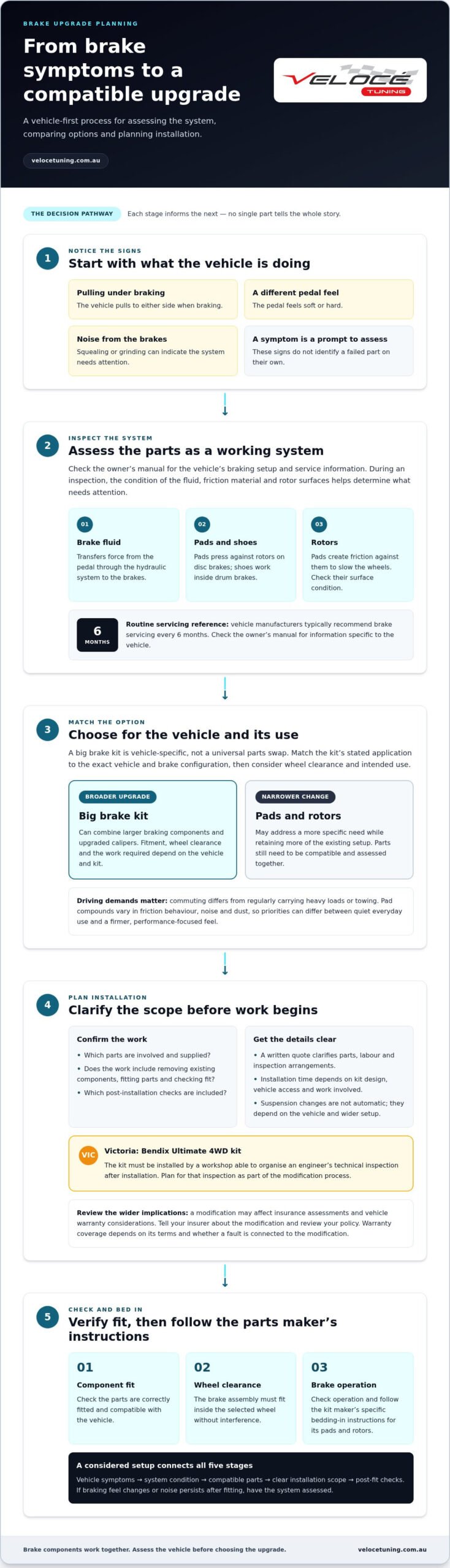
Brake fluid transfers force from the pedal through the hydraulic system to the brakes. On disc brakes, pads press against rotors to create friction and slow the wheels. Shoes do a similar job inside drum brakes. These components work as a system, so replacing one part does not automatically address wear elsewhere.
Vehicle manufacturers typically recommend brake servicing every 6 months. Your owner’s manual provides service information for your specific vehicle, including its braking setup. During an inspection, the condition of the fluid, friction material and rotor surfaces helps determine which parts need attention. For example, worn pads paired with scored rotors call for a different response than a fluid service alone.
In Victoria, the Bendix Ultimate 4WD big brake kit must be installed by a workshop able to organise an engineer’s technical inspection after installation. That inspection is part of the modification process for this kit, so plan for it alongside installation.
A big brake kit may affect insurance assessments and vehicle warranty considerations. Tell your insurer about the modification and review how your policy treats altered braking components. Warranty coverage depends on the terms and whether a fault is connected to the modification.
Pay attention to how the vehicle behaves. Pulling to either side under braking, a soft or hard pedal, and squealing or grinding noises can all indicate that the braking system needs attention. These signs do not identify a failed part on their own; they are reasons to have the system assessed.
A practical first step is to consult the owner’s manual, note any braking symptoms and have the system inspected. An assessment can distinguish a fluid issue from worn pads, shoes or rotors. This helps separate routine replacement from a larger upgrade and match components to the vehicle’s brake design.
Big brake kit installation
A big brake kit is a vehicle-specific upgrade, not a universal parts swap. For big brake kit installation in Mornington, fitment, wheel clearance and the work required for your vehicle all matter.
Kit fitment and upgrade comparisons
For popular Australian cars and 4WDs, kit suitability depends on the exact vehicle and brake configuration. Match the kit’s stated application to the vehicle, then consider wheel clearance and intended use. A kit can combine larger braking components and upgraded calipers; upgraded rotors and pads may address a narrower need while retaining more of the existing setup. Each option still requires compatible parts.
The Bendix Ultimate 4WD kit in Victoria must be installed by a workshop able to organise an engineer’s technical inspection after installation.
Workshop services and installation inclusions
Big brake kit installation in Mornington starts with vehicle-specific fitment. The kit determines which parts are involved; the work may include removing existing components, fitting the supplied parts and checking fit. The scope depends on the vehicle and kit. A written quote clarifies parts, labour and any inspection arrangements for the installation.
Ask which post-installation checks are included, and review the kit and vehicle warranty terms before proceeding. The modification may affect insurance assessment, so disclose it to your insurer.
Installation time and vehicle changes
Installation time depends on kit design, access to the vehicle and the work involved. Inspection arrangements can also affect the process, so there is no single duration for every vehicle. Wheel clearance matters because the brake assembly must fit inside the selected wheel without interference. Suspension changes are not automatically required; they depend on the vehicle and wider setup.
Compare the kit’s requirements with your current wheels to identify clearance issues before work begins.
Post-installation checks and bedding-in
After fitting, check component fit, wheel clearance and brake operation. Follow the kit manufacturer’s bedding-in instructions, which are specific to its pads and rotors. Complete the procedure as directed before returning to normal driving.
Incompatible fitment, wheel interference or incorrect installation can create problems. Clear installation details and post-fit checks help address these risks. For a considered brake system upgrade, weigh the kit, vehicle and intended use together.
Brake pads and rotors
Pads and rotors work together, so choosing either in isolation can overlook the cause of uneven braking. Pads create friction against the rotor, while rotor condition and pad material both influence the system’s response. For example, fitting fresh pads to a rotor with an uneven contact surface may not provide the consistent feel you expect. Assess both components together.
Start by matching replacement pads to the vehicle and how it is used. A car mainly used for commuting has different demands from one regularly carrying heavy loads or towing. Pad compounds vary in friction behaviour, noise and dust. These trade-offs matter: a driver prioritising quiet everyday use may choose differently from someone seeking a firmer, performance-focused feel.
Assess the rotors before replacing them. Look for surface scoring, uneven wear and signs of heat damage, and compare their condition with the pad contact area. A rotor may be reusable if its condition suits the replacement pads, while visible damage may point to replacing both. The right choice depends on the components’ actual condition, not simply on fitting new pads.
Ask for the proposed parts to be matched to your vehicle’s braking system. The assessment should account for rotor dimensions and design, pad shape, caliper compatibility and intended driving. For example, a pad designed for a different caliper may not seat correctly, even if it looks similar. Correct fitment helps the parts make full, even contact.
After installation, follow the parts maker’s instructions for using new pads and rotors. Do not assume every combination has the same run-in procedure. If braking feel changes or noise persists after fitting, have the system assessed rather than treating the sound as normal. A well-planned brake upgrade starts with compatible components and a clear understanding of how you drive.
Caliper upgrades
A caliper presses the brake pads against the rotor when you apply the pedal. Its design and piston arrangement affect how pressure reaches the pads. Choose an upgrade as part of a compatible brake setup, rather than by piston count alone. The rotor, pads, mounting points and vehicle application all matter.
The Bendix Ultimate 4 Wheel Drive Big brake kit for the front axle replaces the factory floating 2-pot caliper with a six-piston monoblock caliper. The Bendix Ultimate 4WD front big brake kit includes 6-pot monoblock calipers. These details describe a specific kit, not a universal fitment for every 4WD.
When assessing an upgraded caliper, start with the vehicle’s current configuration and intended use. A front-axle kit, for example, changes the front caliper arrangement; it does not automatically mean every other brake component is suitable unchanged. Matching the caliper with the kit’s specified pads and rotors helps maintain a compatible setup.
Caliper construction matters during installation. The caliper must mount correctly, align with the rotor and allow the pads to contact the braking surface as intended. Check wheel clearance too, since a larger caliper can affect the space inside the wheel. These are essential fitment checks, not cosmetic details.
More pistons alone don’t establish how a vehicle will brake. The complete system and its application determine whether a change suits the vehicle. Compare the specified kit components, front-axle application and wheel fitment before deciding. For a tailored brake upgrade, discuss the vehicle’s existing setup and the caliper change you’re considering.
Veloce Tuning: Log Book Servcing
Veloce Tuning provides logbook and general servicing for drivers who want routine vehicle maintenance alongside decisions about brake upgrades. Keeping scheduled maintenance in view helps you consider a performance change as part of the vehicle’s overall care, rather than as an isolated modification.
Book logbook and general servicing when your vehicle is due for scheduled maintenance, or when you want to discuss servicing alongside future plans for your car. Fleet operators can explore fleet servicing, while drivers considering broader vehicle changes may find suspension and lift kits or custom ECU tuning relevant to their build.
For help with your servicing needs, contact Veloce Tuning.
Shape a brake upgrade around your driving
Your next step is to connect the braking changes you want with how you use your vehicle. A road-driven car, a touring 4WD and a vehicle carrying regular loads can call for different priorities. Start with what you want to improve, then consider the complete setup rather than choosing a component in isolation.
For big brake kit installation in Mornington, have your vehicle details and current wheel setup ready for a practical discussion. Explain your usual driving, planned vehicle changes and what you want from the brakes. This helps frame the upgrade around fitment and intended use, not appearance alone.
Veloce Tuning offers brake upgrades for drivers planning a considered change to their braking system. Contact Veloce Tuning to discuss your brakes and take the next step towards a setup that suits your build.
Frequently Asked Questions
What brake parts do you install?
Veloce Tuning provides brake upgrades, from work on components such as pads and rotors to broader system changes. The parts selected depend on your vehicle’s existing setup and the planned upgrade. A routine replacement, for example, differs from a full kit conversion. Share your vehicle details and the braking change you have in mind to help shape the discussion.
Where is your workshop?
Veloce Tuning’s workshop is at Unit 28/34 Brett Drive, Carrum Downs, VIC. The location serves drivers travelling from nearby areas, including Frankston, Patterson Lakes, Mornington, Skye, Seaford and Sandhurst. If you’re planning a visit from elsewhere on the Mornington Peninsula, use the Carrum Downs address to map your trip and allow time to discuss your vehicle’s braking setup.
Which brake brands do you work with?
The brake kit example discussed in this guide is the Bendix Ultimate 4WD. Veloce Tuning offers brake upgrades, and a suitable brand or kit depends on the vehicle and the components being changed. For a useful starting point, have your vehicle’s make, model and year ready, along with details of its current wheels and the type of brake upgrade you’re considering.
Which big brake kits fit popular cars and 4WDs in Australia?
The Bendix Ultimate 4WD big brake kit is one example, but suitability depends on the exact vehicle and brake configuration. Match the kit’s stated application and check wheel clearance before installation.
What are the benefits and drawbacks of a big brake kit versus upgraded rotors and pads?
A big brake kit can combine larger braking components with upgraded calipers. Upgraded rotors and pads may suit a more specific need while retaining more of the existing setup. Either option requires compatible parts and vehicle-specific fitment.