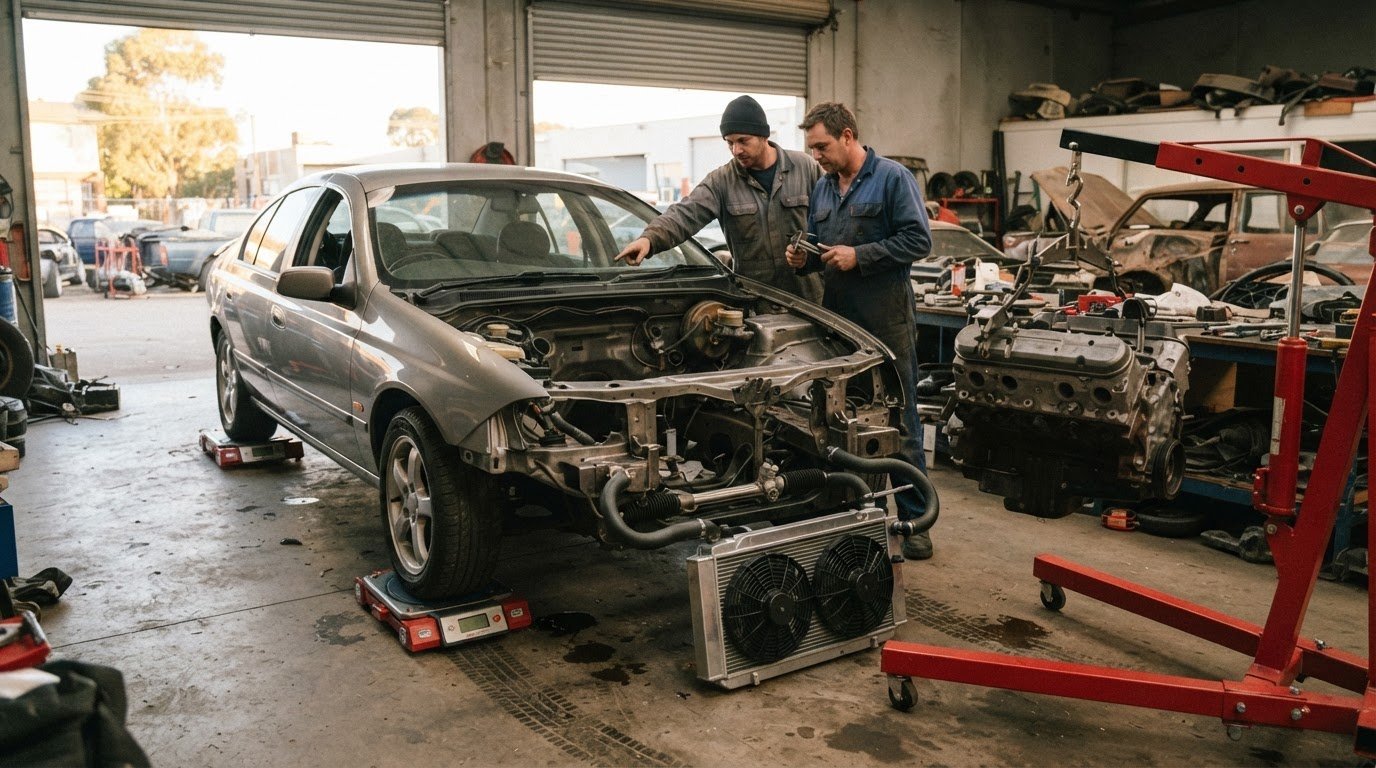
The most powerful engine isn’t automatically the right conversion. Choosing the right engine for a conversion means matching its size and output to the vehicle’s capacity, intended use and Australian compliance requirements, while allowing for the engineering and supporting work the swap may involve.
It’s natural to focus on performance, since that’s what you’ll feel on the road. But fitment, vehicle weight, transmission and certification requirements matter just as much. Before a conversion begins, an engineer familiar with local requirements can help clarify what the vehicle and proposed changes call for.
This guide explains how Australian requirements can shape an engine choice, what affects certification and conversion costs, and why vehicle capacity deserves a close look, especially when considering an LS. It also covers how conversion support and intended use shape a setup that delivers performance without overlooking the engineering work involved.
Key Takeaways
- Bring Australian engineering and registration requirements into the decision early, before committing to an engine or major conversion work.
- Assess an LS by its physical dimensions as well as its performance; space in the engine bay can shape what fits.
- Match engine characteristics to the vehicle’s weight, intended use and transmission for a conversion that works as a complete package.
- Consider how petrol, diesel, hybrid and electric options differ in their conversion requirements, then factor certification and supporting work into your budget.
Australian registration and engineering requirements
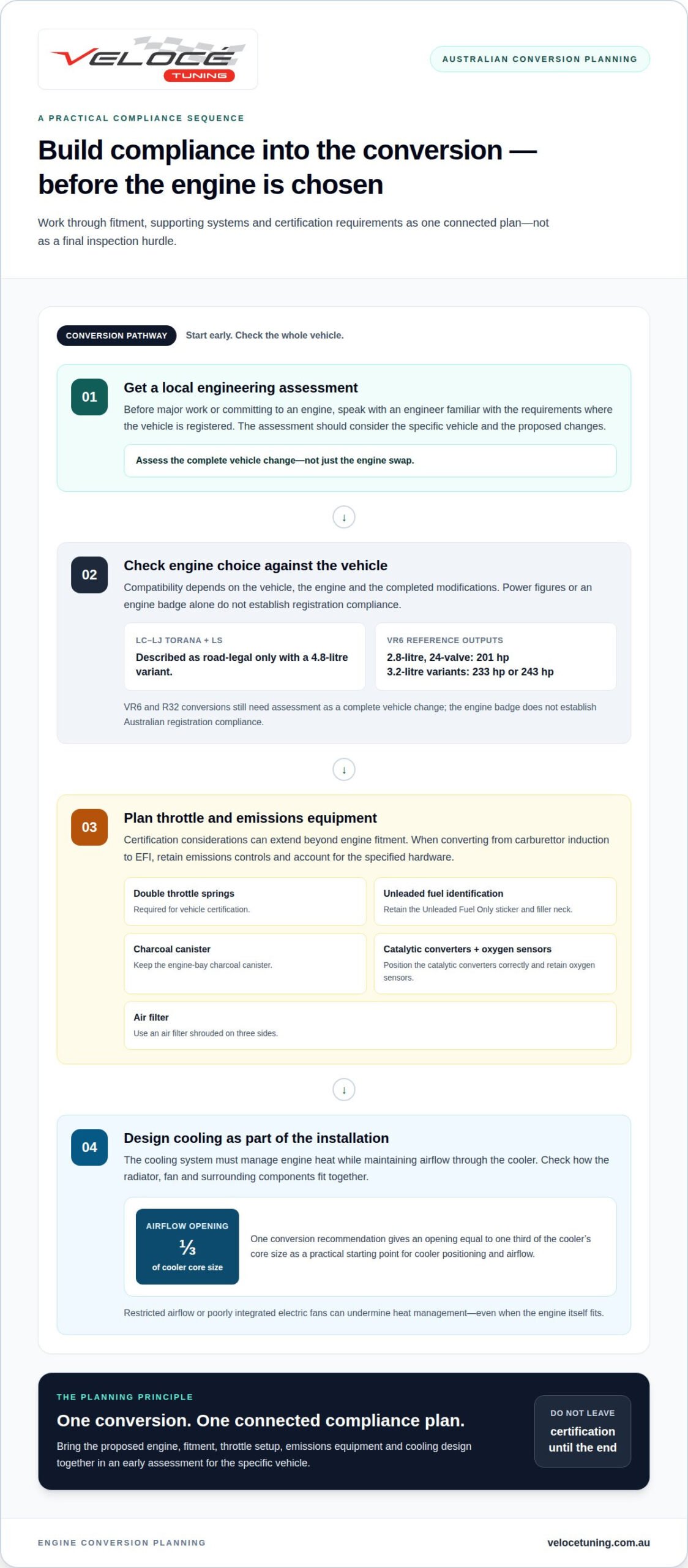
Compatibility depends on the vehicle, engine and completed modifications. An LS conversion in an LC-LJ Torana is described as road-legal only with a 4.8-litre variant; common mistakes include choosing on power alone and overlooking emissions, cooling or throttle requirements.
VR6 and R32 conversion requirements
A VR6 or R32 conversion needs to be assessed as a complete vehicle change, not just an engine swap. A 2.8-litre, 24-valve VR6 is listed at 201 hp, while 3.2-litre VR6 variants are listed at 233 hp or 243 hp. Those outputs make the engine choice relevant to the vehicle’s supporting systems, but the engine badge alone doesn’t establish Australian registration compliance.
Before work begins, consult an engineer familiar with requirements where the vehicle is registered. An early assessment helps identify the fitment and certification considerations for the specific vehicle, rather than relying on a conversion approved for a different model.
Cooling-system requirements
A cooling system must manage the fitted engine’s heat while maintaining airflow through the cooler. One conversion recommendation is an opening equal to one third of the cooler’s core size to provide airflow. This offers a practical starting point for positioning the cooler and its opening within the vehicle.
Cooling also depends on how the radiator, fan and surrounding components fit together. An installation that restricts airflow or integrates the electric fan poorly can undermine heat management, even when the engine itself fits. Treat cooling as part of the conversion design, not a finishing detail.
Australian certification considerations can extend beyond engine and cooling fitment. Vehicle certification requires double throttle springs. When converting from carburettor induction to EFI, retain emissions controls, including the Unleaded Fuel Only sticker and filler neck, engine-bay charcoal canister, correctly positioned catalytic converters and oxygen sensors, and an air filter shrouded on three sides.
These details can be easy to miss when attention is fixed on power or exhaust sound. A local engineer’s assessment before major work helps bring the proposed engine, throttle setup, emissions equipment and installation into the same compliance plan. That is a more reliable starting point than treating certification as a final inspection hurdle.
Choosing an LS engine for vehicle capacity limits
An LS badge doesn’t guarantee an engine will fit. Compare its dimensions with the vehicle’s available space, then consider output, weight and intended use.
Engine capacity limits
Vehicle capacity limits are the physical and practical constraints that determine whether an LS can fit and work in the available space. They matter because the factory intake, sump and accessories all take up room beyond the block itself.
A VX 5.7-litre LS1 measures 500 mm from the bottom of the block to the top of its factory intake manifold, excluding the sump and accessories. Its cylinder heads span 515 mm at their outermost points, while the block is 460 mm across and 530 mm front to rear, excluding accessories. These measurements make clearance a first design consideration, not an afterthought.
Matching engines to vehicle weight and use
Vehicle weight and intended use help determine whether an engine’s output will feel manageable or excessive. An LS-series engine’s listed stock outputs range from 257-476 kW, so “LS” covers a broad performance spread rather than one predictable result.
A lighter vehicle used regularly on the road has different demands from a heavier one built to carry sustained loads. Consider how the engine’s power and torque delivery suit the vehicle and transmission. The strongest output figure alone won’t tell you how the combination will drive.
For reference, the VX 5.7-litre LS1 block measures 335 mm from the bottom of the casting to the top of the lifter valley. That dimension can help assess vertical clearance, but it excludes the full intake height and doesn’t replace checking the complete fitted package. Allow for wiring, injection components and accessories when considering a factory-based or custom arrangement.
Engine size, power and torque shape acceleration, response and how readily a vehicle moves under load. Higher output can affect drivability and fuel consumption, but the result also depends on the vehicle, transmission and how the engine is used.
For an assessment that brings engine fitment and vehicle requirements together, explore engine conversion support.
Matching engines to vehicle weight, use and transmission
Start with the vehicle’s job, then match engine delivery and transmission to that role. A light road car, touring four-wheel drive and work vehicle place different demands on an engine. Peak power alone won’t show how readily the vehicle moves from low speed, carries a load or responds through the gears.
Torque helps explain that character. A Ford Barra is listed with torque outputs of 450-650 Nm, while a Cummins 4.5L four-cylinder common-rail turbo-diesel is described as producing 200 HP and 750 Nm when adapted to a Nissan five-speed manual. Those examples show why an engine’s torque and power figures need to be considered together, not treated as interchangeable measures.
For a heavier vehicle or one that regularly carries loads, consider how the engine delivers usable torque across different driving conditions. A vehicle used mainly for relaxed road driving may need a different response from one that regularly tows or travels off-road. Intended use shapes the balance between sharp acceleration, flexible delivery and a setup suited to sustained work.
The transmission is part of that match. An engine’s output must work with the gearbox, clutch and driveline, so a conversion should account for how the selected transmission handles the engine’s delivery. The Cummins and Nissan example pairs a 4.5L engine with a five-speed manual; it illustrates a complete combination rather than an engine choice in isolation.
Consider how you’ll drive the vehicle, what it will carry and how you’ll use the gears. A high-output engine can feel mismatched if the vehicle’s weight and transmission don’t suit its power delivery. A combination chosen for the vehicle’s actual role can make acceleration and load response feel deliberate, rather than abrupt or strained. Match the whole package, not just the engine badge.
What are the differences between petrol, diesel, hybrid and electric engine conversions?
Each conversion affects a different set of systems, so the engine type changes more than what sits beneath the bonnet. Compare the vehicle’s intended use with the fuel, driveline and control systems the new setup requires.
Petrol conversions centre on a spark-ignition engine and its fuel, ignition and exhaust systems. Changing from carburettor induction to electronic fuel injection also brings emissions equipment into the picture. For Australian certification, this can include catalytic converters, oxygen sensors and an engine-bay charcoal canister. The final arrangement needs to work as a complete system, not simply deliver the desired sound or power.
Diesel conversions use compression ignition and are often considered where torque and load-carrying matter. The engine, fuel system, transmission and vehicle role need to suit one another. For example, a Cummins 4.5L four-cylinder common-rail turbo-diesel is described as producing 200 HP and 750 Nm when adapted to a Nissan five-speed manual. That pairing illustrates how engine output and transmission choice form one package.
Hybrid conversions combine an internal-combustion engine with an electric motor and battery system. The conversion involves integrating more than one source of drive, along with the controls that coordinate them. How these components fit the vehicle and work with its existing driveline shapes the project’s scope.
Electric conversions replace combustion with an electric motor and battery-based energy system. The design must account for the motor, battery placement, power electronics and charging arrangement. These components affect packaging and power delivery, so the vehicle’s available space and intended use remain central to the choice.
For any of these options, the conversion decision should account for the vehicle, its operating demands and the systems that must work together. A petrol setup may suit a different goal from a diesel, hybrid or electric arrangement; there’s no single option that fits every project. Discuss an engine conversion when you’re ready to shape a complete setup around your vehicle.
Veloce Tuning: Engine Conversions
Veloce Tuning carries out engine conversions for drivers planning a change in performance, vehicle use or powertrain. Turn to the Carrum Downs workshop when weighing an engine choice against fitment, drivability and the supporting work your vehicle may need.
A conversion involves more than fitting an engine into the bay. The engine, transmission, cooling, emissions equipment and vehicle’s intended role all need to work together. Veloce Tuning can shape the conversion around these considerations. Suspension and lift kits can also suit vehicles whose setup needs attention. Logbook servicing supports ongoing maintenance after the build, while fleet servicing helps businesses manage their vehicles.
Bring your conversion plans to Veloce Tuning and discuss the engine direction that suits your vehicle and its intended use. Contact Veloce Tuning to talk about an engine conversion.
Shape the conversion around your next drive
Before committing to a powertrain, turn your idea into a clear brief: describe how you use the vehicle, what you want it to do differently and what compromises you’re prepared to make. This gives the conversion a purpose beyond fitting a bigger engine and keeps the discussion focused on the whole vehicle, not a single output figure.
Choosing the right engine for a conversion is ultimately about creating a combination that fits your vehicle and the way you intend to drive it. If you’re ready to move from possibilities to a considered plan, Veloce Tuning in Carrum Downs can discuss an engine conversion and supporting work for your vehicle. Start with a conversation grounded in your goals, not a one-size-fits-all formula.
Contact Veloce Tuning to discuss your conversion and take the next step towards a build shaped around the drive you want. Your project starts with a clear direction.
Frequently Asked Questions
What factors should I consider when choosing an engine for a vehicle conversion?
Choosing the right engine for a conversion starts with the vehicle’s purpose, then considers fitment, driveline compatibility, fuel-system requirements and parts availability. A daily-driven hatchback has different priorities from a ute used for regular loads. Also consider how the conversion may affect servicing and future repairs. A good choice is an engine whose supporting components and maintenance needs suit how you’ll use the vehicle.
What are Australia’s state and territory rules for engine swaps and vehicle modifications?
Engine-swap requirements can depend on where the vehicle is registered and the extent of its modifications. Don’t assume an approval or interpretation in one state or territory automatically applies elsewhere. Before settling on an engine, discuss the proposed changes with an engineer familiar with requirements where the vehicle is registered. This can help clarify the relevant assessment pathway before parts are fitted or major work begins.
What approvals, inspections and engineering certificates are needed for an engine conversion in Australia?
Approvals and inspections depend on the vehicle and the conversion’s scope. An engineer’s assessment can identify which modifications need consideration and what evidence may be needed for certification. Keep clear records of the engine details, components fitted and work completed. These help explain how the finished vehicle differs from its original configuration. Plan the assessment before work progresses, rather than treating certification as an afterthought.
How does an engine conversion affect registration, insurance, roadworthiness and emissions compliance?
A conversion can affect how the vehicle is assessed for registration and roadworthiness, whether its emissions equipment remains appropriate, and what information is relevant to your insurance policy. Keep modification records together and provide accurate details to the relevant registration authority and insurer. For example, an EFI conversion from carburettor induction needs attention to emissions equipment, not just fuel delivery and engine operation.
What steps should I follow to choose and plan an engine conversion?
First, define the vehicle’s intended use and the changes you want in how it drives. A practical approach to choosing the right engine for a conversion is to narrow options by fitment, transmission compatibility, supporting systems and the applicable engineering pathway. Discuss the proposed setup with an engineer familiar with local requirements before major work begins. Then plan documentation and ongoing maintenance so the engine suits the vehicle’s role beyond its first drive.