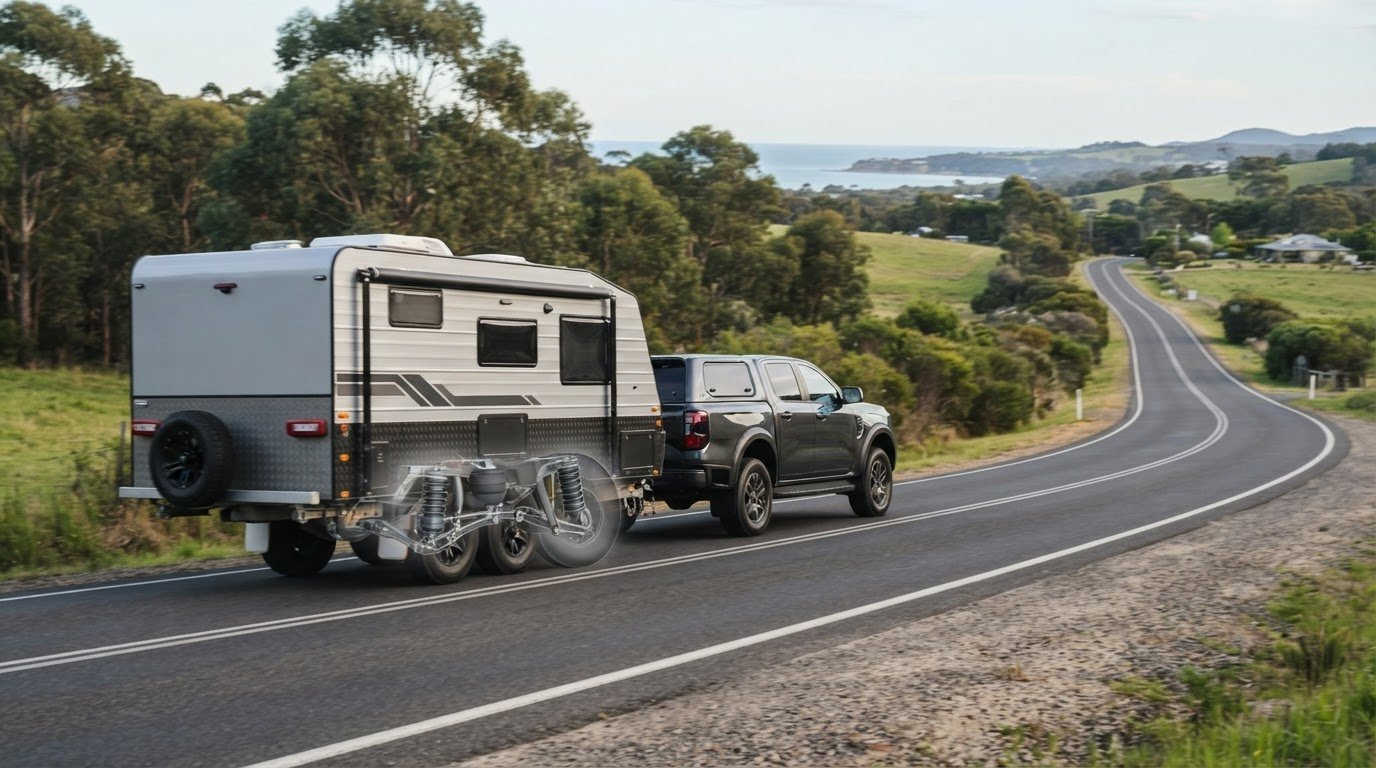
Bolting in stiffer rear springs just to hide bumper droop is the quickest way to compromise a tow rig. You know the white-knuckle sensation all too well; headlights aiming into the treetops, the steering wheel going light and numb in your palms, and a heavy caravan dragging your chassis into a sickening sway as an oncoming road train blasts past. That tail-down posture is far more than an eyesore. It unweights your front tyres, bleeds off steering traction, and risks pushing your vehicle over legal axle limits. Finding the best suspension upgrade for towing heavy loads is not about cosmetically leveling the tow bar; it is about mastering dynamic axle loads under real-world touring conditions.
In this 2026 buyer’s guide, you’ll discover how engineered suspension upgrades eliminate sag, stabilise heavy loads, and keep your towing setup safe and legal across Australian roads. We unpack the critical differences between helper airbags, dual-rate coils, and position-sensitive dampers, giving you the clarity needed to achieve flat cornering and razor-sharp braking stability without turning your unhitched daily drive into a bone-jarring chore.
Key Takeaways
- Rear sag levers critical weight off your steer axle, lengthening braking distances and inviting dangerous trailer sway at open-road speeds.
- Choosing the right suspension upgrade for towing heavy loads requires balancing heavy-duty spring rates with pneumatic helper airbags to preserve unladen daily ride quality.
- Aftermarket suspension hardware alone does not legally increase your vehicle’s factory Gross Vehicle Mass (GVM) or rear axle load ratings without certified engineering compliance.
- Accurately calculating your true payload and tow ball download on calibrated scales is essential before locking in any hardware modifications.
- Transforming a tow vehicle into an unshakable touring rig requires a total system approach, integrating tailored suspension geometry, tuned dampers, and high-performance braking.
Why Factory Suspension Collapses Under Heavy Towing Loads
Showroom dual-cabs and four-wheel drives leave the dealership calibrated for empty-tray suburban comfort. Their compliant factory springs deliver a supple, passenger-car ride across city streets, but hooking up a multi-tonne caravan completely destroys that delicate chassis balance. Under persistent tongue weight, stock springs rapidly bind up, forcing the vehicle to ride permanently on its secondary stages. Meanwhile, standard twin-tube shock absorbers overheat as they fight relentless oscillation, frothing their hydraulic fluid into useless foam. Damping control vanishes. The rear end begins to wallow through highway undulations, while the chassis hammers violently against factory rubber bump stops. Investing in an engineered suspension upgrade for towing heavy loads solves this foundational weakness, transforming a compromised, pitching platform into an unshakable tow vehicle.
The Physics of Tow Ball Weight and Dynamic Sag
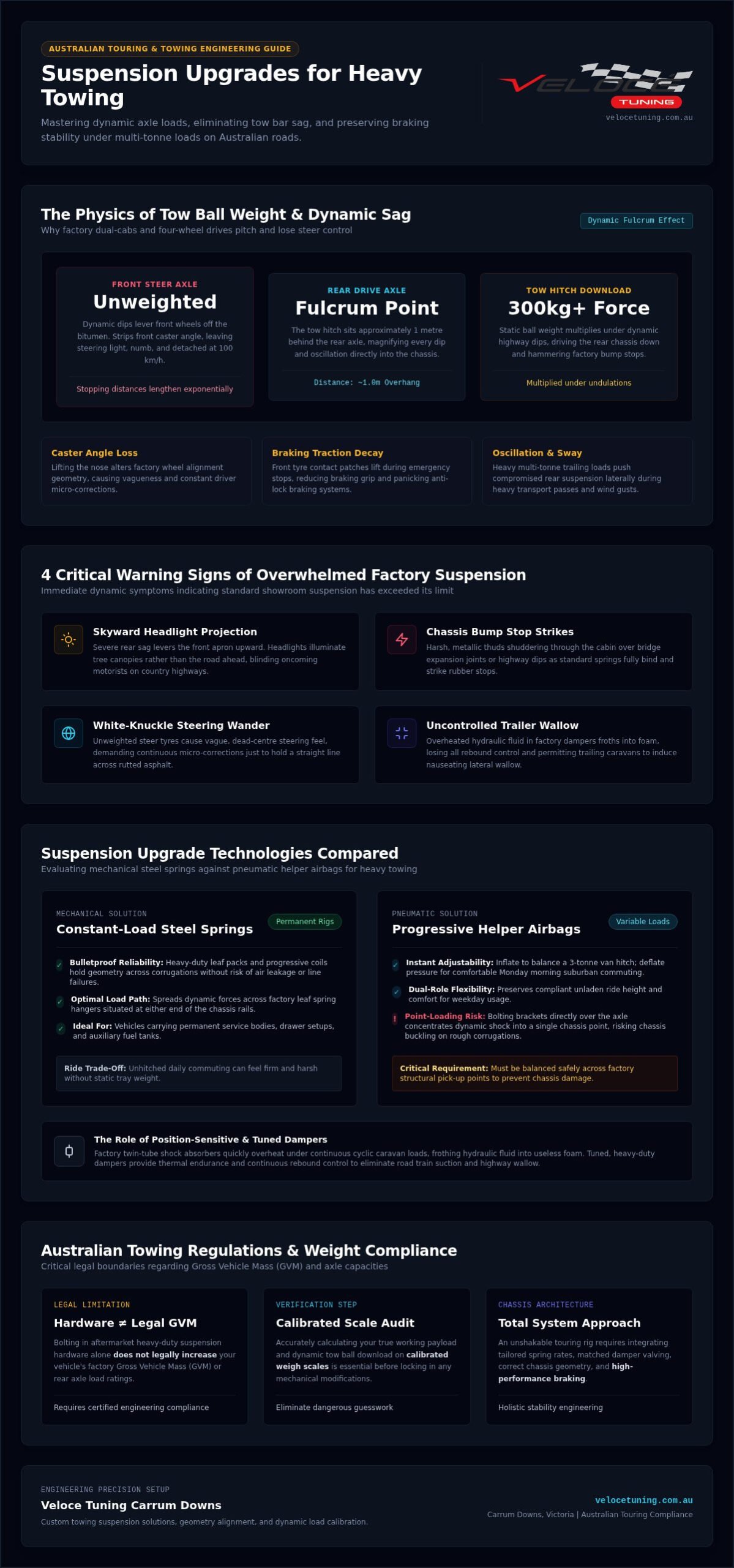
Towing dynamics operate on simple, ruthless physics. Because your tow hitch sits roughly a metre behind the rear axle, that rear axle acts as a fulcrum. A 300kg static ball weight does not simply compress the rear springs; dynamic highway dips multiply that force, levering the front wheels right off the tarmac. This sudden chassis tilt strips away essential front caster angle, leaving your steering sensationally light, numb, and detached at 100 km/h. During sudden avoidance manoeuvres or emergency stops, front tyre contact patches lift. Braking capacity decays instantly, sending anti-lock braking systems into a panic and exponentially lengthening stopping distances.
Recognising the Warning Signs of Overwhelmed Suspension
Pushing a factory vehicle suspension system past its dynamic limits reveals distinct, immediate symptoms on the blacktop:
- Skyward headlight projection: Pronounced rear sag raises the front apron, illuminating tree canopies while blinding oncoming motorists on country highways.
- Chassis-jarring bump stop strikes: Harsh, metallic thuds shuddering through the cabin whenever the vehicle encounters bridge expansion joints or undulating dips.
- White-knuckle steering wander: Constant micro-corrections required at the steering wheel to keep the rig tracking straight across rutted asphalt.
- Uncontrolled trailer wallow: Trailing loads rocking the tow tug laterally after encountering wind gusts, rutted bitumen, or passing heavy transports.
Addressing these red flags with a dedicated suspension upgrade for towing heavy loads restores crucial front-axle bite and anchors your chassis firmly to the pavement.
Suspension Upgrade Technologies Compared: Springs, Airbags, and Dampers
Tackling severe dynamic sag demands hardware engineered for structural discipline. Upgrading your rig is never a one-size-fits-all equation; matching spring rates and hydraulic valving to your specific setup determines whether your vehicle glides serenely or fights you at every highway bend. Selecting the right suspension upgrade for towing heavy loads means understanding how steel, air, and damping fluids interact under crushing dynamic stress.
Constant Load Springs vs. Progressive Auxiliary Airbags
Heavy-duty steel leaf packs and progressive-rate coils provide unyielding mechanical integrity. For dedicated touring builds carrying permanent service bodies, drawer systems, and auxiliary fuel tanks, constant-load steel springs are bulletproof. They hold their geometry across thousands of brutal corrugations without risk of air leakage or line failure.
Pneumatic helper airbags, on the other hand, offer instant adjustability. Pump them up when hitching a 3-tonne van; drop the pressure back down on Monday morning for a comfortable suburban commute. Caution is vital, however. Dual-cab ute chassis rails are designed to distribute weight across leaf spring hangers at either end. Bolting an airbag bracket directly over the axle concentrates immense dynamic shock into a single point on the chassis rail. Over rough corrugated routes, this concentrated leverage can buckle a chassis clean in half. Maintaining structural safety and adhering to Australian towing regulations requires balancing these axle loads safely across factory structural pick-up points.
The Critical Role of Heavy-Duty Shock Absorbers
Springs carry the weight, but dampers command the motion. Factory twin-tube shocks quickly overheat under relentless tow-ball oscillation. Aerated oil loses its viscosity, inducing dangerous secondary rebounds that whip the trailer into uncontrolled harmonic sway.
Upgrading to large-bore monotube dampers or remote-reservoir units separates high-pressure nitrogen gas from the shock oil with a floating piston, completely eliminating fluid cavitation. Velocity-sensitive valving instantly controls both low-speed body roll during high-speed lane changes and high-speed impacts over sunken bridge joints. When dialled in correctly, your rig tracks straight and settles immediately after every dip.
To eliminate guesswork, exploring engineered suspension and lift kits ensures your spring rates and shock valving are calculated to work in perfect harmony. Investing in a properly matched suspension upgrade for towing heavy loads turns an unpredictable, wallowing rig into a rock-solid towing machine.
Australian Towing Regulations: GVM, Axle Capacities, and Legal Compliance
Bolting in reinforced coils or heavy-duty leaf springs transforms dynamic stability, but mechanical strength does not grant instant legal clearance. Many drivers assume fitting an aftermarket suspension upgrade for towing heavy loads automatically increases their payload rating. It does not. A vehicle’s legal limits remain fixed to its factory compliance plate until an accredited engineering signatory certifies and plates the modification. Grasping the legal architecture behind how car suspensions work under load protects you from catastrophic insurance denials and crushing regulatory fines.
Decoding Towing Acronyms: GVM, GCM, ATM, and TBM
Safe towing requires balancing four interrelated weight thresholds:
- Gross Vehicle Mass (GVM): The maximum permissible operating weight of your vehicle, encompassing kerb weight, passengers, fuel, bullbars, camping setups, and the trailer’s tow ball download.
- Gross Combination Mass (GCM): The absolute maximum legal weight of the tow vehicle and trailer hitched together. Exceeding this figure is illegal, regardless of individual vehicle modifications.
- Aggregate Trailer Mass (ATM): The total weight of your fully packed trailer unhitched from the vehicle.
- Tow Ball Mass (TBM): The vertical mass pressing down onto the tow ball. In Australia, this generally sits between 8% and 12% of the total loaded trailer mass.
Dynamic transfer complicates these static numbers. Every kilogram of tow ball weight levers additional strain across the rear axle while simultaneously unloading the front tyres.
Engineering Certification and State Road Compliance in Victoria
Exceeding manufacturer axle ratings is a critical compliance failure. If you cross a weighbridge over your rear axle limit, or cause a crash with an uncertified, overloaded vehicle, insurers can reject claims entirely. Road safety authorities enforce strict penalties, and under Heavy Vehicle National Law Chain of Responsibility rules, corporate penalties can stretch into millions for severe load breaches.
Installing an engineered suspension upgrade for towing heavy loads delivers the structural composure needed to support heavy gear, but post-registration GVM upgrades in Victoria demand a formal Vehicle and Safety Engineering Certificate (VASS sign-off). This process verifies that braking response, chassis integrity, and steering geometry remain fully compliant with Australian Design Rules. Professional wheel alignments must follow every suspension alteration, resetting caster and toe angles under real-world load conditions to prevent rapid tyre shredding and erratic highway tracking.
How to Choose the Right Towing Suspension Setup for Your Rig
Dialling in the perfect towing setup requires a methodical engineering approach rather than pulling generic parts off a showroom shelf. When you build a system around your vehicle’s specific operating demands, you eliminate both white-knuckle highway handling and punishing unladen ride harshness. Follow this five-step framework to configure the ideal setup:
- Calculate true operating payload: Total up the mass of your bullbar, winch, dual-battery systems, roof racks, fuel, and passengers.
- Weigh actual tow ball download: Use a calibrated tow ball weight scale to check your unhitched trailer tongue mass rather than relying on manufacturer estimates.
- Assess operating cycles: Determine whether your rig functions as a full-time heavy haulier or alternates between weekend towing and daily suburban commuting.
- Select matched components: Pair appropriate spring rates with large-bore dampers capable of managing heavy dynamic loads.
- Integrate supporting vehicle systems: Upgrade braking hardware and powertrain output to match your newly stabilised chassis dynamics.
Matching Hardware to Towing Applications
Different tasks demand purpose-built hardware configurations. A tradie’s dual-cab hauling heavy mini-excavators or tandem plant trailers requires heavy multi-stage leaf packs, reinforced spring shackles, and poly bushes to withstand brutal downward force. Conversely, a touring wagon pulling a three-tonne off-road caravan performs best with progressive-rate coil springs and remote-reservoir monotube dampers. Fitting an engineered suspension lift kit Melbourne drivers trust allows extra clearance for rugged tracks while retaining the dynamic stability essential for safe highway towing.
The Complete Heavy-Haul Performance Ecosystem
Stabilising your chassis is only half the battle when shifting multi-tonne loads. Hauling massive drag up steep alpine gradients demands sustained low-end grunt. Calibrating your engine management system via ECU tuning for fuel economy Melbourne wide broadens the torque band, reducing transmission hunting and keeping exhaust temperatures in check. Heavy loads also punish standard braking systems. Fitting upgraded slotted rotors and high-friction brake pads delivers firm, repeatable pedal response, eliminating terrifying fade down winding mountain passes. Regular mechanical check-ups via a certified log book service Carrum Downs workshop protect transmission fluid life and drivetrain seals under extreme duty cycles.
If you’re ready to transform your towing experience, speak with the team at Veloce Tuning to build a tailored suspension upgrade for towing heavy loads that delivers unmatched highway poise.
Engineering Precision: Custom Towing Upgrades at Veloce Tuning Carrum Downs
Off-the-shelf retail lift kits often treat heavy towing as an afterthought, relying on rigid, generic valving that rattles your teeth loose when the trailer is unhitched. True dynamic composure requires master-craftsman precision. At Veloce Tuning in Carrum Downs, we apply European-calibrated mechanical principles directly to tough Australian towing platforms. We look past cosmetic ride height to engineer complete chassis synergy. By integrating high-capacity springs, tailored dampers, performance brake upgrades, and custom ECU tuning under one roof, our technicians transform standard workhorses into unflappable, cross-country tourers.
Bespoke Suspension Calibrations for Frankston and the Mornington Peninsula
Positioned conveniently in Carrum Downs, our specialised workshop serves drivers across Frankston, Seaford, Patterson Lakes, and the broader Mornington Peninsula. We recognise that hauling a twin-axle offshore fishing boat out to Port Phillip Bay places vastly different stresses on your rear geometry than towing an off-road horse float through the rolling hills of Red Hill. Every build begins with an exact axle load assessment.
Our workshop team fits premium dampers, reinforced leaf or coil configurations, and sophisticated pneumatic helper systems matched strictly to your specific towing profile. Precision matters. Once hardware is torqued to spec, your rig undergoes computerised laser alignment to restore optimal caster, camber, and toe angles under real-world load conditions. The result is total straight-line stability, rock-solid braking bite, and zero tyre scrub.
Transform Your Towing Confidence Today
White-knuckle towing belongs in the past. Eliminate the stomach-churning wallow of passing road trains, banish headlight flare, and rediscover the visceral satisfaction of a vehicle that corners flat and stops on command. When your chassis, brakes, and engine work as a unified performance ecosystem, hauling heavy loads shifts from a high-stress chore to an effortless drive.
Stop settling for generic compromise. If you want a perfectly matched, legally compliant suspension upgrade for towing heavy loads, partner with automotive specialists who share your passion for mechanical excellence. Take total control of your rig and book your suspension consultation at Veloce Tuning today.
Take Total Command of Your Next Heavy Haul
Hooking up multi-tonne machinery or an off-road caravan shouldn’t turn highway touring into a white-knuckle ordeal. Investing in an engineered suspension upgrade for towing heavy loads does far more than mask rear sag; it restores crucial front-end steering bite, eliminates trailer sway, and ensures strict legal compliance across Australian roads. True towing poise comes from total mechanical balance, not generic quick fixes.
At Veloce Tuning in Carrum Downs, our specialised performance facility uses precision diagnostic tooling to eliminate compromise. Our master technicians draw on deep 4×4, commercial, and European platform expertise to deliver comprehensive vehicle optimisation, integrating tailored suspension geometry with upgraded brakes and custom ECU tuning. Ready to experience flat, unflappable handling on every journey? Upgrade your towing rig at Veloce Tuning and conquer the open road with complete confidence.
Frequently Asked Questions
Will a suspension upgrade increase my vehicle legal towing capacity?
No, hardware upgrades do not legally alter your vehicle’s factory braked towing capacity or Gross Combination Mass (GCM). Upgraded springs and dampers significantly enhance dynamic stability, eliminate tail squat, and protect running gear under heavy loads. However, legally increasing your vehicle’s payload capacity requires a certified Gross Vehicle Mass (GVM) upgrade package signed off by an accredited automotive engineer to update your vehicle compliance records.
Can I tow heavy loads using helper airbags alone without upgrading my springs?
Helper airbags level out cosmetic rear sag, but relying on them alone for extreme towing can compromise your chassis. Airbags inflate to restore ride height, yet they do not increase underlying structural spring rates. On dual-cab utes, heavily inflated airbags concentrate severe upward shock loads onto a single point on the chassis rail. A comprehensive suspension upgrade for towing heavy loads combines rated steel springs with matched dampers to distribute weight safely across factory mounting points.
How much tow ball weight causes my front steering to become dangerously light?
Any tow ball download exceeding roughly 10% of a vehicle’s unladen kerb weight can trigger noticeable front-end lift if factory springs are too soft. Once 250kg to 350kg levers down behind the rear axle, the chassis pivots, unweighting the steer tyres. This reduces positive caster angle, leaving the steering wheel feeling detached and twitchy at 100 km/h while drastically increasing stopping distances on wet Victorian roads.
What happens if my vehicle exceeds its Gross Vehicle Mass or axle load limits while towing?
Exceeding legal mass thresholds carries severe financial and safety risks on Australian roads. Transport authorities and highway patrols can issue heavy infringement notices, apply demerit points, or issue immediate grounding notices that prevent you from continuing your trip. More critically, driving an overloaded vehicle breaches road safety compliance, providing insurance providers with direct justification to void your comprehensive policy entirely after an accident.
Is a suspension lift kit suitable for towing heavy caravans and commercial trailers?
Yes, provided the kit is engineered specifically for load management rather than extreme axle articulation. Standard off-road lift kits often prioritise supple suspension flex, which amplifies body roll and highway trailer sway. A dedicated suspension upgrade for towing heavy loads utilises constant-load progressive coils or heavy-duty leaf packs with tailored damper valving, maintaining a modest, functional ride height while keeping your tow rig flat, composed, and rock solid.
How do heavy-duty shock absorbers reduce trailer sway on regional Australian highways?
Heavy-duty monotube dampers prevent dynamic oscillations before they escalate into dangerous lateral sway. Factory twin-tube shock absorbers quickly overheat on undulating country roads, aerating their hydraulic fluid and losing damping force. High-performance dampers utilise larger oil volumes and high-pressure nitrogen gas to prevent cavitation. Their velocity-sensitive valving immediately controls violent rebound strokes caused by crosswinds, road ruts, or passing semi-trailers, settling the chassis instantly.
Can Veloce Tuning install and set up towing suspension packages in Carrum Downs?
Yes, our fully equipped workshop in Carrum Downs provides complete towing suspension installations for drivers throughout Frankston, Seaford, Patterson Lakes, Sandhurst, Skye, and Mornington. Our master technicians carry out precise axle weight checks, install heavy-duty suspension and lift kits, and complete precision laser wheel alignments. We also deliver supporting brake upgrades and custom ECU tuning to ensure your entire vehicle performs with effortless capability under heavy loads.