A breakdown is a safety issue before it’s a mechanical one. If you need an emergency breakdown service in Frankston, move your vehicle to a safe place off the traffic lane where possible. If it stops close to traffic, leave through the passenger-side door and stand as far from the road as you can. Drivers must slow to 40 km/h when passing specified stationary or slow-moving roadside and emergency vehicles with flashing lights.
It’s understandable to want to know what an emergency breakdown service in Frankston can cover: whether the issue can be dealt with roadside, what happens if the vehicle can’t continue, and how to stay safe while waiting. The right response depends on the fault and the vehicle’s condition, not just the fact that it has stopped.
This guide explains what roadside assistance can involve, what to do while waiting, and when towing may be needed because a repair isn’t possible at the roadside. It also covers the details that help describe the fault clearly, so you can identify the practical next step and get back on the road when it’s safe to do so.
Key Takeaways
- Know what details to share when arranging roadside help, so the fault and your location are clear.
- Understand what can determine whether a vehicle is repaired at the roadside or needs towing.
- Learn what to consider when a flat battery or tyre brings your trip to a stop.
- See when a breakdown service can help and how ongoing vehicle care may support more dependable driving.
24/7 Roadside assistance contact
Contact roadside assistance with your exact location and a clear description of the breakdown. Near Frankston, a road name, direction of travel and nearby landmark can help identify where assistance needs to attend.
Contacting Assistance in Frankston and Victoria
Use the roadside assistance number provided by your service provider or vehicle assistance documents. When travelling elsewhere in Victoria, give the operator the town or suburb, road name, direction of travel and nearest exit or intersection. A freeway marker or recognisable landmark can help distinguish your position from the opposite carriageway. Tell the operator if the vehicle is obstructing traffic or occupants are exposed to passing vehicles, so they understand the situation from the outset.
Details to Give the Operator
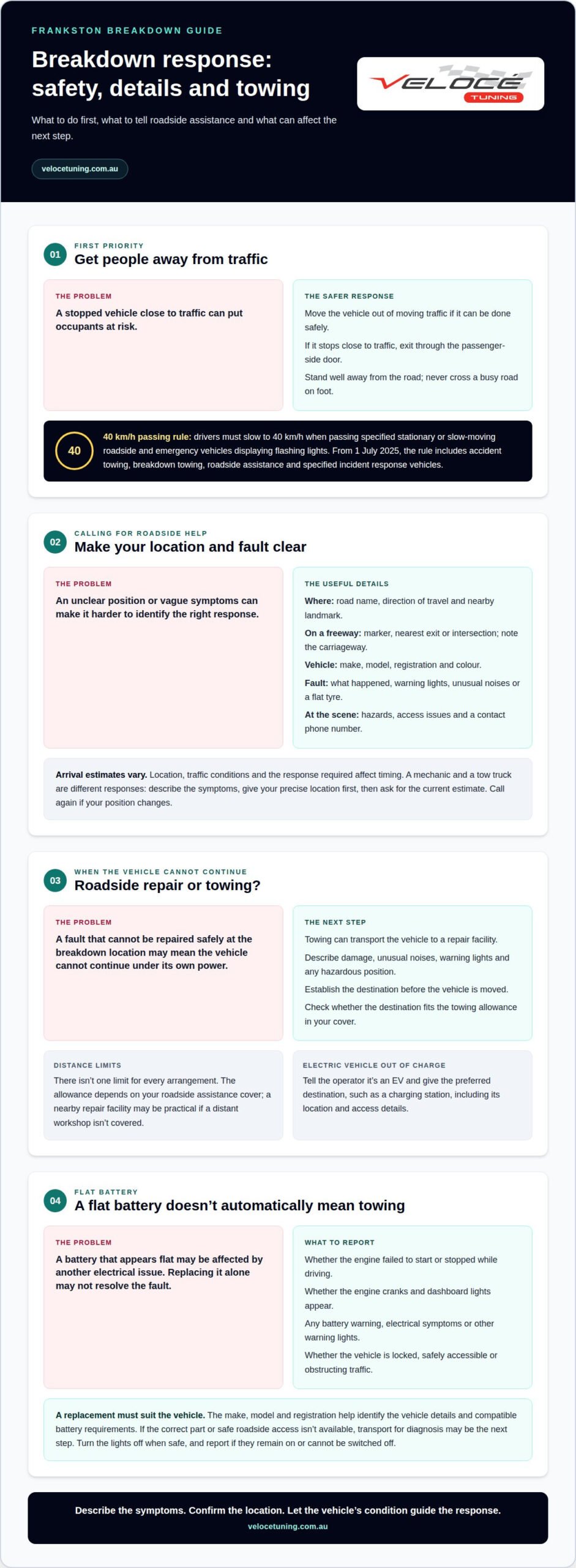
Share the vehicle’s make, model, registration and colour, then describe what happened, such as a warning light, flat tyre or engine that won’t start. Give your exact location, direction of travel and a phone number for someone at the scene. Mention hazards such as smoke, a vehicle partly blocking a lane, or passengers who need assistance. Clear details help the operator understand the incident and arrange an appropriate response.
Mechanic and Tow Truck Arrival Times
There isn’t one arrival time for every Frankston breakdown. The estimate depends on the vehicle’s location, traffic conditions and the response required. A mechanic and a tow truck are different responses, so describe the symptoms rather than assuming which one is needed. Give the operator your precise location first, then ask for the current estimated arrival time. If your position changes, call again with the updated location.
Breakdowns on Roads and Freeways
Move the vehicle out of moving traffic to a safe place if it can be done safely. If it stops close to traffic, exit through the passenger door and stand well away from the road; never cross a busy road on foot. Victoria’s Road Rule 79A requires drivers to slow to 40 km/h when passing specified stationary or slow-moving roadside and emergency vehicles displaying flashing lights. From July 1, 2025, the rule includes accident towing, breakdown towing, roadside assistance and specified incident response vehicles.
Towing when on-the-spot repairs are not possible
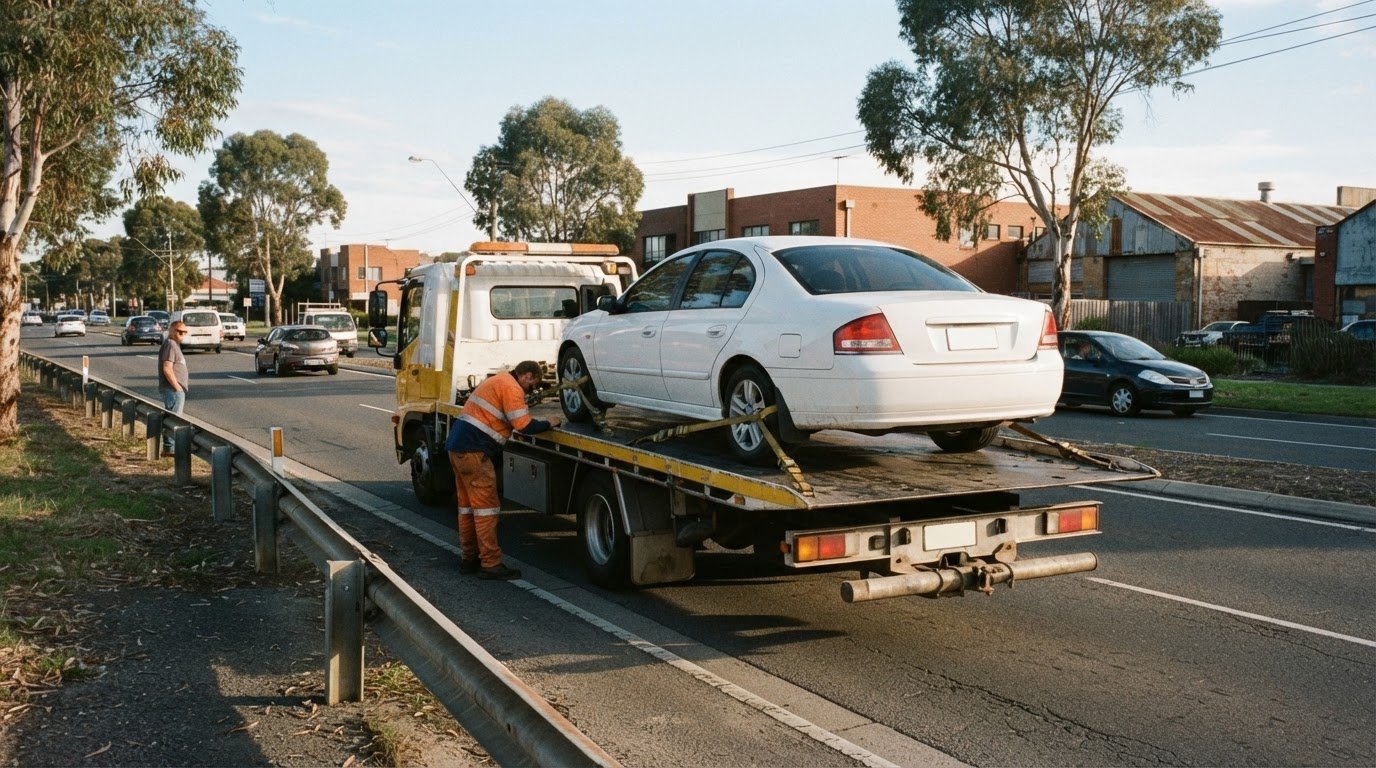
If a fault can’t be repaired safely at the roadside, towing can take the vehicle to a repair facility. The destination and method of transport matter.
If an electric vehicle has run out of charge, tell the operator it’s an EV and explain where you’d like it taken, such as a charging station. Include the station’s location and access details. The vehicle’s condition and suitable transport arrangements help determine the next step.
Vehicle Towing and Transport
Towing moves a vehicle that can’t continue under its own power. The operator can arrange transport to a repair facility when the fault can’t be fixed where the breakdown occurred. Describe any damage, unusual noises or warning lights, and say whether the vehicle is in a hazardous position. These details help identify the response required and clarify the proposed destination.
Breakdown Towing Distance Limits
There isn’t one distance limit for every breakdown towing arrangement. The allowance depends on the roadside assistance cover, and the destination may also affect the transport plan. Before the vehicle is moved, establish where it’s going and whether that destination fits the cover. A nearby repair facility may be a practical option when transport to a distant workshop isn’t covered.
Flat Battery Support and Towing
A flat battery doesn’t automatically mean the vehicle needs towing. Tell the operator whether the engine failed to start, stopped while driving, or showed a battery warning, as these symptoms can point to different faults. If the issue can’t be resolved at the breakdown location, towing to a repair facility can allow further diagnosis. Mention any electrical problems or warning lights before transport is arranged.
Battery and emergency parts replacement
A flat battery can leave a vehicle unable to start, but it may not be the only cause. A technician can assess the symptoms, including whether the engine cranks and dashboard lights appear. If a battery replacement is suitable, the vehicle’s make and model help identify a compatible part. The registration can also help confirm the vehicle details.
Describe what happened before the breakdown, such as whether the battery warning light appeared while driving or the vehicle failed to start after being parked. Tell the operator if the vehicle is locked, parked in traffic or difficult to access. Those details help determine whether roadside assessment is practical and what equipment or parts may be needed.
- Give the vehicle’s make, model and registration.
- Describe warning lights, starting problems and any recent electrical symptoms.
- Explain whether the vehicle is safely accessible or obstructing traffic.
Emergency parts replacement depends on matching the component to the fault. A battery that appears flat may be affected by another electrical issue, so replacing it alone may not resolve the problem. For example, if the vehicle starts but warning lights remain on, report that clearly rather than describing the incident only as a flat battery. Accurate symptoms guide the next assessment.
For a replacement, the operator needs enough detail to identify the battery size and vehicle requirements. A part that fits one model may not suit another. If the correct part or safe roadside access isn’t available, the next step may be transport for diagnosis. Turn the vehicle’s lights off when safe, and tell the operator if they remain on or can’t be switched off.
Flat tyre changes and repairs
A flat tyre can result from a puncture, damaged valve or impact with road debris. The first priority is to get the vehicle away from moving traffic, where it’s safe to do so. Don’t continue driving on a deflated tyre, as the wheel and tyre may sustain further damage. Tell the operator whether the tyre lost pressure suddenly or gradually.
A roadside assessment helps determine whether a repair is suitable or a wheel change is needed. The location and size of the damage matter, as does the tyre’s condition. A visible object in the tread is useful information, but don’t remove it yourself. Damage near the sidewall or a tyre that has come off its rim may require a different response.
When arranging assistance, give the operator the vehicle’s make and model, your location, and which tyre is affected. Mention whether the vehicle has a usable spare and whether it’s accessible. A spare that’s missing, damaged or unsuitable changes the options. If a replacement tyre or repair isn’t possible roadside, ask about the next step, such as transport to a repair facility.
If a tyre failure follows an accident or hard impact, describe what happened and report any visible wheel damage. A bent wheel, change in steering or vibration can indicate that the problem extends beyond the tyre. Don’t treat a temporary change as proof the vehicle is ready for normal driving; it may need further assessment before continuing.
For a puncture in Frankston, share clear symptoms and the vehicle details so the response can be planned around the fault. If another mechanical issue remains after the tyre incident, seek further vehicle support rather than continuing to drive with unresolved warning signs.
Veloce Tuning: 24/7 Breakdown Service
Veloce Tuning provides a 24/7 Breakdown Service for drivers who need assistance after a vehicle stops unexpectedly. It’s a practical next step when the car can’t continue and you need breakdown support. Share your location, vehicle details and what happened so the situation is clear.
Once the immediate issue is addressed, ongoing vehicle care can help keep your vehicle ready for the road. Veloce Tuning offers logbook servicing and fleet vehicle management, while suspension and lift kits support vehicle-specific setups. These services suit different needs, from scheduled maintenance to managing fleet vehicles or changing a vehicle’s suspension.
If you’re stranded or need help with vehicle care in Frankston, contact Veloce Tuning to discuss the assistance you need.
Keep your next drive moving
A roadside incident can be a prompt to think beyond getting the vehicle moving again. Once the immediate fault is addressed, consider what ongoing support fits your driving needs, whether scheduled maintenance, fleet management or changes to your vehicle’s setup. Veloce Tuning offers logbook servicing, fleet vehicle management, and suspension and lift kits for different ownership and driving requirements.
If you need an emergency breakdown service in Frankston or want to discuss the right next step for your vehicle, explain what happened and what support you need. Clear information makes the conversation more useful, whether you need urgent roadside assistance or ongoing vehicle care.
Contact Veloce Tuning for help and take the next step towards getting your vehicle ready for the road.
Frequently Asked Questions
What’s covered?
An emergency breakdown service in Frankston can involve assessing the fault, helping roadside or arranging towing if the vehicle can’t continue. Battery, tyre, lockout and fuel assistance may have separate inclusions or conditions. For example, a plan might assist with a flat battery but not cover a replacement part. Check the terms for the specific help included.
What do I do if my car breaks down at night?
Move the vehicle out of traffic if it’s safe, then make it visible with hazard lights. Give the operator your road, direction of travel and nearest landmark, especially where street lighting is poor. If you stay inside the vehicle while waiting, keep your seatbelt fastened. If there’s no phone reception in a remote area, stay with the vehicle and flag down another vehicle for help.
Which breakdown services cover Frankston and nearby suburbs?
Veloce Tuning provides an emergency breakdown service in Frankston and surrounding areas, including Carrum Downs, Patterson Lakes, Mornington, Skye, Seaford and Sandhurst. If the vehicle stops near a suburb boundary, share the road name, direction of travel and closest landmark. A precise location helps identify where assistance is needed, particularly on major roads with multiple entrances or access points.
Does roadside assistance cover battery, flat tyre, lockout and fuel emergencies?
These incidents may be included in some roadside assistance arrangements, but the specific help depends on the cover. A response to a flat battery, for example, may differ from supplying a replacement battery; changing a tyre may differ from repairing it. Lockout and fuel assistance can also have separate conditions. Read the inclusions and exclusions to understand what the plan covers.
What are the safety risks and steps when waiting for roadside assistance in Victoria?
Passing traffic is a key hazard, particularly when a vehicle is stopped near a live lane or in low visibility. If you’re in a remote area without phone reception, stay with your vehicle rather than sending passengers to find help. Never cross a busy road on foot after a breakdown. If you remain inside while waiting, keep your seatbelt on.
Does roadside assistance require membership, and are there call-out limits or exclusions?
Membership requirements, call-out limits and exclusions depend on the assistance arrangement. Before relying on a plan, look for limits on call-outs, towing distance, eligible vehicles or covered incidents. A policy may treat towing, parts replacement and roadside repairs differently. Keep the relevant membership or policy details accessible so you can identify the applicable cover if a breakdown interrupts your trip.