DSG servicing isn’t one-size-fits-all: the correct interval depends on the transmission, vehicle configuration, use and maintenance history. For many wet-clutch units, a VW DSG service in Frankston is due at about 60,000 kilometres, but other transmissions follow different requirements. If your Volkswagen has Haldex all-wheel drive, its fluid and pump screen maintenance has a separate schedule.
It’s easy to assume every DSG needs the same oil change at the same interval. But the gearbox code matters, as does its service history. This guide explains how transmission types affect maintenance, when DSG and Haldex servicing may be due, and why the correct fluid, procedure and service records matter. You’ll also learn what routine servicing covers, how it differs from fault diagnosis, and what information helps determine the next step for your Volkswagen.
Key Takeaways
- Identify the gearbox before planning maintenance: dry- and wet-clutch DSGs can have different service needs and procedures.
- For Haldex-equipped Volkswagens, include fluid changes and pump-screen cleaning in the maintenance plan at the recommended interval.
- Use oil that meets the required specification and keep clear service records to help track what’s due next.
- A service can help maintain a DSG, but existing symptoms or fault codes may call for diagnosis rather than routine maintenance alone.
Transmission-specific service requirements
Volkswagen DSG and Audi S tronic gearboxes come in different configurations, so servicing starts by identifying the transmission code. These gearboxes may have six or seven forward gears, with one clutch for odd-numbered gears and another for even-numbered gears. The code, not just the model badge, determines the correct fluid, filter and service procedure.
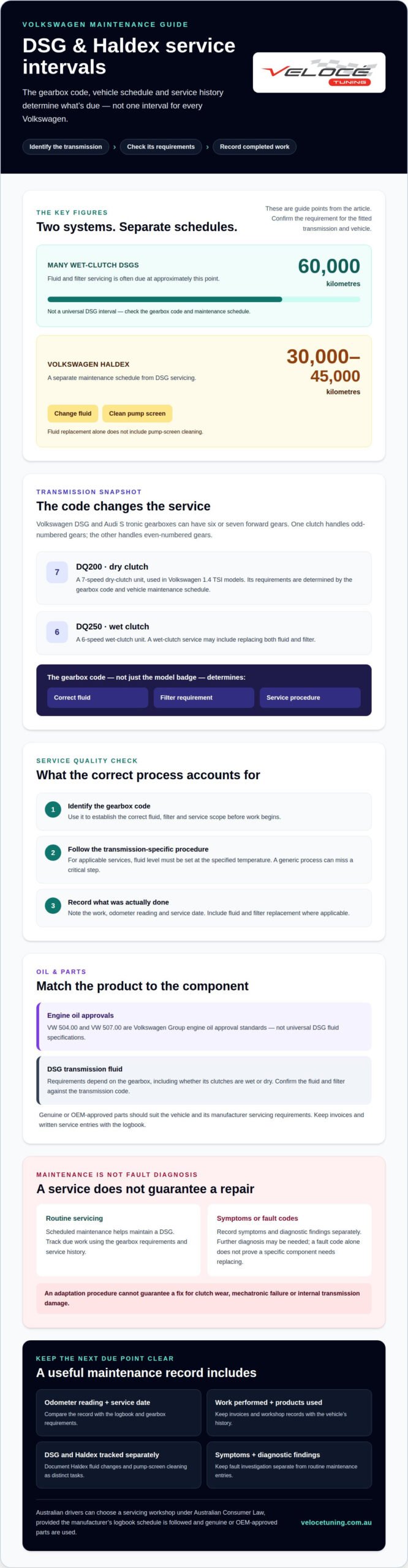
For the question of Volkswagen’s recommended service for each model, there isn’t one interval that applies to every DSG. Many wet-clutch transmissions require fluid and filter servicing at approximately 60,000 kilometres, while the DQ200 is a 7-speed dry-clutch unit and the DQ250 is a 6-speed wet-clutch unit. The gearbox code and vehicle maintenance schedule determine the applicable requirements.
That distinction matters across Volkswagen models. The DQ200 is used in Volkswagen 1.4 TSI models; the DQ250 has a wet-clutch design. A wet-clutch service may include replacing both fluid and filter. A technician must follow the procedure for that transmission, including setting fluid level at its specified temperature. Using a generic process can miss a critical step.
For VW DSG service in Frankston, choose a workshop that can handle DSG servicing and repairs rather than treating every gearbox the same. Before work begins, the mechanic can identify the gearbox code and establish the service scope. A fault code is diagnostic information, not proof that a specific component needs replacing. This helps distinguish scheduled maintenance from fault investigation.
A transparent service starts with a clear inspection and explanation of the work. The service record should state what maintenance was carried out, including fluid and filter replacement where applicable. If the car has symptoms or stored fault codes, it may need diagnosis as well as routine servicing. A DSG service is preventative maintenance, not an automatic fix for an existing transmission fault.
Service time depends on the gearbox-specific procedure, fluid-temperature checks and inspection findings, so there is no single duration for every DSG. When arranging a booking, provide the vehicle details so the workshop can plan the service and prepare the correct fluid and filter. An adaptation procedure can’t guarantee a fix for clutch wear, mechatronic failure or internal transmission damage.
DSG and Haldex schedules
Plan DSG maintenance around the fitted transmission, not a single interval for every Volkswagen. Many wet-clutch units require fluid and filter servicing at approximately 60,000 kilometres. Record the odometer reading and service date, then compare them with the vehicle’s logbook and gearbox requirements. The next due point depends on what has already been completed.
Haldex maintenance follows a separate schedule from DSG servicing. For Volkswagen Haldex systems, fluid changes and pump screen cleaning are recommended every 30,000 to 45,000 km. Treat these as two distinct maintenance tasks: changing fluid alone doesn’t include cleaning the pump screen. Add both to the vehicle’s records when completed.
Use the service history to decide what needs attention next. If DSG servicing is documented but Haldex maintenance isn’t, the records show why the two systems need separate attention. A useful logbook entry identifies the work performed and the odometer reading. Keep invoices and workshop records with the vehicle’s maintenance history.
Australian drivers can choose where to have their vehicle serviced under Australian Consumer Law, provided servicing follows the manufacturer’s logbook schedule and uses genuine or OEM-approved parts. Accurate records and adherence to the schedule are especially important for a vehicle still covered by warranty. An independent workshop can carry out servicing under these conditions.
For fleet operators, missed intervals can become harder to track across multiple vehicles. A central maintenance record can capture each vehicle’s DSG and Haldex due points, completed work and upcoming tasks. Fleet vehicle management can help organise servicing records across a fleet, keeping scheduled maintenance visible rather than relying on memory.
Don’t treat scheduled servicing as a guaranteed repair for existing symptoms. If a DSG develops a fault, record the symptoms and diagnostic findings separately from routine maintenance. This helps clarify whether the next step is scheduled servicing, further diagnosis or component replacement.
Genuine-quality parts and oils
Choosing oil for a Volkswagen involves matching the specification to the component. Engine oil and DSG transmission fluid serve different systems, so an engine oil approval doesn’t identify suitable gearbox fluid. Volkswagen Group specifies VW 504.00 and 507.00 as engine oil approval standards. Follow the vehicle’s requirements rather than selecting oil by brand name or viscosity alone.
DSG fluid requirements depend on the gearbox, including whether its clutches are wet or dry. A wet-clutch unit may require fluid and a filter at its service interval. The gearbox code helps identify the correct fluid and parts. Treating every DSG as interchangeable risks using a product or filter that doesn’t match the transmission.
For routine servicing, confirm the fluid specification and filter requirement against the transmission code, then check that the workshop follows the correct procedure. Keep the service record with the vehicle’s logbook, including the work completed and products used. This gives the next mechanic a clearer maintenance history.
“Genuine” describes a parts category, but suitability still depends on the application. Genuine or OEM-approved parts should match the vehicle and the manufacturer’s servicing requirements. Using parts suited to the vehicle and following its service requirements can help support warranty coverage. Keep invoices and written service entries together.
Don’t confuse engine maintenance with DSG servicing. Volkswagen Group’s VW 504.00 and 507.00 approvals relate to engine oil, not a universal DSG fluid specification. For example, a service plan for a Volkswagen engine and gearbox needs to identify each system separately. The engine oil approval, gearbox fluid, filter and service timing each answer a different maintenance need.
Ask for the completed service record to identify the work performed and relevant parts. If the DSG has symptoms, routine fluid maintenance doesn’t establish that the clutch or another component is faulty. That requires diagnosis. Clear records distinguish scheduled servicing from repairs and make the vehicle’s maintenance history easier to follow.
Service intervals and maintenance history
A DSG interval isn’t universal. The correct schedule depends on transmission type and code, vehicle configuration, usage and maintenance history. For many wet-clutch units, fluid and filter servicing is due at approximately 60,000 kilometres. That figure is a useful reference, not a substitute for the manufacturer’s schedule for the specific Volkswagen.
Service history can change the next maintenance decision. When the logbook is incomplete, distinguish documented servicing from assumed servicing. Check previous invoices and entries for the odometer reading, date, gearbox identification and work performed. An entry that simply says “service completed” without specifying the DSG work leaves important gaps.
Usage matters as well as distance travelled. Stop-start driving, regular heavy loads and long gaps between services all contribute to the vehicle’s maintenance picture. The transmission code identifies the unit; the service history shows what has already been done. Together, these details help determine the next step for the specific Volkswagen, rather than relying on a generic interval.
- Match the gearbox: record its code and vehicle configuration.
- Build the timeline: note service dates, odometer readings and completed work.
- Separate concerns: keep fault symptoms and diagnostic results distinct from routine servicing.
Diagnostics provide context when a vehicle has symptoms, but a fault code alone doesn’t prove which component needs replacing. A mechanic should interpret the code alongside the symptoms and maintenance record. Routine servicing helps maintain the transmission; it doesn’t automatically repair clutch wear, mechatronic failure or internal damage.
For VW DSG service in Frankston, a written record makes it easier to track the next interval and make informed maintenance decisions. Keep each invoice with the logbook, then update the mileage and work completed after servicing. This gives the next Volkswagen service a clear starting point, especially if ownership changes or earlier records are incomplete.
Keep your maintenance history moving forward with a Volkswagen service plan tailored to the vehicle’s records and requirements.
Veloce Tuning: Log Book Servcing
Veloce Tuning’s logbook servicing gives Volkswagen owners a practical way to keep scheduled maintenance and service records organised. A clear history helps track completed work against the manufacturer’s schedule, including maintenance needs for the DSG transmission.
Bring the available logbook and previous service records when arranging maintenance. They show what’s been completed and what may be coming due, without relying on memory or an incomplete entry. If the vehicle has a DSG fault or symptoms, routine servicing and repairs are different needs; the service history helps clarify the situation.
For businesses managing several vehicles, Veloce Tuning’s fleet servicing helps organise maintenance across the fleet. The right approach depends on whether you need scheduled servicing for one Volkswagen or broader fleet management.
To discuss your vehicle’s maintenance needs, contact Veloce Tuning.
Keep your next drive in focus
Good maintenance planning means making informed decisions before the next drive, rather than reacting only to a warning. If your Volkswagen’s behaviour changes, note when it happens, what the vehicle is doing and whether the change is consistent. These details can help distinguish a new concern from routine maintenance.
Before arranging a VW DSG service in Frankston, gather the vehicle identification details and any service records you have. This gives you a clear starting point to discuss the transmission’s needs and decide what should happen next. If the car has symptoms, describe them plainly rather than assuming servicing alone will address the cause.
Describe the conditions around any change, such as traffic, engine temperature or acceleration, and whether it happens consistently or comes and goes. A factual, precise account gives the discussion a stronger starting point.
Veloce Tuning can help you take the next practical step for your vehicle. Contact Veloce Tuning to discuss your service, then move forward with confidence.
Frequently Asked Questions
Does Every DSG Have the Same Service Requirements?
No. Volkswagen DSG and Audi S tronic service needs depend on the fitted gearbox, not simply the badge or model year. Wet-clutch and dry-clutch units don’t share one automatic service plan. Provide the mechanic with your vehicle details and previous service records so they can match the transmission code to the correct maintenance requirements.
Can you diagnose a DSG warning light?
Yes. Veloce Tuning provides DSG servicing and repairs, with computer diagnostics to investigate warning lights. A stored code helps narrow the investigation, but doesn’t prove a particular part has failed. Note when the light appeared, any change in shifting and whether it returns after restarting. These observations give the workshop useful context alongside diagnostic results.
Do I have to service my VW at a dealership to keep the warranty?
No. Australian drivers can choose an independent workshop, provided servicing follows the manufacturer’s logbook schedule and uses genuine or OEM-approved parts. Keep invoices and entries that show the work completed, date and odometer reading. If your Volkswagen has a warranty concern, these records provide a clear account of its maintenance. The key is following the schedule and using approved parts.
Is DSG servicing really necessary?
Yes. DSG servicing is preventative maintenance, not something to consider only after a warning appears. Following the applicable schedule helps prevent required maintenance from being overlooked and documents the work completed. That history can also give a mechanic useful context if drivability changes later. Servicing alone doesn’t repair clutch wear, mechatronic failure or internal transmission damage, so symptoms need diagnosis.
What Is Included in a DSG Service?
The service scope depends on the gearbox type and code. Routine DSG servicing can include the specified transmission fluid and, for units that require it, a filter. The fluid level is set according to that gearbox’s procedure, including its specified temperature where applicable. Fault diagnosis and repairs are separate from routine servicing. Record the work completed to support future maintenance planning.
Who will be working on your Volkswagen?
Veloce Tuning’s workshop team includes five qualified staff and operates under a head engineer. The team services and repairs European vehicles, including Volkswagens. A DSG concern may call for servicing, repairs or diagnostics, depending on the issue. The work is tailored to the vehicle’s specific maintenance or repair needs.