Why do we settle for the factory floor when the horizon demands more clearance and a posture that commands absolute respect? The air changes when you climb into a cabin that sits higher, offering a panoramic view of the track ahead while the upgraded coils soak up the brutal feedback of the Australian outback. You know that the difference between a rig that glides over corrugated tracks and one that suffers a “death wobble” comes down to more than just height; it is about the soul of the machine and the surgical precision of its geometry. Calculating a realistic 4×4 lift kit installation cost in 2026 is about balancing ambition with the reality of Australian compliance. It is a transformation. It requires mastery.
We understand the anxiety of staring at a massive price gap between budget kits and premium engineering, especially when your insurance and VicRoads legality are at stake under the 50mm lift regulations. This guide promises to unlock the true potential of your vehicle by stripping back the mystery of suspension pricing, ensuring you achieve a commanding road presence that handles better than the day it left the showroom. We will break down the impact of VSB 14 regulations, compare component tiers, and explain how to invest in a setup that survives the harshest conditions from the Victorian High Country to the red dust of the Territory.
Key Takeaways
- Discover the essential hardware components, from high-performance bushings to precision-engineered shock absorbers, that justify a premium suspension investment.
- Learn how vehicle architecture and modern electronic stability sensors influence the total 4×4 lift kit installation cost across different Australian makes and models.
- Understand the critical role of a professional 4-wheel alignment and engineering certification in maintaining legal compliance and road safety.
- Identify why budget strut spacers are a “false economy” compared to fully tuned suspension systems that enhance off-road handling and durability.
- Gain insights into customising your suspension setup to account for specific loads like bullbars, winches, and rear canopies for a perfectly balanced ride.
Understanding the Investment: What Makes Up the Cost of a 4×4 Lift?
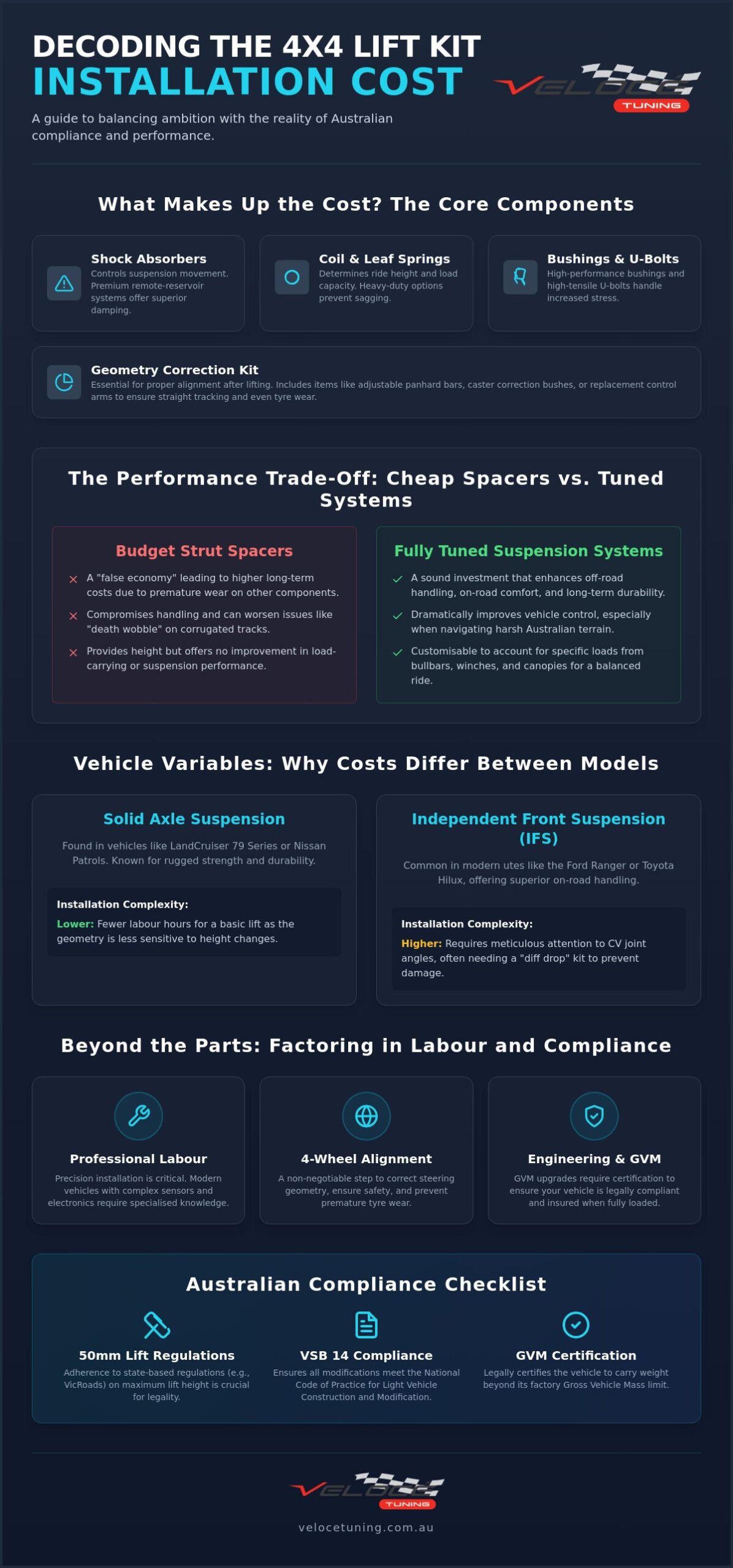
Think of your suspension as the rhythmic pulse of your rig. When you are carving through the Victorian High Country or navigating the corrugated stretches of the red centre, every component must act in perfect synchronicity. The 4×4 lift kit installation cost is rarely a single, static figure because it represents a surgical upgrade of your vehicle’s entire foundation. At the heart of this investment are the raw components: heavy-duty coil springs designed to hold their height under load, leaf packs that refuse to sag, and shock absorbers that act as the dampers for your ambition. Understanding what a suspension lift is goes beyond just gaining ground clearance; it is about re-engineering how your vehicle interacts with the earth.
Quality hardware forms the backbone of a reliable build. You aren’t just paying for the visible parts. High-performance bushings, greasable shackles, and high-tensile U-bolts ensure that the increased stress of a lifted geometry doesn’t lead to mechanical fatigue. Then there is the “hidden” geometry kit. As you increase height, your axle alignment shifts. To keep your steering true and your tyres wearing evenly, you often need adjustable panhard bars, caster correction bushes, or even replacement control arms. These precision-engineered pieces add to the initial bill but are non-negotiable for anyone seeking a rig that tracks straight at 110km/h on the Monash Freeway.
Premium Components vs. Budget Bundles
The Australian sun is a brutal critic of cheap manufacturing. Budget kits often rely on inferior seals and low-grade oil that foams under pressure, leaving you with a ride that feels like a boat in a swell. Premium remote reservoir systems offer a visceral difference you can feel through the seat of your pants. By separating the oil and nitrogen, these systems provide consistent damping even during high-speed desert crossings. It is a sensory reward. Investing in high-tier brands prevents the “false economy” of replacing worn-out components every two years, ultimately lowering your long-term 4×4 lift kit installation cost by protecting your drivetrain and tyres from premature failure.
The Role of GVM Upgrades in Costing
For the serious Aussie tourer, a lift is often more than an aesthetic choice; it’s a legal requirement. If your ute is loaded with a steel bullbar, a winch, a dual-battery system, and a canopy full of gear, you are likely pushing the limits of your Gross Vehicle Mass (GVM). When we integrate a GVM upgrade into your installation, we are certifying that your vehicle can safely and legally carry that weight. This process involves specific testing and compliance paperwork that ensures you remain insured while towing your caravan or boat. It adds complexity to the install, but the peace of mind of knowing your rig is fully compliant is worth every cent.
Just as you ensure your vehicle’s electrical systems are up to the task, maintaining your property is equally vital; for expert residential and commercial support, Electrical Repair 4U offers comprehensive wiring and system rewiring services.
Vehicle Variables: Why Installation Costs Differ Between Models
The mechanical DNA of your vehicle determines the complexity of its transformation. A rugged, older Toyota Hilux shares very little in common with the sophisticated architecture of a LandCruiser 300 Series or a Next-Gen Ford Ranger. These structural differences are the primary drivers behind the 4×4 lift kit installation cost. While an older rig might offer a straightforward bolt-on experience, modern platforms are a dense network of sensors, computers, and intricate linkages. Precision is no longer optional; it is the baseline for safety. Every millimetre of height added must be accounted for in the vehicle’s digital and physical brain.
Solid Axle Simplicity vs. IFS Complexity
Suspension design falls into two distinct camps: the uncompromising strength of a solid axle and the refined handling of Independent Front Suspension (IFS). Solid axle vehicles, like the LandCruiser 79 Series or a Nissan Patrol, typically require fewer labour hours for a basic lift because the geometry is less sensitive to minor height changes. However, multi-link setups and leaf-sprung rears still demand a craftsman’s eye to ensure the axle remains centred. In contrast, IFS vehicles require significant attention to CV joint angles. Increasing the height on a Ranger or Hilux often necessitates a “diff drop” to prevent premature wear on your driveline. This adds both components and labour time to your build, ensuring your CV boots don’t tear under the new, aggressive angles.
- Solid Axle: Robust and predictable; often requires adjustable panhard bars to re-centre the axle after a lift.
- IFS (Independent Front Suspension): Complex and sensitive; requires precise camber and caster adjustments to prevent tyre scrub.
- Next-Gen Platforms: The Ford Ranger and Everest utilize advanced multi-link rear ends that require meticulous setup to maintain their class-leading ride quality.
Modern Tech and Sensor Recalibration
The 4x4s of 2026 are essentially rolling supercomputers. When you elevate the chassis, you are also moving the “eyes” of the vehicle; the Advanced Driver Assistance Systems (ADAS). Radars for autonomous braking and cameras for Lane Keep Assist are calibrated to a factory height. A 50mm lift changes their perspective of the road. If these sensors aren’t professionally recalibrated, your safety tech might fight against your new height, triggering phantom braking or steering interventions. This digital alignment is now a non-negotiable part of a professional install. It ensures your rig remains a partner on the road, rather than a liability. If you are looking for a team that understands this delicate balance of hardware and software, our specialists in suspension and lift kits can guide your build through the complexities of modern engineering.
Beyond the Parts: Factoring in Labour, Alignments, and Engineering
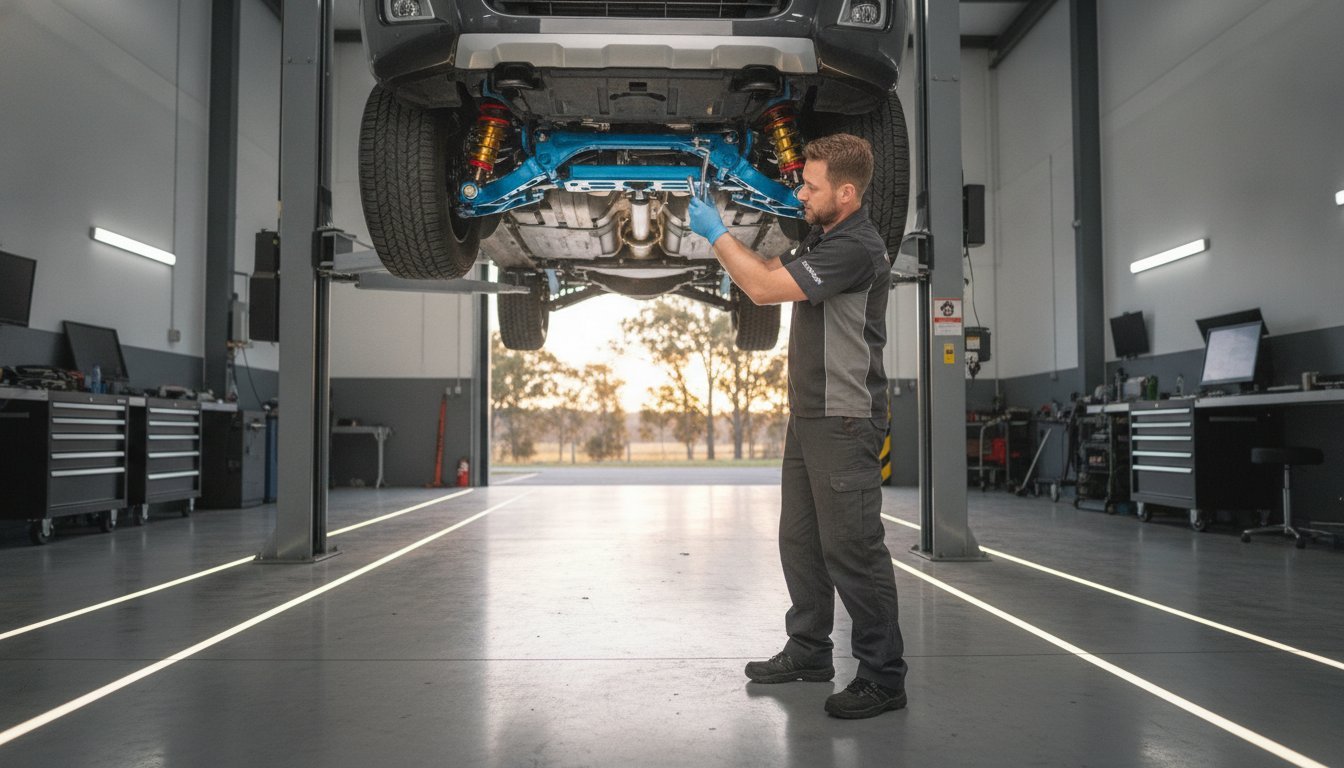
The raw components of a suspension system are merely potential energy waiting to be unleashed. To truly transform your ride, those parts must be integrated with mechanical empathy and technical precision. Determining the total 4×4 lift kit installation cost means looking past the shiny boxes and into the workshop hours where the real transformation happens. In Carrum Downs and across Melbourne’s South-East, a professional installation typically requires a dedicated four to six hour window for a standard spring and shock setup. This time is spent ensuring every bolt is torqued to its specific limit and every line is routed away from moving parts. It is a meticulous process. Precision takes time, and time is the foundation of safety.
Once the vehicle is back on its feet, the work is only half finished. A critical 4-wheel alignment is the final gear shift that ensures your steering wheel remains dead-centre and your tyres don’t succumb to premature scrub. This isn’t a standard “toe-and-go” service. A 4WD-specific alignment accounts for the new caster and camber angles created by your increased height. Furthermore, we always emphasize the importance of a 500km post-install check-up. As the new components settle into their seats and the springs find their final height, a secondary inspection ensures everything remains tight and true. This sensory reward of a rig that tracks straight and feels planted is what separates a professional build from a weekend compromise.
The Professional Installation Workflow
- Step 1: Pre-install measurement and safety inspection. We document your factory ride height and inspect existing components for wear to ensure a clean baseline.
- Step 2: Surgical removal of factory components and chassis cleaning. Old struts and shocks are discarded; the mounting points are cleaned and prepared for their new high-performance heart.
- Step 3: Torque-to-spec installation. Every component is installed using specialised tools to meet manufacturer specifications, ensuring long-term durability under load.
- Step 4: Dynamic road testing. A thorough test drive ensures the “Veloce” feel, checking for noise, vibration, and harshness before the keys are returned to you.
Legal Compliance and Victorian Standards
In Victoria, the line between a legal daily driver and an “off-road only” liability is often measured in millimetres. Under VSB 14 regulations, a suspension lift of up to 50mm is generally permitted without a VASS engineering certificate, provided the total lift including tyres does not exceed 75mm. If your ambition takes you higher, you must factor in the cost of a “Blue Plate” or VASS certificate. This engineering process typically costs approximately 10 percent of your total modification expense and is essential for insurance coverage. Staying within these legal height limits ensures that in the event of an incident, your insurance provider remains a partner rather than an adversary. It is the cost of peace of mind.
The Performance Trade-off: Cheap Spacers vs. Tuned Suspension Systems
The temptation to take a shortcut is powerful when you are staring down the barrel of a full suspension build. You see the height, you want the look, and a set of “eBay special” strut spacers seems like a victimless way to lower your 4×4 lift kit installation cost. It is a false economy. Strut spacers are the mechanical equivalent of a sugar hit; they provide an immediate lift in height but leave your vehicle’s handling in a state of total collapse. By simply pushing the factory strut further down, you are robbing the system of its essential downward travel. The result is a visceral, jarring sensation every time your suspension tops out over a speed hump or a pothole. It is a compromise that no master craftsman would ever endorse.
Professional workshops often refuse to install these generic components because they understand the liability involved. A tuned suspension system is a holistic engineering solution that manages the release of energy through high-quality valving and spring rates. When you invest in a complete system, you aren’t just buying height; you are buying a rig that remains composed when the track turns hostile. A tuned setup eliminates the “bottoming out” that plagues cheap alternatives, replacing it with controlled, progressive damping that protects your chassis from the brutal feedback of the Australian terrain. For Melbourne 4WD owners who demand this level of precision, a purpose-built suspension lift kit Melbourne solution is the only path to a truly engineered result. It is about the pursuit of excellence over the convenience of a bolt-on block.
The Danger of Excessive Lift
Chasing height for the sake of ego is a dangerous game. When you push beyond the 50mm “sweet spot” without proper supporting modifications, you invite a host of hidden enemies into your drivetrain. Excessive lift puts extreme tension on your brake lines and creates driveline vibrations that can shake a rig to pieces over time. More critically, it raises your centre of gravity, significantly increasing the risk of a roll-over during emergency manoeuvres. This is why 2 inches remains the gold standard for Australian adventurers; it provides the liberation of extra clearance while maintaining the surgical stability required for high-speed touring on bitumen and dirt alike.
The Sensory Reward of Quality Suspension
There is a profound, emotional reward in driving a rig that feels truly “planted.” On corrugated outback roads, a high-performance suspension system works with a rhythmic efficiency, soaking up the heat and the impact so you don’t have to. It transforms the driving experience from a struggle into a symphony of power and control. A perfectly tuned rig eliminates “nose dive” during heavy braking and keeps the chassis level through tight corners, giving you the confidence to push harder and explore further. If your springs have begun to sag or your shocks are fading after years of hard use, investing in professional 4×4 suspension repair Melbourne specialists can restore that planted, composed feel before you commit to a full lift upgrade. If you are ready to move beyond basic bolt-ons and experience a truly engineered transformation, explore our professional suspension and lift kits service today. It is time to turn your car into a precision tool.
Elevate Your Rig at Veloce Tuning: Precision Installation in Carrum Downs
Walking into our Carrum Downs workshop, you won’t find a generic assembly line. You will find a sanctuary of mechanical performance where the scent of gear oil and the hum of precision tools set the stage for your vehicle’s transformation. We treat every 4WD that enters our bay as a unique engineering challenge, not a commodity. When you discuss the 4×4 lift kit installation cost with our team, you aren’t just paying for labour hours. You are investing in a master craftsman approach that considers the weight of your steel bullbar, the leverage of your rear canopy, and the specific damping required for your style of adventure. It is a meticulous process. It is the only way to ensure your rig remains composed when the bitumen ends.
Our Carrum Downs facility has become the centre of excellence for local 4WDers because we refuse to settle for “close enough.” We understand that a lift kit is a surgical modification to your vehicle’s soul. By matching spring rates to your specific constant load, we eliminate the sagging and harshness that plague off-the-shelf solutions. This bespoke attention to detail ensures that your investment delivers a visceral driving experience every time you turn the key. We don’t just build cars; we build partners for the path less travelled. Performance is our obsession, a philosophy mirrored by industry leaders like Tim Halpin Equipment Corp who specialise in precision truck equipment and commercial upfitting to ensure every vehicle is a masterpiece of function and safety.
Tailored Solutions for Frankston and Mornington Locals
We know the tracks around the Mornington Peninsula and the demands of the Victorian High Country. For Frankston and Mornington locals, Veloce Tuning represents a local partnership in the pursuit of automotive excellence. We don’t believe in “one size fits all” kits that leave your ute feeling unbalanced or skittish. To achieve total dominance on and off the road, many of our clients choose to integrate their suspension upgrades with our Custom ECU Tuning. This creates a holistic performance package where the power of your engine is perfectly matched by the capability of your chassis. It is a transformation of both strength and spirit.
Book Your Transformation
Your journey toward a more commanding road presence begins with a transparent, itemised quote tailored to your specific vehicle and goals. We strip away the ambiguity, providing a clear breakdown of the 4×4 lift kit installation cost so you can invest with absolute confidence. Our commitment to your adventure doesn’t end when you drive out of our workshop; our 24/7 breakdown support ensures we have your back even in the deepest parts of the bush. You deserve a rig that reflects your ambition. Take the first step toward a superior drive and Contact Veloce Tuning today to discuss your build. The horizon is waiting.
Own the Horizon with Absolute Confidence
A true suspension transformation is the bridge between a factory standard vehicle and a rig that feels like an extension of your own ambition. We have explored how the 4×4 lift kit installation cost reflects a commitment to precision, covering everything from the surgical recalibration of modern ADAS sensors to the visceral difference in damping quality. You now understand that skipping the “eBay special” spacers isn’t just about ride quality; it’s about protecting your drivetrain and ensuring your insurance remains a partner in your adventures. Whether you are navigating the tight tracks of the Dandenongs or the endless corrugations of the outback, your suspension is the pulse of your performance.
At Veloce Tuning, we bring master craftsman engineering and local Carrum Downs expertise to every build, ensuring your rig is perfectly balanced for its specific load. Our 24/7 emergency support means we’ve got your back long after you leave our workshop. It’s time to stop compromising and start dominating. Elevate Your Adventure: Get a Precision Lift Kit Quote. Your rig is ready for its evolution. Let’s make it happen.
Frequently Asked Questions
How much does it cost to install a 2-inch lift kit in Australia?
Industry data suggests that a professional 4×4 lift kit installation cost typically falls between A$750 and A$1,000 for labour alone. This usually represents five to seven hours of surgical work by a qualified technician to ensure every component is seated and torqued correctly. While basic “supplied and fitted” packages for entry-level kits can start from approximately A$680, high-performance systems engineered for heavy outback touring often range between A$3,000 and A$4,000 including premium components.
Will a lift kit void my new car warranty?
A lift kit will not void your entire new car warranty; however, the manufacturer is not obligated to cover failures directly caused by the modification. If a suspension component or a related driveline part fails because of the increased height or altered geometry, that specific claim will likely be denied. Using reputable brands and ensuring a professional installation helps maintain a clear trail of mechanical accountability and satisfies most insurance provider requirements for roadworthiness.
Do I need a wheel alignment after a lift kit installation?
Yes, a comprehensive 4-wheel alignment is non-negotiable after any height adjustment to ensure your steering remains precise and your tyres don’t scrub. Changing the ride height significantly alters your vehicle’s caster and toe settings. Failing to perform this step leads to rapid tyre wear and a nervous, wandering sensation on the highway. Expect to pay between A$120 and A$180 for a 4WD-specific alignment that accounts for the new geometry and centres the steering wheel perfectly.
How long does a professional 4×4 lift kit installation take?
A professional installation of a complete spring and shock system usually takes between four and six hours in a dedicated workshop. This timeframe allows for the meticulous removal of factory hardware, the cleaning of mounting surfaces, and the torqueing of new components to manufacturer specifications. More complex builds involving independent front suspension (IFS) or the recalibration of modern electronic sensors may require a full day to ensure the transformation is mastered to the highest safety standards.
Is a 3-inch lift legal in Victoria without engineering?
No, a 3-inch (75mm) suspension lift is not legal in Victoria without a VASS engineering certificate. Under current Victorian regulations, you are permitted a maximum suspension lift of 50mm without certification. When combined with larger tyres, the total combined lift cannot exceed 75mm. Exceeding these limits without a “Blue Plate” can lead to costly defect notices and may result in the denial of insurance claims if the modification is found to have contributed to an incident.
What is the difference between a body lift and a suspension lift?
A suspension lift replaces the springs and shocks to increase actual ground clearance and improve off-road articulation and handling. Conversely, a body lift utilizes spacers to increase the distance between the vehicle’s body and its chassis. While a body lift provides more room for larger tyres and is often a cheaper aesthetic choice, it does not improve the clearance under the differentials or enhance the vehicle’s performance and damping characteristics on corrugated outback tracks.
Can I install a 4×4 lift kit myself to save on costs?
You can physically install a kit yourself if you possess advanced mechanical skills and heavy-duty tools; however, it is rarely the most efficient path to a high-performance result. The total 4×4 lift kit installation cost at a professional workshop includes the peace of mind of geometry correction and the recalibration of sophisticated safety sensors. Even with a DIY install, you must still visit a professional for a 4WD alignment and a safety inspection to ensure your rig remains compliant and insured.
Why is my car vibrating after a lift kit install?
Post-install vibrations are usually caused by altered driveline angles or wheels that require re-balancing after the height change. When you increase the chassis height, the angle of the tailshaft becomes more acute, which can lead to a visceral shudder during acceleration if not corrected with a diff drop or adjustable arms. In more severe cases, a “death wobble” can occur if the steering geometry is not precisely aligned or if critical components have not been torqued to their specific limits during the build. If you are already experiencing these symptoms before a lift, addressing them through expert 4×4 suspension repair Melbourne services first will ensure your vehicle is in peak condition before any further modifications are undertaken.