Your car is currently holding its breath. From the factory, your engine is choked by a “one-size-fits-all” software map designed to survive sub-zero Siberian winters and low-grade fuel in remote outposts. It’s a compromise that leaves your throttle feeling doughy and your torque curve flat. You want that extra grunt for the caravan or the visceral snap of a responsive street machine, but a nagging question remains: is ECU tuning safe for engine longevity under the harsh Australian sun? It’s a valid fear. Nobody wants to trade a bit of extra power for a catastrophic mechanical failure or a voided warranty.
The truth is that professional remapping isn’t a “hack”; it’s a precise recalibration that replaces generic global settings with local engineering excellence. We’ll pull back the curtain on the technical reality of ECU tuning, explaining how we optimise parameters like ignition timing and boost pressure while staying well within the safety margins of your hardware. You’ll learn the critical difference between a cheap “chip” and a custom dyno tune, the latest 2026 certification rules for power increases, and how to unlock serious performance without cooking your motor on a mid-summer climb. Let’s shift your perspective from mechanical anxiety to total confidence.
Key Takeaways
- Reclaim the hidden potential your manufacturer left on the table by understanding the “Global Compromise” and how local recalibration restores lost performance.
- Master the mechanics of risk, from managing Exhaust Gas Temperatures to pre-ignition detection, to ensure your engine thrives under the pressure of Australian conditions.
- See why a bespoke recalibration is the only definitive answer to the question: is ECU tuning safe for engine health when compared to generic, sensor-tricking chips?
- Learn the importance of a meticulous pre-tune health check and real-time data logging to safeguard your vehicle’s mechanical integrity during every gear shift.
- Discover how to tailor your tune to your specific mission, balancing the heavy demands of outback towing with the pursuit of visceral street performance.
Decoding the Factory Safety Margin: Why Manufacturers Leave Power on the Table
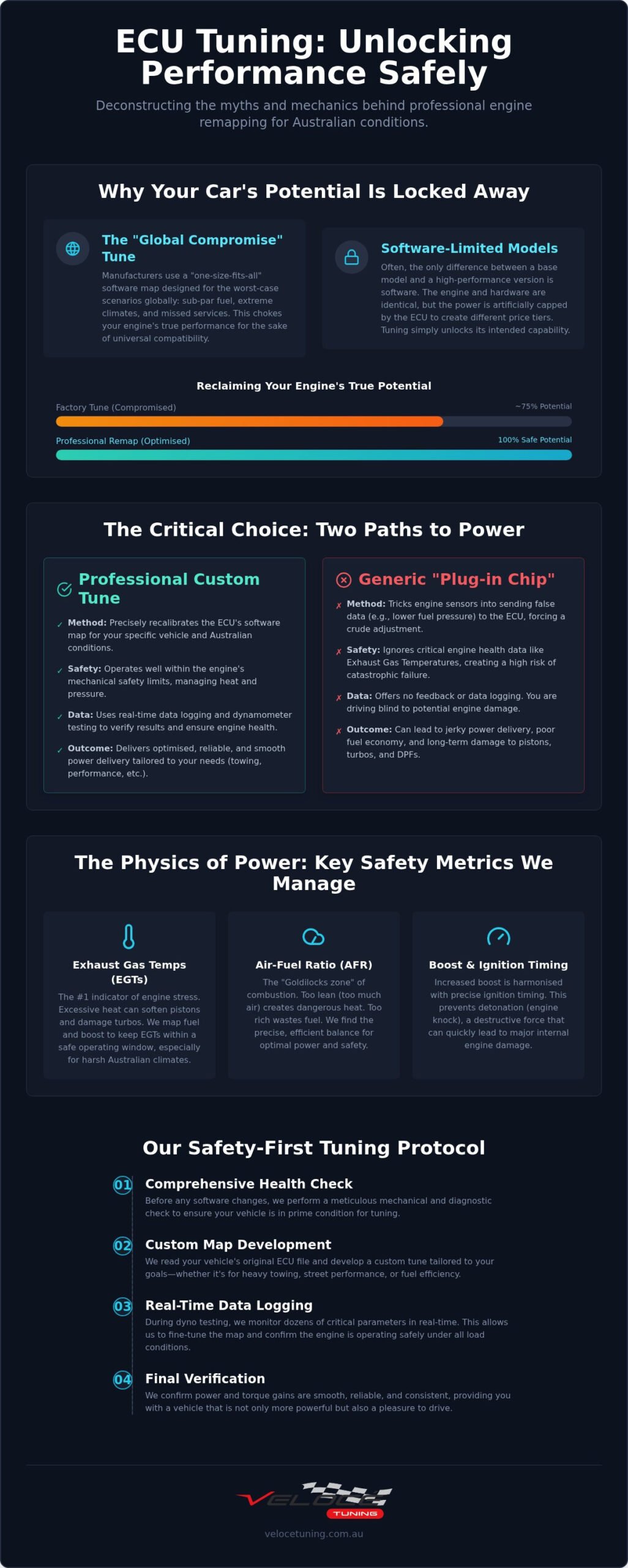
Every engine that rolls off a production line is a masterpiece of compromise; a silent agreement between accountants, emissions regulators, and global logistics managers. Manufacturers don’t tune for peak performance. They tune for the lowest common denominator. This massive “safety factor” is built into the mechanical DNA of your engine block to ensure it survives even the most negligent owners in the harshest corners of the globe. When enthusiasts ask is ECU tuning safe for engine longevity, they’re often surprised to learn how much mechanical overhead actually exists. Understanding the history of What is Chip Tuning? shows that this practice isn’t about pushing an engine past its breaking point. It’s about reclaiming the efficiency that was sacrificed to meet broad, global emissions targets and rigid marketing requirements.
The Global One-Size-Fits-All Calibration
The Software-Limited Engine Hierarchy
Automotive marketing is built on power tiers. Often, a manufacturer will produce one high-spec engine and use software to artificially cap its output for lower-priced models. Many European diesel engines share identical injectors, turbos, and internal components across multiple power variants. The only difference is the digital leash held by the ECU. Unlocking this potential isn’t a mechanical gamble; it’s an act of liberation. It restores the engine to its intended engineering potential. When you consider these artificial limits, the answer to is ECU tuning safe for engine health becomes a matter of professional recalibration, such as that offered by Dynogen Remapping Solutions, rather than risk. You aren’t forcing the car to do something it wasn’t built for. You’re simply letting it do what it was designed to do before the marketing department stepped in.
Unlocking raw power feels like a surge of pure adrenaline; however, beneath the bonnet, your engine is a furnace of controlled explosions. Physics is a harsh mistress. When you increase boost or sharpen ignition timing, you’re inevitably playing with heat and pressure. The central concern for most drivers is whether is ECU tuning safe for engine longevity when these variables are pushed. The answer lies in the tuner’s ability to respect mechanical limits rather than simply chasing a number on a dyno sheet. Power is the reward; heat is the enemy.
Thermal Management and EGTs
Exhaust Gas Temperatures (EGTs) are the most critical metric for engine health. If a tuner increases boost pressure without a corresponding correction in fuel delivery, the combustion chamber becomes a blowtorch. This excessive heat can lead to softened piston crowns or cracked turbine housings. In the Australian context, this risk is amplified. A tune that works in the cool air of a European spring might fail during a 40-degree climb over the Great Dividing Range. We design thermal maps that account for these ambient extremes, ensuring your oil and coolant temperatures remain within safe operating windows even when the mercury rises. If you are pushing your vehicle to these limits, a custom ECU tuning session provides the real-time data logging necessary to keep your hardware safe.
Air-Fuel Ratio (AFR) and Detonation
Finding the “Goldilocks” zone of combustion is a delicate balancing act. A “lean” mixture (too much air, not enough fuel) creates terrifying heat, while a “rich” mixture (too much fuel) is cooler but can lead to bore wash and wasted energy. We aim for the stoichiometric sweet spot where power is maximised without sacrificing safety. High-octane 98 RON fuel is a non-negotiable requirement here; it provides a vital safety buffer against “knock” or pre-ignition. The factory knock sensor acts as a digital sentry, constantly listening for the tell-tale “ping” of detonation and instantly retarding timing to prevent catastrophic piston damage before you even feel a vibration.
Mechanical stress isn’t limited to the cylinders. As torque increases, the factory clutch or gearbox often becomes the true bottleneck. A responsible recalibration respects these drivetrain limits, delivering a smooth, linear surge of power that preserves your gears while transforming your driving experience. By monitoring these variables meticulously, we ensure that the pursuit of performance never comes at the expense of your vehicle’s soul.
Custom Dyno Tuning vs. Generic Plug-and-Play Chips: A Safety Duel
The performance market is currently flooded with quick fixes that promise instantaneous power for a bargain price. Cheap “performance chips” or “black boxes” often lure drivers with the prospect of easy grunt, but they operate on a fundamental digital lie. These devices sit between your engine sensors and the ECU, intercepting signals and “tricking” the computer into thinking rail pressure or boost is lower than it actually is. It’s a crude, deceptive tactic. When you ask is ECU tuning safe for engine health, these generic boxes are almost always the culprits behind the horror stories. They don’t recalibrate your engine; they manipulate it. A true professional tune is a conversation with your hardware, not a trick played upon it.
The Dangers of Signal Manipulation
Generic chips are dangerous because they frequently bypass the factory safety protocols designed to prevent catastrophic failure. By masking the true operating conditions, these devices prevent the ECU from triggering “limp mode” even when internal temperatures skyrocket. In diesel vehicles, this lack of precision leads to incomplete combustion and a massive increase in particulate matter. This excessive soot clogs filters rapidly, leading to the expensive DPF replacement Melbourne drivers often face after using unrefined hardware. A professional remap, by contrast, works within the existing OEM protection logic. It ensures that every safety net remains active while we optimise the fuel and timing maps for local conditions.
Bespoke Calibration: The Veloce Standard
No two engines are truly identical. A vehicle with 100,000 kilometres of heavy towing has different wear patterns and tolerances than a car fresh off the showroom floor. Generic “flash” files downloaded from the internet are a mechanical gamble because they ignore these individual variances. We take a different path. Our process involves real-time data logging on a dynamometer to capture the unique heartbeat of your engine under load. We meticulously adjust torque delivery to protect sensitive drivetrains, helping you avoid the need for DSG mechatronic repair Melbourne enthusiasts often encounter with aggressive, “off-the-shelf” maps. This is the role of the master craftsman. We interpret the feedback from the dyno to create a linear, safe, and visceral power delivery that respects the mechanical reality of your specific machine. It’s the difference between a tailored suit and a one-size-fits-all garment.
The Veloce Safety Protocol: How We Safeguard Your Pride and Joy
Safety is not a happy accident; it is the result of a rigorous, uncompromising engineering protocol. Many enthusiasts approach us with a singular question: is ECU tuning safe for engine longevity when the stakes are this high? The answer depends entirely on the preparation. We don’t just “flash and dash.” We treat your vehicle as a high-performance ecosystem where every component must be in peak physical condition before we even think about unlocking its hidden potential. This meticulous approach ensures that the visceral surge of power you feel on the road is backed by a foundation of mechanical integrity.
The Mechanical Audit
Our process begins long before the laptop is plugged in. We perform a comprehensive mechanical audit to ensure your hardware is ready for transformation. We look for the hidden gremlins that generic tuners ignore: boost leaks, worn fuel injectors, and restrictive carbon build-up in the intake. If your vehicle has an underlying DPF issue or a turbocharger showing signs of fatigue, we refuse to tune it. Tuning a “sick” engine is a recipe for disaster. By ensuring your injectors are firing with precision and your seals are holding tight, we guarantee that the recalibration is a source of joy rather than a mechanical liability.
Real-World Stress Testing
Australia presents a unique set of challenges that European-developed generic tunes simply cannot handle. A 40-degree summer day in the Mallee, combined with a three-tonne caravan on a steep incline, is the ultimate engine killer. Our protocol involves simulating these extreme loads during the calibration phase. We adjust “cold start” and “hot restart” parameters to ensure reliability in every climate, from the snowy peaks of the High Country to the humid tropics. We meticulously monitor air-fuel ratios in real-time to prevent the lean spikes that can occur when a generic tune meets a sudden increase in load. This level of data logging allows us to capture the heartbeat of your engine, ensuring every gear shift is as safe as it is exhilarating.
The transformation doesn’t end when you leave our workshop. Performance is a partnership between software and maintenance. To keep your machine running at its peak, adhering to a strict log book service Carrum Downs schedule is essential. Higher performance demands higher-quality care, and regular mechanical check-ups ensure your custom tune continues to deliver that visceral grunt for years to come. If you are ready to experience the true capability of your vehicle without the risk, book your performance consultation with our engineering team today.
Is Tuning Right for You? Balancing Performance Desires with Longevity
Deciding to recalibrate your vehicle is a pivotal moment for any driver. You’re no longer content with the factory-set median; you want a machine that responds to your intent with surgical precision. But as we’ve explored throughout this guide, the question of is ECU tuning safe for engine health eventually lands on your own doorstep. Performance is a privilege that requires a higher standard of care. If you’re prepared to treat your vehicle with the respect its new power demands, the rewards are transformative. It’s the difference between driving a commuter appliance and commanding a precision instrument.
Maintaining Your Tuned Machine
We live by the “Service or Suffer” rule. A tuned engine operates with higher efficiency and increased combustion pressures, which means your maintenance schedule is your primary line of defence. Changing your oil every 7,500km is the cheapest mechanical insurance you can buy. It prevents the thermal breakdown of lubricants and keeps your internal components bathed in fresh, high-performance protection. Using premium synthetic fluids and OEM-spec filters isn’t just a suggestion; it’s a requirement for the performance lifestyle. Interestingly, this pursuit of precision often leads to the ECU tuning for fuel economy Melbourne drivers seek, as a more efficient engine naturally requires less effort to maintain highway speeds.
Your mission defines the calibration. A weekend track toy requires aggressive, high-rpm responsiveness that makes every gear shift feel like a lightning strike. Conversely, a trans-continental 4WD needs a massive, low-down torque plateau to haul a heavy caravan across the Nullarbor. A safe tune improves driveability as much as it boosts peak “grunt.” It eliminates the frustrating throttle lag at roundabouts and provides a linear, predictable surge of power. It’s about the visceral connection between your right foot and the tarmac, giving you total confidence in your machine’s capability.
The Veloce Partnership
At Veloce Tuning, we don’t view a recalibration as a one-off transaction. We see it as a long-term partnership in performance. We’re in this for the life of your vehicle, which is why we provide a 24/7 breakdown service to act as the ultimate safety net for our clients. We share your obsession with automotive excellence. Our engineers are master craftsmen who balance raw power with meticulous safety margins to ensure you never have to wonder is ECU tuning safe for engine longevity again. If you’re ready to stop compromising and start experiencing the technical truth of your engine’s potential, visit our workshop in Carrum Downs for a professional performance consultation. Let’s unlock the machine your car was always meant to be.
Reclaim Your Vehicle’s True Potential
Your car is capable of so much more than the factory permitted. By stripping away the global compromises and artificial software limits, you unlock a driving experience defined by visceral power and surgical responsiveness. We’ve established that the technical reality of performance isn’t about reckless risk; it’s about professional recalibration. When executed by our European-trained engineers, the question of is ECU tuning safe for engine longevity is answered with a resounding yes. Through custom dyno-developed calibrations and a meticulous mechanical audit, we ensure your hardware thrives under the specific demands of the Australian climate.
Choosing a custom remap over a generic chip means choosing integrity over deception. You gain the “grunt” you need for towing and the “snap” you want on the street, all backed by our 24/7 emergency mechanical support for ultimate peace of mind. Performance is a partnership, and we are ready to be your technical advisors in this transformation. Unleash your engine’s hidden potential—book a custom tuning consultation at Veloce Tuning today! It’s time to stop driving a compromise and start commanding a masterpiece.
Frequently Asked Questions
Will an ECU tune void my new car warranty in Australia?
Manufacturers cannot simply cancel your entire warranty because of a modification; however, they can legally deny specific claims if the tune is found to be the cause of a failure. Since the July 2026 regulation changes, power increases exceeding 15% also require documented certification to remain legal on Australian roads. Under Consumer Law, the dealer must prove the modification caused the damage, but drivetrain hardware is often scrutinised.
Does tuning a diesel engine make it less reliable for towing?
A professional recalibration actually enhances towing reliability by providing the torque necessary to maintain momentum on steep inclines without overworking the engine. By optimising the torque curve, we reduce the need for constant downshifting and high-rpm stress. Reliability only suffers when generic chips are used that spike Exhaust Gas Temperatures beyond safe limits. Our custom maps are designed to keep thermal loads within the hardware’s safe operating window.
How much extra wear and tear does a Stage 1 tune actually cause?
Can I ‘untune’ my car and return it to factory settings easily?
Returning your vehicle to its factory state is a straightforward process that involves overwriting the modified map with the original OEM software. We always store a digital backup of your factory calibration before we begin the tuning process. This allows us to restore the stock settings whenever required. While the software can be reverted, modern ECUs often feature a flash counter that may still indicate to a dealer that the software was previously modified.
Do I need to use 98 RON fuel after my car has been tuned?
Using 98 RON fuel is a non-negotiable requirement for high-performance petrol tunes because it provides the necessary resistance to detonation. Higher octane fuel allows us to sharpen ignition timing safely, which is how we unlock that visceral throttle response. Running lower-grade 91 or 95 RON fuel on a 98-optimised map can lead to engine knock; this forces the ECU to retard timing and significantly reduces the safety and performance of the calibration.
Is a custom remap safer than a plug-and-play tuning chip?
A custom remap is infinitely safer because it works with the engine’s internal logic rather than trying to trick it with external signals. When considering is ECU tuning safe for engine health, remapping is the only professional choice as it maintains all factory safety nets and limp modes. Unlike chips that manipulate rail pressure blindly, a remap recalibrates every parameter, from boost to fuel delivery, ensuring a linear and safe surge of power.
How do I know if my engine is ‘healthy’ enough to be tuned?
We determine engine health through a comprehensive diagnostic audit that includes checking for boost leaks, logging injector deviations, and inspecting for excessive carbon build-up. If your engine shows signs of underlying fatigue or mechanical wear, we will refuse to tune it until the issues are rectified. A healthy engine is the only canvas suitable for high-performance work. This ensures that the question of is ECU tuning safe for engine longevity is answered with total confidence.
What happens to my DPF and EGR systems after an ECU remap?
Your DPF and EGR systems remain fully functional and often operate more efficiently after a professional remap. By optimising the combustion process, we reduce the amount of soot produced, which means your DPF requires fewer regeneration cycles. Generic tunes often choke these systems with excessive particulates, leading to premature failure. Our custom calibrations are designed to respect emissions hardware while still delivering the visceral grunt and responsiveness you expect from a high-performance machine.