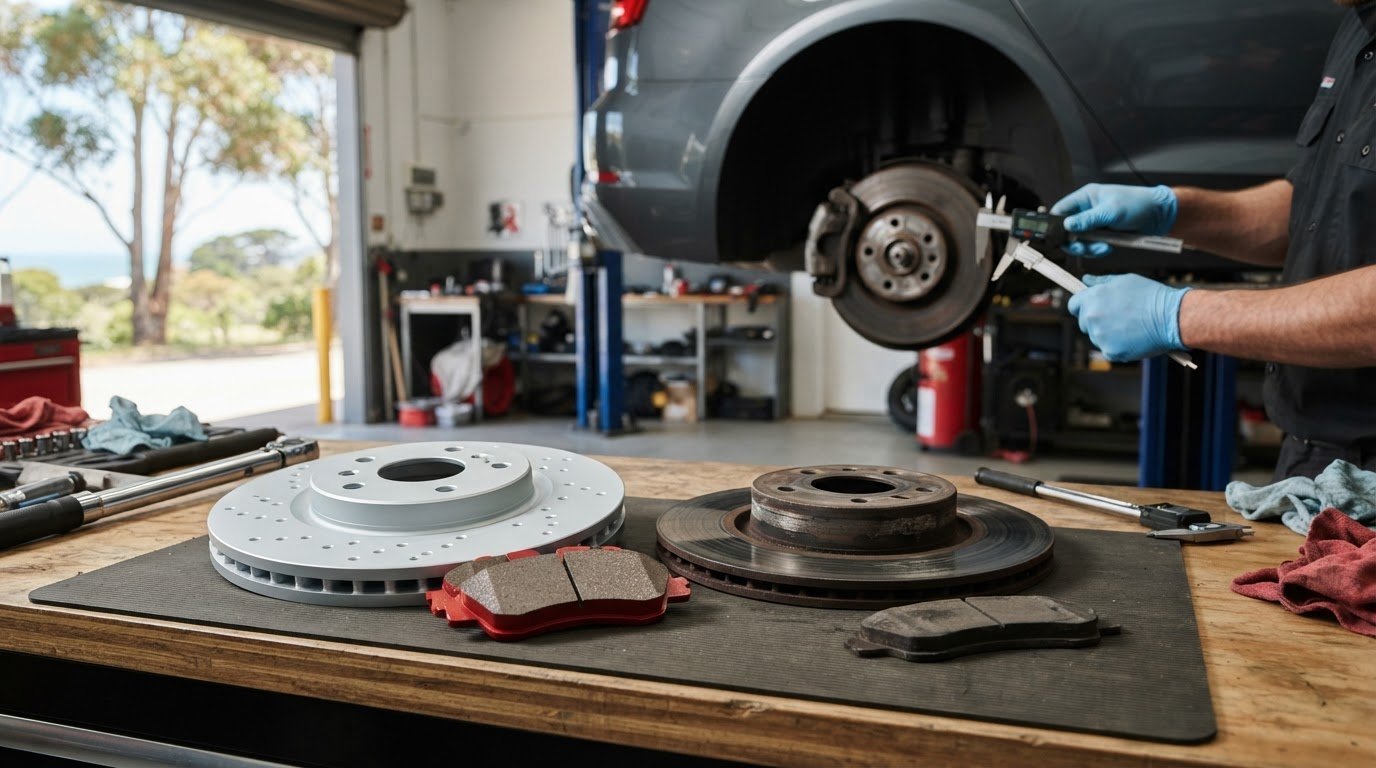
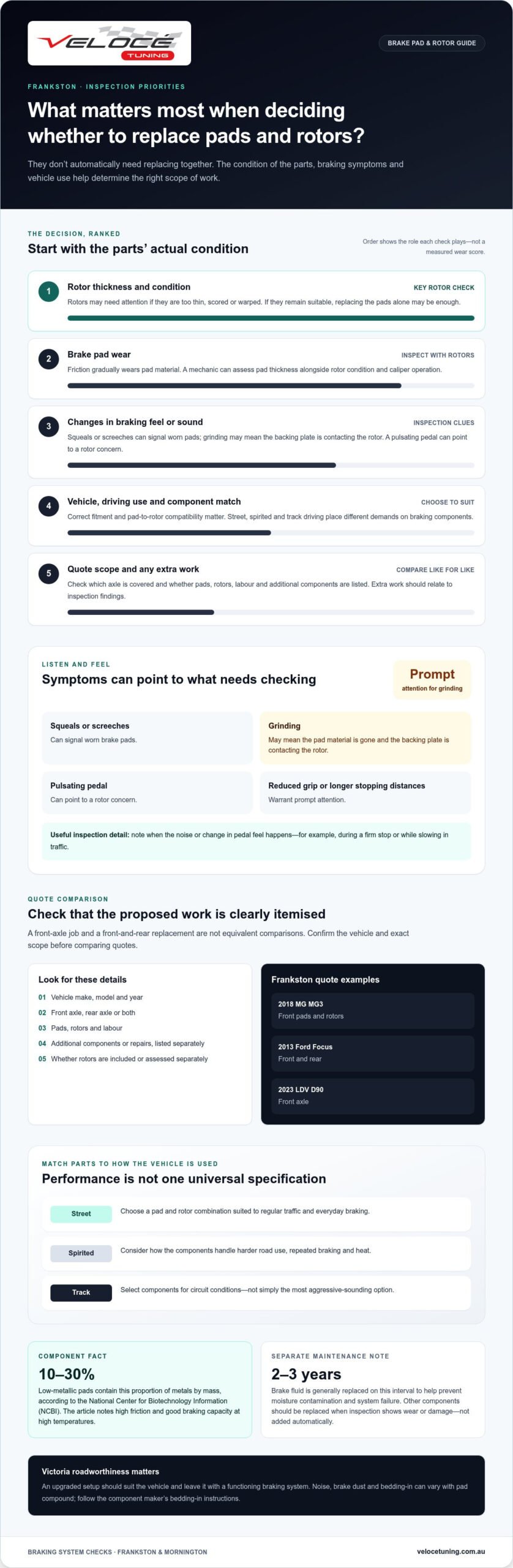
Brake pads and rotors don’t automatically need replacing together. For performance brake pads and rotors in Frankston, the decision depends on rotor thickness and condition, including scoring or warping, as well as pad wear. If the rotors remain suitable, replacing the pads alone may be enough.
It’s reasonable to want a clear answer before approving brake work. Pads and rotors work together, but they don’t always wear at the same rate. Understanding how they wear and which symptoms call for an inspection helps you assess the recommendation.
This guide explains when pads and rotors may need replacing as a pair, what affects wear and braking response, and what to look for in a replacement quote. It also covers details that can change the work required, so you can compare options with a clearer picture.
Key Takeaways
- Brake pads and rotors don’t always need replacing together; rotor thickness, scoring and warping help determine whether both need attention.
- Compare what a replacement quote includes, such as which axle is covered and whether it lists pads, rotors and labour.
- Pay attention to changes in braking feel and sound: friction gradually wears pads, while grinding can signal contact between the backing plate and rotor.
- Choose performance components to suit your vehicle and driving needs; pad material and heat performance can influence how the brakes respond.
Brake pad and rotor replacement quotes
A useful quote identifies the work by axle and shows whether it includes pads, rotors, labour and related components. For drivers in Frankston and Mornington, the vehicle and inspection findings determine the scope.
Performance and Standard Replacement Parts
Performance parts should suit the vehicle, driving conditions and braking response you want. Standard replacement parts are chosen to match the original setup, while performance components may have different friction characteristics or heat capacities. Prioritise correct fitment, pad and rotor compatibility, and intended use over the product label alone.
For either option, ask for the quote to identify the parts being replaced and the axle covered. A specific scope makes it easier to compare proposals.
Installation Time and Related Replacements
Installation time depends on whether the work covers one or both axles and whether inspection reveals additional issues, such as seized fittings or damaged components. The quote should separate the requested replacement from any extra work identified during servicing.
Brake fluid is generally replaced every 2-3 years to help prevent moisture contamination and system failure. Its condition and service history matter; other components should be replaced when inspection shows wear or damage, rather than automatically adding them to every pad-and-rotor job.
Local examples show why axle coverage matters. A Frankston quote for a 2018 MG MG3 covered front pads and rotors, while a 2013 Ford Focus quote covered both front and rear. A 2023 LDV D90 example covered the front axle. These different scopes make vehicle details essential when comparing quotes.
Before approving work, check that the quote names the vehicle, axle or axles, parts, labour and any additional components. Confirm whether rotors are included or assessed separately. Discs aren’t automatically replaced with pads: thickness, scoring and warping guide that decision. A clear breakdown lets you compare equivalent work, rather than focusing only on the headline total.
In Victoria, upgraded brakes still need to leave the vehicle with a functioning braking system. Choose a setup suited to the vehicle, and ensure the installation doesn’t compromise its roadworthiness.
Brake pad friction and wear
Each stop turns motion into heat as the pads meet the rotors. Components suited to how you use your vehicle help maintain a predictable braking response.
Options for Different Driving Uses
For street driving, consider a pad and rotor combination suited to regular traffic and everyday braking. Spirited driving places greater demands on the system, so consider how the parts handle repeated braking and heat. Track use calls for components selected for circuit conditions, not simply the most aggressive-sounding option.
Which brake pad and rotor options suit street, spirited and track driving? Choose for the vehicle and its use, whether that means daily road driving, harder road use or track sessions. A mechanic can match pad characteristics with compatible rotors, rather than treating performance as one universal specification.
Pad and Rotor Wear Considerations
Friction gradually wears pad material as it presses against the rotor. According to the National Center for Biotechnology Information (NCBI), low-metallic pads contain 10-30% metals by mass and provide high friction and good braking capacity at high temperatures.
What are the risks of fitting performance pads and rotors, including noise, dust and bedding-in? A different pad compound may produce more noise or brake dust, while bedding-in helps establish contact between new friction surfaces. Follow the component maker’s bedding-in instructions and assess the setup after completing that process.
Listen for changes. Squeals or screeches can signal worn pads; grinding may mean the pad material is gone and the backing plate is contacting the rotor. Reduced grip or longer stopping distances also warrant prompt attention. A pulsating pedal can point to a rotor concern.
Regular checks help a mechanic assess pad thickness, rotor condition and caliper operation together. For drivers around Carrum Downs and the peninsula, note when noises or changes in pedal feel occur, then describe them during the inspection. A brake upgrade assessment can help connect component choices with your driving use.
Local brake repair workshops and specialists
For Frankston drivers, a brake assessment should connect the symptoms with the condition of the full braking system. A careful inspection considers pads, rotors, calipers and how the vehicle responds under braking. This can distinguish routine component wear from a fault requiring broader repairs.
Useful servicing and repairs start with clear vehicle details. Share the make, model, year and any changes to the braking setup, then describe what you’ve noticed. Pulling to one side, steering-wheel shudder, unusual noise or a soft pedal can help direct the inspection. The workshop can explain which components need attention and why.
Before approving work, check the quote’s scope. Confirm which axle it covers, whether it includes pads and rotors, and whether labour or additional repairs are listed separately. A front-axle job and a front-and-rear replacement aren’t equivalent comparisons. Ask how the inspection findings relate to each recommended part, so the work addresses the vehicle’s actual condition.
Location can shape practical arrangements. Some service providers offer vehicle drop-off or pick-up within a 5 km radius of their business. Around Frankston, Seaford and nearby areas, travel distance and your own schedule may affect how you organise the vehicle handover. Confirm the arrangement when organising the booking.
Choose a workshop visit based on the issue, not only the part you suspect has worn. If braking feels different, describe when it happens, such as during a firm stop or while slowing in traffic. Mention any warning light too. These observations give the mechanic useful context before inspecting the components.
After repairs, notice any changes in pedal feel, noise and stopping response during normal driving. If the same symptom remains, report when it occurs and whether it has changed. That feedback can help determine the next diagnostic step.
What performance brake pad and rotor brands are available in Frankston?
A brand name alone doesn’t show whether a brake setup suits your car. In Frankston, start with the vehicle’s make, model, year and intended use, then compare compatible pad and rotor options by fitment, friction characteristics and heat demands. Exact part numbers matter more than a familiar logo.
A daily-driven hatchback and a track-driven performance car, for example, place different demands on their brakes. A street-focused setup needs predictable response in ordinary traffic, while repeated hard braking puts more emphasis on managing heat. Pads and rotors must work together, so upgrading either component alone can result in a mismatched setup.
Use these steps to compare options in a quote:
- Match the listed pads and rotors to your vehicle’s exact model and year.
- Check whether the quote names the manufacturer and part numbers for each component.
- Compare the stated use and friction characteristics, including likely noise and dust.
- Confirm whether the quoted parts cover the front axle, rear axle or both.
That detail makes proposals easier to compare accurately. A quote that names a pad brand but leaves the rotor unspecified provides less information than one identifying both components and their intended application.
Brand choice should also fit your driving pattern. Stop-start traffic around Frankston may call for different priorities from spirited driving on open roads. Track use adds sustained heat and repeated braking. Describe how you drive, then compare options designed for that use instead of choosing on price or reputation alone.
Compatibility remains essential after you choose a brand. The pad’s shape, rotor dimensions and vehicle fitment must align; otherwise, the parts won’t form a suitable matched system. For a performance-focused setup, explore brake upgrade options and compare the components against your vehicle and driving needs.
They can be compatible when the pads and rotors are listed for your exact make, model and year, and their fitment, pad shape and rotor dimensions align. Check both part numbers to confirm they form a suitable matched setup.
Veloce Tuning: Log Book Servcing
Veloce Tuning can consider routine maintenance alongside your vehicle’s wider upkeep. Its logbook servicing helps drivers address scheduled maintenance, while fleet servicing supports businesses managing vehicle maintenance.
If you’re considering a brake setup as part of a wider vehicle plan, Veloce Tuning also offers Suspension & Lift Kits and Diesel & Petrol Tuning. These upgrades address different aspects of vehicle performance, so consider how each fits your driving needs rather than treating them as substitutes for assessing the brakes.
Bring your vehicle’s service history and describe how you use it. That context can help guide a maintenance or upgrade discussion.
Contact Veloce Tuning to discuss your vehicle’s servicing needs, or visit velocetuning.com.au.
Set up your next drive with confidence
The next step is to turn your driving priorities into a clear parts decision. For performance brake pads and rotors in Frankston, consider how you use the car, the braking feel you want and whether the components suit the vehicle as a complete system. This gives you a practical starting point, whether you’re refining a daily driver or building a more focused setup.
Veloce Tuning offers brake upgrades, Suspension & Lift Kits, Diesel & Petrol Tuning, Logbook & General Servicing and Fleet Servicing. If you’re weighing a brake change against other vehicle plans, explain what you want from the setup and how you drive. A considered discussion can help identify a suitable next step without assuming every upgrade is necessary.
Ready to move from research to a tailored discussion? Plan your next brake upgrade with Veloce Tuning and keep your next drive moving in the right direction.
Frequently Asked Questions
Do I need to replace both brake pads and discs at the same time?
No, pads and discs don’t automatically need replacing together. The discs’ thickness and condition determine whether they’re suitable to use with new pads. Scoring or warping can mean replacement is needed, while a disc in suitable condition may remain in service. Ask for the inspection findings to identify which axle and components need attention, rather than assuming every part requires replacement.
Do you use quality parts?
Veloce Tuning describes its brake upgrades as high-quality. The right choice still depends on matching components to your vehicle and how you drive. For example, daily traffic and repeated hard braking place different demands on a setup. Ask for the proposed pad and rotor details to be identified in your quote, so you can understand what’s being fitted and why it suits your vehicle.
How do I know if my brakes need attention?
Changes in sound, feel or stopping response can signal a brake issue. Listen for squealing or grinding, notice whether the car pulls to one side, and watch for steering-wheel shudder or a soft, low pedal. A flashing brake warning light also needs attention. Describe when the symptom occurs, such as during gentle slowing or a firmer stop, to help focus the inspection.
How often should I have my brakes serviced?
A practical recommendation is to have brakes inspected every 12,000 miles or once a year, whichever comes first. Regular checks can identify wear in pads, rotors and calipers before braking effectiveness declines. If you notice a new noise, altered pedal feel or reduced stopping response between inspections, arrange an assessment rather than waiting for the next scheduled check.
What happens if I leave worn brakes too long?
Worn brakes can reduce stopping power and increase stopping distances. If the pad material wears away completely, the backing plate can contact and damage the disc, making replacement necessary. Continued deterioration can further compromise braking and potentially lead to brake failure. Don’t ignore grinding, a warning light or a sudden change in braking response; arrange an inspection promptly.
Which Frankston workshops sell and install performance brake pads and rotors?
Veloce Tuning offers brake upgrades, including brake pads and rotors, from its Carrum Downs workshop. For performance brake pads and rotors in Frankston, the key is a matched setup suited to your vehicle and driving use. Share your vehicle details and intended use when discussing the work, then review the proposed components and installation scope before proceeding.