The legal requirements for engine swaps in VIC depend on what changes. A like-for-like replacement generally needs the registration authority to be notified of the new engine number, rather than engineering certification. If an engine modification increases power by more than 20 per cent, it must be certified by a VASS signatory under the relevant VSB 14 Section LA code.
That threshold isn’t the only consideration. A change in engine type, size or fuel can also require engineering certification, and supporting modifications may affect whether the vehicle meets safety and emissions requirements. The details matter.
This guide explains when a VASS certificate may be required, how like-for-like replacements differ from power increases, and which supporting systems may be assessed, including braking, cooling, the driveline, exhaust and emissions equipment. It also explains how Victorian rules and national modification standards fit together, helping you understand the approval pathway before a conversion moves from planning to road use.
Key Takeaways
- A like-for-like replacement is generally treated differently from a change in engine type, size or fuel; the engine number may need to be updated with the registration authority.
- An engine modification that increases power by more than 20 per cent requires certification by a VASS signatory under the relevant VSB 14 Section LA code.
- Brakes, cooling, driveline strength, emissions equipment, exhaust and axle weights can all affect whether a conversion meets requirements.
- Vehicle build date and the changes made help determine which emissions and exhaust requirements apply after an engine swap.
Need a VASS Certificate for Your Engine Swap/Modifications?
In Victoria, the required approval depends on the engine change and its effect on the vehicle. Relevant modifications must comply with VSB 14 or receive VicRoads approval under Regulation 22(3)(c).
When engine swaps require VASS certification
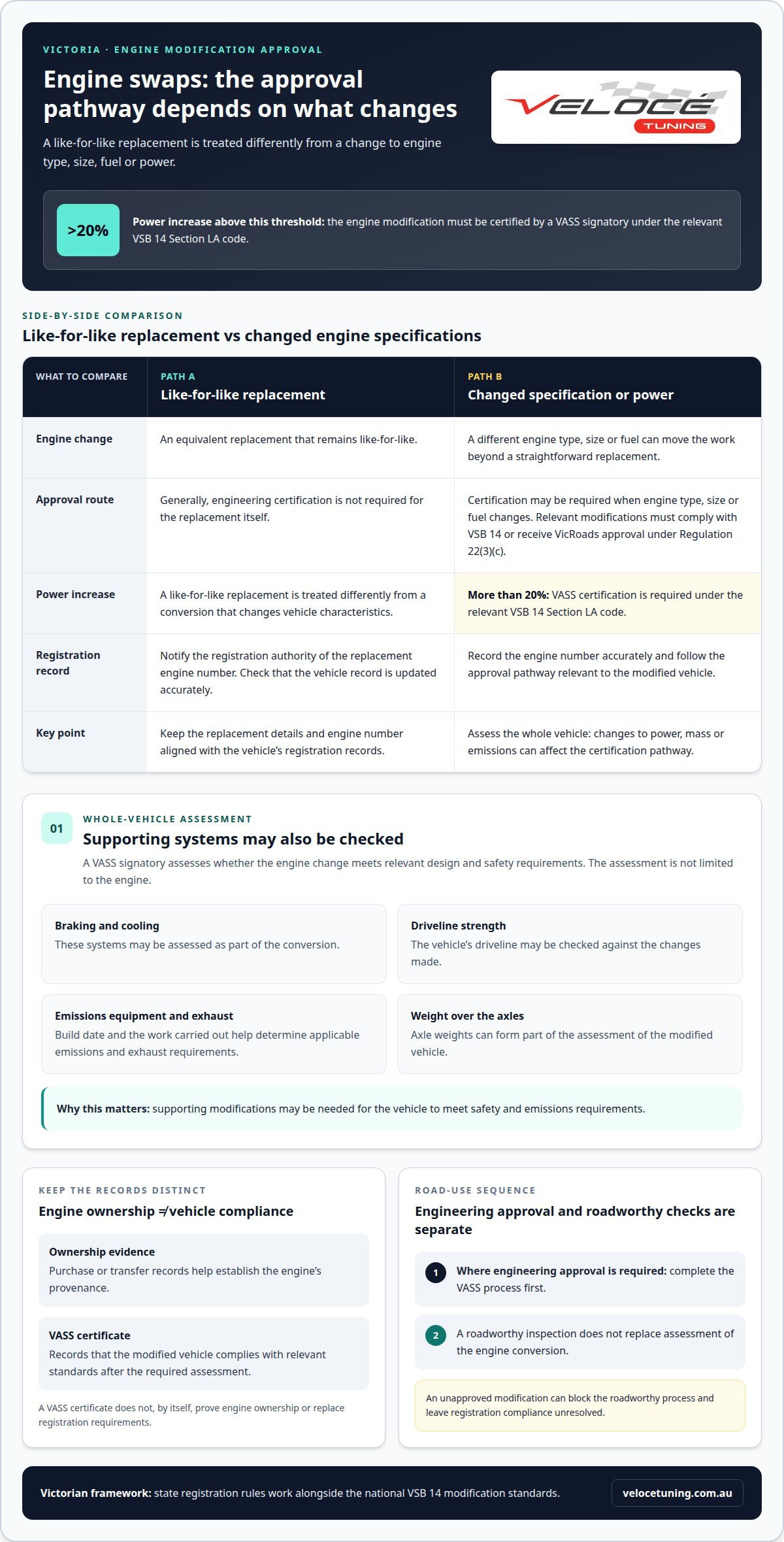
VASS certification is an engineering assessment for a modified vehicle that needs approval under Victoria’s vehicle standards. A different engine type, size or fuel can require certification, as can an engine modification that increases power by more than 20 per cent under the relevant VSB 14 Section LA code.
That threshold matters before the conversion is driven on public roads. The assessment considers the whole vehicle, not just the engine. Changes to power, mass or emissions can affect the certification pathway, and a like-for-like replacement is treated differently from a conversion that changes these characteristics.
Engineering assessment and certification
A VASS signatory assesses whether the engine change meets relevant design and safety requirements. The assessment may cover braking, cooling, driveline strength, emissions equipment, exhaust and weight over the axles. These checks help determine whether supporting modifications are needed as part of the engine installation.
Certification timing and costs vary with the work and assessment. The conversion’s complexity and the modifications requiring assessment can affect costs, while VicRoads approval timing depends on the pathway and the information needed to assess the modified vehicle.
Ownership evidence and approval certificates
Proof of engine ownership helps establish the engine’s provenance, while a VASS certificate records compliance with relevant standards. They serve different purposes: ownership evidence relates to the engine, while certification relates to the modified vehicle.
Keep purchase or transfer records with the engine details, and make sure the engine number is recorded accurately. A Vehicle Assessment Signatory Scheme engineer issues a VASS certificate after the required assessment. The certificate doesn’t, by itself, prove ownership or replace registration requirements.
Certification and roadworthy inspections
VASS certification and a roadworthy inspection are separate steps. If the vehicle requires engineering approval, the VASS process must be completed before a roadworthy certificate can be issued. A roadworthy inspection doesn’t replace assessment of the engine conversion.
An unapproved modification can block the roadworthy process and leave the vehicle’s registration compliance unresolved. It may also complicate insurance if the vehicle’s modifications haven’t been disclosed or accepted under the policy. Confirming the approval pathway before driving on public roads helps avoid these risks.
Like-for-like engine replacement and engine-number updates
A like-for-like engine replacement generally requires notifying the registration authority of the replacement engine number, rather than obtaining engineering certification. The change still needs to be recorded accurately. An outdated engine number can cause avoidable confusion when the vehicle is inspected or its details are checked.
The key distinction is whether the replacement remains like-for-like or changes the vehicle’s specifications. Replacing a worn engine with an equivalent unit differs from fitting an engine with a different type, size or fuel. For Victorian owners, the legal requirements for engine swaps VIC drivers need to understand depend on these differences. A changed specification can move the work beyond a straightforward replacement and into the engineering certification pathway.
For a like-for-like change, record the replacement engine number and notify the relevant registration authority. In Victoria, keep the registration details aligned with the engine fitted to the vehicle. Don’t assume the swap automatically updates the vehicle’s registration record.
Keep a clear record of the replacement, including the engine number and documents showing how the engine was acquired. This helps distinguish the replacement unit from the original and supports accurate vehicle records. Record the engine number precisely, as a transcription error can make the update harder to reconcile.
The manufacturer’s original engine options can help explain whether a proposed replacement is genuinely equivalent, but they don’t replace the need to assess what has changed. If the new unit alters power, mass, emissions or other vehicle characteristics, the relevant VSB 14 requirements may apply. Understanding the legal requirements for engine swaps VIC owners face means considering the full modification, not just whether the engine fits.
For a planned conversion, separating engine-number administration from engineering approval keeps the process clear. Engine conversion planning can help map the mechanical work against the vehicle’s compliance pathway before the change is carried out.
What Victorian laws and standards apply to engine swaps in registered vehicles?
Victoria’s framework combines state registration rules with national modification standards. Light-vehicle modifications or additions must be certified as complying with VSB 14 or otherwise approved by VicRoads under Regulation 22(3)(c). This sets the approval basis for a registered vehicle; fitting an engine is assessed as part of the modified vehicle, not as an isolated component.
VSB 14 is the national code of practice for light vehicle construction and modification, endorsed by Australian state and territory vehicle registration authorities. Its Modification Code LA covers engine modifications. Section LA guides assessment of engine substitutions, including capacity, mass and emissions compliance. Those factors help distinguish a replacement that remains within applicable limits from a conversion needing a different certification pathway.
Victoria’s VSI 8 modification information applies to vehicles with a GVM of 4.5 tonnes or less. That scope matters because the vehicle’s gross vehicle mass determines whether this light-vehicle guidance applies. Engine modifications are also assessed against Australian Design Rules and Victorian road safety standards. A proposed change therefore needs to be considered alongside the vehicle’s registration category and applicable standards.
Registration standards are set out in Schedule 2 of the Road Safety (Vehicles) Regulations 2021. Together, these requirements frame how a modified vehicle is assessed for use on Victorian roads. For example, an engine substitution may raise questions about capacity, mass or emissions under VSB 14 Section LA, while the wider vehicle must still satisfy relevant safety requirements.
The practical distinction is between technical conformity and formal approval. VSB 14 provides the modification criteria; Regulation 22(3)(c) identifies the route of certification or VicRoads approval for relevant light-vehicle changes. A VASS assessment applies where the modification requires engineering certification. The vehicle’s specifications and the full extent of its changes determine which criteria are relevant.
What emissions, ADR, noise and exhaust requirements apply after an engine swap in Victoria?
Emissions compliance depends on the vehicle’s build date and the equipment required for its category. An engine swap must preserve applicable controls; fitting a different engine doesn’t remove the vehicle’s existing obligations.
For passenger vehicles built on or after 1 January 1986, the engine must comply with ADR 37 and run on unleaded fuel. Vehicles built after 1 January 1986 must also have catalytic converters fitted. For passenger vehicles built on or after 1 July 1976, an effective evaporative emission control system is required under ADR 27A.
Earlier vehicles have different requirements. For vehicles built after 1972 but before 1 July 1976, the emissions guidance identifies positive crankcase ventilation. Vehicles built after 1 July 1976 but before 1 January 1986 require positive crankcase ventilation, evaporative emissions control and exhaust gas recirculation, maintained and operating properly. After an engine change, missing or inoperative equipment can undermine compliance.
Victoria also sets certification triggers by vehicle type and manufacture date. For off-road and passenger vehicles manufactured on or after January 1986, significant engine-performance increases or modifications affecting exhaust emissions require certification by a VASS signatory. For commercial vehicles below 2.7 tonnes GVM manufactured on or after July 1988, the same kinds of changes also require VASS certification.
Exhaust changes can bring separate requirements. Under the VSB 14 LA2 pathway, the relevant ADR or in-service vehicle rule must be met when the exhaust system is modified. ADR 83 is identified as an external-noise standard for vehicles, so exhaust changes need to account for noise as well as emissions. For a motor vehicle manufactured before July 1976, extractors may be fitted without the stated emissions evidence requirement, provided they don’t foul steering, suspension, braking or fuel systems.
Plan the conversion around the vehicle’s build date, emissions equipment and exhaust configuration. Discuss an engine conversion with Veloce Tuning to align the mechanical work with these compliance considerations.
Veloce Tuning: Engine Conversions
Veloce Tuning carries out engine conversions for drivers planning a replacement or a performance-focused change. A conversion involves more than choosing an engine: the vehicle’s intended use, supporting systems and Victorian compliance pathway all shape the project.
Discuss the proposed engine change during planning, before mechanical work begins. Veloce Tuning can carry out the conversion, with suspension and lift kits available where they suit the vehicle’s overall setup. For business vehicles, Fleet Vehicle Management can support ongoing fleet needs.
Clear planning connects the mechanical specification with the approval requirements outlined above. Contact Veloce Tuning in Carrum Downs to discuss your engine conversion.
Plan your next move with confidence
An engine conversion can change how your vehicle performs, but a sound plan accounts for compliance from the outset. Before settling on a specification, consider how the vehicle will be used and how the proposed changes work together as a complete build. This helps connect the engineering pathway to the result you want.
Understanding the legal requirements for engine swaps in Victoria gives you a clearer basis for discussing the project, its intended performance and the supporting work involved. Start with a practical conversation about your vehicle and the change you’re considering, before committing to the mechanical work.
Contact Veloce Tuning about your engine swap to discuss the next step. Bring your conversion goals into focus and move towards a build that’s considered from the first decision through to the finished vehicle.
Frequently Asked Questions
Are VASS certificates recognised in other states besides Victoria?
A VASS certificate for a vehicle under 4495 kg GVM is valid only in Victoria. For a vehicle with a GVM over 4495 kg, the certificate is valid across the whole east coast. If you move a modified vehicle interstate, the certificate’s stated scope matters; a Victorian approval shouldn’t be assumed to apply nationally to every vehicle.
Can I put a turbo engine in a car that came with a non-turbo engine?
Yes, a turbo conversion can be possible, but the vehicle must meet the relevant modification requirements. Installing a turbocharger or supercharger may be assessed under VSB 14 Section LA. The assessment considers the change’s effect on power, engine mass and emissions, along with supporting systems. A power increase above the applicable threshold requires certification under a relevant LA code.
Is it legal to put a different engine in your car?
Yes. An engine change isn’t automatically illegal, but the modified vehicle must meet the rules that apply in its state. In Victoria, the change may require engineering certification or VicRoads approval, depending on the modification. Changing engine type or fuel differs from replacing an engine with an equivalent unit. Where required, registration details must also reflect the replacement engine number.
Is a VASS certificate required for roadworthy certification?
If a vehicle modification requires VASS engineering approval, the VASS process must be completed before a roadworthy certificate can be issued. A VASS assessment and a roadworthy inspection have different purposes, and one doesn’t replace the other. Passing an inspection doesn’t certify an engine conversion that requires engineering approval.
Is it illegal to change the engine in your car in Australia?
No. Changing an engine isn’t automatically illegal across Australia. The approval pathway depends on the state or territory and the nature of the change. A like-for-like replacement generally involves notifying the registration authority of the new engine number. A change to engine type, size, fuel or power may require further assessment before the vehicle is used on roads.
What is VSB 14 (NCOP) and how do the states apply it?
VSB 14, also known as the National Code of Practice, sets out guidance for light vehicle construction and modifications. Australia’s state and territory registration authorities endorse the national code, then apply it through their own approval arrangements. In Victoria, engine changes are addressed in Modification Code LA; relevant vehicle modifications must comply with VSB 14 or receive VicRoads approval.